
This album is included in the following sets:
This set contains the following albums:
- Producer's Note
- Full Track Listing
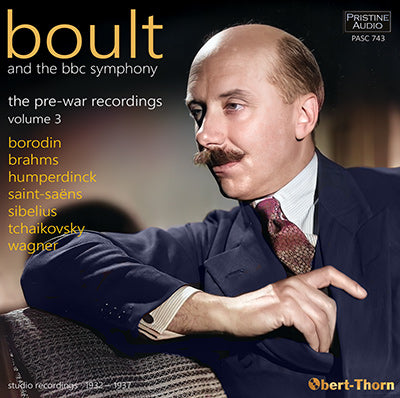
- Cover Art
This volume is the third in a series of four which will reissue all of Sir Adrian Boult’s orchestral recordings with the BBC Symphony from the 1930s, many for the first time since their appearance on 78 rpm discs. While his concerto recordings with the ensemble during this period have remained sporadically available, his purely orchestral discs have seen only a handful of reissues over the years, focusing on a small amount of repertoire. The present release features the only recordings of three Brahms Hungarian Dances, the Tchaikovsky Serenade for Strings, Borodin Polovtsian March and Saint-Saëns Bacchanale that Boult made over his long career; and the Parsifal, Samson and Hansel und Gretel Dream Pantomime selections on this release have never previously been reissued on LP or CD.
Adrian Boult had been the music director of the City of Birmingham Orchestra since 1924 when he was approached by the British Broadcasting Company regarding the creation of a permanent orchestra for broadcasts and concerts. Its first appearance in October, 1930 revolutionized the London music scene with a standard of playing far above what had hitherto been the norm, an achievement that was soon rivaled by Beecham’s creation of the London Philharmonic two years later. The BBC Symphony, which Boult led until he reached his mandatory retirement age in 1950, made its first recordings in May, 1932. He was knighted in 1937.
The present volume focuses on music from the late Romantic and early modern periods. Boult’s recording of the Prelude to Act 1 of Tristan und Isolde with Wagner’s own rarely-heard concert ending puts him in a select group of others who recorded it during the 78 rpm period (Muck, Richard Strauss and Klemperer), and was the last to be set down before the LP era. Boult had previously recorded both excerpts from Humperdinck’s Hansel und Gretel presented here during the acoustic era, along with the Witch’s Ride; but these electrical remakes would be the last time he assayed them on disc.
Boult greatly admired Toscanini (as can be heard in his radio interval talk during one of The Maestro’s postwar Philharmonia Brahms concerts on PASC 377), and it is interesting to compare his version of the Brahms Tragic Overture to that of the Italian Maestro conducting Boult’s orchestra five years later. His approach in this work mirrors the elder conductor’s focus on clarity of instrumental lines, forward-moving tempi and avoidance of interpretational indulgence. On the other hand, Boult’s sole recording of this group of three of Brahms’ Hungarian Dances shows more rhythmic freedom and interpretational willfulness than he usually displayed, but it is entirely in service to the spirit of the music.
The Borodin Polovtsian March and Tchaikovsky Polonaise were originally issued as fillers to two three-sided Berlioz overtures, and display great energy and panache. His sole recorded version of Tchaikovsky’s Serenade for Strings comes off as a bit rushed. This was perhaps due to its being limited to six sides, with the famous Waltz a casualty of having to allow room to start the Élégie on the same side. The finale, however, is exhilarating.
Boult’s only recording of the Bacchanale from Saint-Saëns’ Samson et Dalila benefits from bravura playing by the orchestra at the conductor’s swift tempo. The two Sibelius works, recorded for HMV’s Sibelius Society Series, show Boult to be a completely idiomatic interpreter of the Finn’s music. It is interesting to note that at the same session, Boult recorded The Bard , which was approved but not released in favor of Beecham’s recording, and remains unissued.
The sources for the transfers were American Victor “Z”-type shellac pressings for the Hansel Dream Pantomime and the Brahms and Sibelius items. The Hansel Overture, Borodin and Tchaikovsky items came from Victor “Gold” era pressings. The Meistersinger, Tristan and Samson tracks were transferred from British HMVs, and the Parsifal came from a German Electrola copy. None of these last items were issued on the quieter Victor pressings.
Mark Obert-Thorn
BOULT & BBC SO Pre-War Recordings, Volume 3 (1932-37)
CD 1 (61:37)
1. WAGNER Die Meistersinger von Nürnberg– Overture (9:02)
Recorded 6 April 1933 ∙ Matrices: 2B 4170-1A & 4171-1A ∙ First issued on HMV DB 1924
2. WAGNER Tristan und Isolde – Prelude to Act 1 (9:28)
Recorded 25 July 1932 ∙ Matrices: 2B 2991-2 & 2992-2 ∙ First issued on HMV DB 1757
3. WAGNER Parsifal – Good Friday Spell (9:07)
Recorded 6 April 1933 ∙ Matrices: 2B 2853-5 & 2854-4 ∙ First issued on HMV DB 1677
4. HUMPERDINCK Hansel und Gretel - Overture (7:38)
Recorded 25 July 1932 ∙ Matrices: 2B 2993-2 & 2994-2 ∙ First issued on HMV DB 1758
5. HUMPERDINCK Hansel und Gretel – Dream Pantomime (9:02)
Recorded 2 November 1934 ∙ Matrices: 2B 4616-3A & 4617-3A ∙ First issued on HMV DB 2366
6. BRAHMS Tragic Overture, Op. 81 (12:54)
Recorded 30 May 1932 ∙ Matrices: 2B 2905-2B, 2906-2A & 2907-2B ∙ First issued on HMV DB 1803/4
BRAHMS (orch. Dvořák) Hungarian Dances
7. No. 19 in B minor (1:34)
8. No. 20 in E minor (1:31)
9. No. 21 in E minor (1:17)
Recorded 7 October 1932 ∙ Matrix: 2B 3457-2 ∙ First issued on HMV DB 1804
Recorded 28 January 1937 ∙ Matrix: 2EA 4632-1A ∙ First issued on HMV DB 3094
Recorded 28 January 1937 ∙ Matrix: 2EA 4629-1A ∙ First issued on HMV DB 3132
CD 2 (63:08)
1. BORODIN Prince Igor– Polovtsian March (4:37)
2. TCHAIKOVSKY Eugene Onegin - Polonaise (4:15)
TCHAIKOVSKY Serenade for Strings, Op. 48
3. 1st Mvt.: Pezzo in forma di sonatina: Andante non troppo — Allegro moderato (8:39)
4. 2nd Mvt.: Valse: Moderato — Tempo di valse (3:16)
5. 3rd Mvt.: Élégie: Larghetto elegiaco (6:46)
6. 4th Mvt.: Finale (Tema russo): Andante — Allegro con spirito (6:42)
Recorded 25 June 1937 ∙ Matrices: 2EA 5265-1, 5266-1, 5267-1, 5268-1, 5269-1 & 5270-2A ∙ First issued on HMV DB 3303/5
Recorded 20 October 1933 ∙ Matrices: 2B 4691-1 & 4692-1 ∙ First issued on HMV DB 2077
Recorded 23 January 1936 ∙ Matrices: 2EA 2880-1 & 2881-2 ∙ First issued on HMV DB 2797
Recorded 23 January 1936 ∙ Matrices: 2EA 2882-1, 2883-1, 2884-1 & 2885-1 ∙ First issued on HMV DB 2795/6
7. SAINT-SAËNS Samson et Dalila - Bacchanale (7:16)
8. SIBELIUS The Oceanides, Op. 73 (8:01)
9. SIBELIUS Night Ride and Sunrise, Op. 55 (13:31)
Sir Adrian Boult ∙ BBC Symphony Orchestra
Producer and Audio Restoration Engineer: Mark Obert-Thorn
Special thanks to the British Library, Nathan Brown, Michael Gartz, Richard A. Kaplan and Charles Niss for providing source material
All recordings made at Abbey Road Studio No. 1, London except for CD 1, Tracks 7 – 9, recorded in Kingsway Hall, London
Total duration: 2hr 4:45
MusicWeb International Review
Boult gets it, as he usually did, just right
The first thing to say about these recordings is that they are just so very good! I mean the performances and the recording quality, though clearly Mark Obert-Thorn’s dedicated work enhanced the latter.
Adrian Boult, born in Chester in 1889, went on to study music at Christchurch College Oxford, and then at the Leipzig Conservatory. In 1930, the BBC appointed him music director, responsible for forming a new symphony orchestra. Over the next decade, he largely met his goal of attracting the best available players, and setting the standard for English orchestras. He became their permanent conductor at the end of the first season. Visiting conductors like Arturo Toscanini and Bruno Walter were impressed with what he had been able to achieve.
Boult took the BBC SO to Europe, and soon he too became an international figure, conducting orchestras all over the world. When he reached the official retirement age in April 1949, the BBC pensioned him off after he had made over fifteen hundred broadcasts. (Gary Lineker, eat your heart out.) The London Philharmonic Orchestra promptly made him their music director!
Boult may be best remembered nowadays for his interpretations of British music. He gave the world premieres of Holst’s The Planets , and two of Ralph Vaughan Williams’s symphonies, along with many other works by his contemporaries. But he undoubtedly had wide sympathies, as this release demonstrates. He saw it as part of his work, and that of the BBC, to introduce his musicians and the listening public to a full range of modern music.
So, we have here an interesting selection: Wagner, Humperdinck and Brahms on CD1, Borodin, Tchaikovsky, Saint-Saëns and Sibelius on CD2. In the first Wagner item, a splendid Meistersinger Prelude, Boult refuses to let the music ‘sit down’ complacently. Even when the Prize Song appears, he keeps a firm hand on the tiller. That makes the many little Wagnerian turns that now crop up very tricky for his violinists. We thus learn a lot about the excellent standard of players he had been able to attract. Maintaining the forward momentum of the music means less bombast and a more satisfying sense of culmination at the conclusion.
The Prelude to Act 1 of Tristan is, for my money, the outstanding track on these discs. Boult’s undemonstrative demeanour on the podium and his slightly military appearance,made people sometimes think that Sir Adrian lacked passion. There is an important lesson when one responds to music: listening is more important than looking . So, this simply gripping performance builds inexorably, and expresses powerfully the feeling of overwhelming yet unsated sexual desire. Also interesting is Boult’s use of Wagner’s own extended concert ending, which I had never heard before. The way the music hints distantly at the Liebestod is rather wonderful.
Next we get two extracts from Humperdinck’s Hansel und Gretel , the Overture and the Dream Pantomime , both played with touching sensitivity. The disc ends with a powerful reading of Brahms’s great Tragic Overture and three of his Hungarian Dances.
The second disc kicks off with a couple of Russian operatic bonbons: Borodin’s Polovtsian March from Prince Igor , and Tchaikovsky’s Polonaise from Eugene Onegin . Then comes the latter composer’s Serenade for Strings, one of his most successful and satisfying works. The standard of the string playing does not let Boult down; but the first movement, in its slow introduction and following main theme, is far too heavy and over-accentuated. So, the charm of the work and its grandeur do not come through here.
The remainder of the work fares much better. The irresistible waltz is as delightful as ever, and the great Larghetto elegiaco is played with real feeling and surprising flexibility. I particularly love the coda to this movement, where Tchaikovsky’s harmonies briefly cast a shadow over the music’s serenity. The finale, with its irrepressible Russian theme, brings the necessary lively conclusion. There are a few slightly scrappy moments in this movement, but let us remember two things. This is very taxing music, despite its charm; and these recordings are one-take-wonders from an era when editing was still largely impossible, until magnetic tape arrived in the 1940s.
Another bonbon opératique is the famous Bacchanale from Saint-Saëns’ Samson et Dalila , a fairly tame version this time. The final tracks contain two of Sibelius’s finest tone-poems. The Oceanides is one of the greatest seascapes in the whole of music. To finish with, we get one of my own favourites, Night Ride and Sunrise . Sibelius describes an overnight journey by sleigh through an icy landscape. The bumpy, obsessive ride suddenly stops, and there follows the most uplifting and glorious depictions of dawn that you can imagine – even Ravel could not surpass this one! Boult gets it, as he usually did, just right.
Gwyn Parry-Jones
MusicWeb International