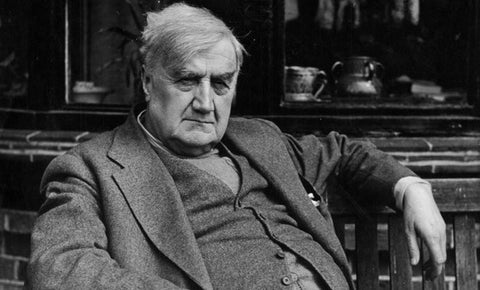
Vaughan Williams
Vaughan Williams was born to a well-to-do family with strong moral views and a progressive social outlook. Throughout his life he sought to be of service to his fellow citizens, and believed in making music as available as possible to everybody. He wrote many works for amateur and student performance. He was musically a late developer, not finding his true voice until his late thirties; his studies in 1907–08 with the French composer Maurice Ravel helped him clarify the textures of his music.
Vaughan Williams is among the best-known British symphonists, noted for his very wide range of moods, from stormy and impassioned to tranquil, from mysterious to exuberant. Among the most familiar of his other concert works are Fantasia on a Theme by Thomas Tallis (1910) and The Lark Ascending (1914). His vocal works include hymns, folk-song arrangements and large-scale choral pieces. He wrote eight works for stage performance between 1919 and 1951. Although none of his operas became popular repertoire pieces, his ballet Job: A Masque for Dancing (1930) was successful and has been frequently staged.
Two episodes made notably deep impressions in Vaughan Williams's personal life. The First World War, in which he served in the army, had a lasting emotional effect. Twenty years later, though in his sixties and devotedly married, he was reinvigorated by a love affair with a much younger woman, who later became his second wife. He went on composing through his seventies and eighties, producing his last symphony months before his death at the age of eighty-five. His works have continued to be a staple of the British concert repertoire, and all his major compositions and many of the minor ones have been recorded.
Vaughan Williams
VAUGHAN WILLIAMS Symphonies 1 - 9
VAUGHAN WILLIAMS Old King Cole ‒ Ballet
VAUGHAN WILLIAMS English Folk Song Suite
VAUGHAN WILLIAMS Norfolk Rhapsody No. 1
VAUGHAN WILLIAMS Fantasia on Greensleeves
VAUGHAN WILLIAMS Job ‒ A Masque for Dancing
VAUGHAN WILLIAMS The Wasps ‒ Aristophanic Suite
VAUGHAN WILLIAMS Partita for Double String Orchestra
VAUGHAN WILLIAMS Fantasia on a Theme by Thomas Tallis
Studio recordings, 1952-1958
Isobel Baillie, soprano
Margaret Ritchie, soprano
John Cameron, baritone
John Gielgud, speaker
London Philharmonic Choir
London Philharmonic Orchestra
conducted by Sir Adrian Boult
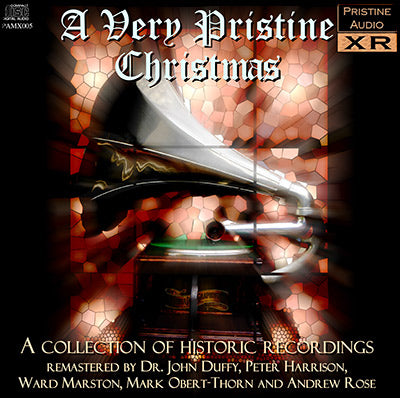
VAUGHAN WILLIAMS Symphony No. 6
Recorded in 1949
Duration 32:54
London Symphony Orchestra
Conducted by Sir Adrian Boult
VAUGHAN WILLIAMS A London Symphony
DEBUSSY Petite Suite
DVOŘÁK Slavonic Dances Nos. 1-4
Studio recordings, 1925/26 (& *1923)
Total duration: 72:31 (*downloads: 87:52)
London Symphony Orchestra
conducted by Sir Dan Godfrey
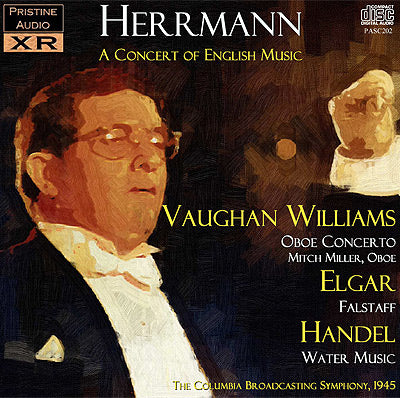
HANDEL Water Music Suite (arr. Harty)
VAUGHAN WILLIAMS Concerto for Oboe and Strings in A minor
ELGAR Falstaff, Op. 68
Recorded 1945
Total duration: 75:50
Mitch Miller, Oboe
The Columbia Broadcasting Symphony
conducted by Bernard Herrmann
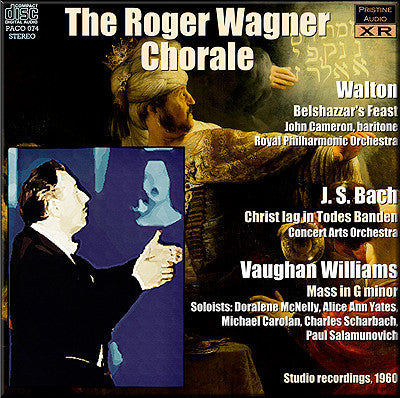
J. S. BACH Cantata No. 4: Christ lag in Todes Banden, BWV4
VAUGHAN WILLIAMS Mass in G minor
Recorded in stereo in London and Hollywood, 1960
Total duration: 79:52
Royal Philharmonic Orchestra
Concert Arts Orchestra
The Roger Wagner Chorale
Roger Wagner, conductor
VAUGHAN WILLIAMS Fantasia on 'Greensleeves'
SCHUMANN Symphony No. 2
ENESCU Romanian Rhapsody No. 1
WALTON Spitfire Prelude and Fugue
Recorded 1949
Total duration: 55:26
New York Philharmonic Orchestra
conducted by Leopold Stokowski