This album is included in the following sets:
This set contains the following albums:
- Producer's Note
- Full Track Listing
- Cover Art
Artur Rodziński was engaged by NBC to recruit, rehearse and generally prepare the NBC Symphony Orchestra for the eventual arrival of Toscanini as its primary conductor in the autumn of 1937. Although he had conducted a ‘pilot’ broadcast on 2 November 1937, the first official broadcasts were taken by Pierre Monteux, beginning 13 November 1937. Thereafter Rodziński conducted a further three broadcasts immediately prior to Toscanini’s debut on Christmas Day, 1937.
After Toscanini’s NBC first concert season was completed, on 5 March 1938, the orchestral concerts continued to be broadcast with a series of guest conductors, including Monteux, Boult, Mitropoulos, Molinari, Howard Hanson and, for three further engagements, Rodziński. In total, Rodziński conducted the orchestra for seven concerts in 1938 – four more were scheduled in December of that year during the orchestra’s second season, culminating in his final performance of the year on New Year’s Eve.
This release brings you the first two Rodziński NBC concerts of 1938, broadcast live on 2 and 9 April 1938 from NBC’s Studio 8H, each scheduled to run for 90 minutes, and each offering a pretty packed programme – so much so that you may just make out the words of Milton Cross at the beginning of the final item on disc two, excerpts from Wagner’s Die Meistersinger, which were still being announced when the orchestra began playing, no doubt starting to a carefully worked-out timing schedule.
Rodziński’s second broadcast of the year brought with it a real coup – for the conductor, the orchestra, the NBC and indeed the nation: Shostakovich’s Fifth Symphony. Premièred in Leningrad in November 1937 and played elsewhere within the Soviet Union, and after the debacle of the composer’s Fourth Symphony, withdrawn at the last minute under intense political pressure, there was no shortage of orchestras and conductors wishing to take up and première the new work outside of the country.
As Halina Rodziński, the conductor’s wife, would later recall in her memoirs: “Artur, thanks to his good connections with the composer, was awarded the prize. NBC's John Royal, through the American ambassador in Moscow, made the arrangements - at a huge price. The Soviet government demanded the then unheard of sum of $5,000 for the premiere. Since introducing the piece would be as much of a coup for the radio network as for Artur, NBC's management did not object to the cost.
After all the expense and effort in acquiring the score and parts, Artur was a bit concerned the piece might not be all that was expected of it. His reactions when he first examined it were far from favorable. There was a coarseness to the sound of the scoring. The piece seemed overlong. Indeed, Artur was not altogether sure he cared for it. In discussion with NBC, it was decided to perform the work just as it had been delivered - without cuts, without reservations. If the critics did not care for it, no one could blame Rodziński.
Gradually, in rehearsals, the work began to take Artur's imagination, and soon enough he even was in love with it. The piece entered his repertoire and became one of his specialties.”
Mrs. Rodziński’s memory here fails her somewhat. The version heard on 9 April, 1938, as revealed in this recording, was far from the complete work, with substantial cuts that reduced the symphony from about fifty minutes in duration to a little over thirty. Nevertheless, the new work made a favourable impression, and would go on to become one of Shostakovich’s most played symphonies.
Whilst the present Shostakovich performance has been referred to in various texts and discussions over the years, we believe this is the first time any of these recordings have been made publicly available (it is interesting to note that the recordings reveal several errors in Mortimer H. Frank’s reference work charting the Toscanini’s career with the NBC orchestra, suggesting he had not had access to them). Because of the length of the broadcasts, once again I have been forced to cut announcements and other speech content in order to fit each one onto a single Compact Disc. Sound quality of these exceptionally rare discs, although generally good for their age, is not uniformly perfect; at times the listener will have to make some accommodations for slightly damaged sections, though I’m relieved to report that the concerts themselves survive intact.
Andrew Rose
The performance was one of exceptional brilliancy and one that displayed to very marked advantage the virtuosity of the orchestra. Aside from its interpretive merits, it may be said that a presentation of this music which displays so much certainty and such high technical quality is rare. Add to this the authority and the fire of the reading.
“Zarathustra” is anything but a simple score to interpret. The conductor’s handicap from the aspect of concert effect is the faint and enigmatical conclusion. This can so easily become anti-climax, to say nothing of the mystifying effect of the strange harmonic scheme. But the audience responded last night to a work which formerly baffled the public with unstinted enthusiasm.
And this is noteworthy: the music triumphed in the complete absence of any programmatic explanation. Explanatory paragraphs would have been wholly in order. Strauss himself affixed lines from Nietzsche's poem to his score. The audience deserves a program note when this work is played.
This does not lessen the music, but it can greatly conduce to a listener’s appreciation of the composer’s intention, if he knows, for example, that the magnificent introduction, which made Philip Hale think of “the portals of eternity swinging slowly asunder,” is Strauss’s evocation of the sunrise; that the pathetic and mystical passages immediately following, and the great hymn passionately intoned by organ and orchestra, is reference to religion upon which man pinned his faith; that the climax of frantic rejoicing while the great bell tolls in the orchestra is the song of Nietzsche’s victorious Over-man; and that the ending, in two keys, with the theme of Nature heard in the plucked basses, and the theme of the Ideal, like receding stars, soaring aloft, is Strauss’s comment upon the unsolvable riddle of the universe.
But the music made its mark and greatly moved the audience. It would have been still more imposing for those personally present if the performance had taken place in an auditorium with better acoustics than those of Studio H-8, which deadens sound and lessens the sonority of an orchestra. The effect of breadth as well as sheer body and brilliancy of sound in this place is thus modified, and blazing sonorities are part of the very conception of this score. But the effect was on the whole so adequate and eloquent that it would be captious to fuss over details. “Zarathustra” has waited longest of all Strauss’s tone-poems to come into its own. The sum of this occasion was a performances which carried it convincingly and in a very exciting way to the public.
The concert opened with the excellent Wertheim’s version of the Bach D minor Toccata and Fugue, a sonorous and effective performance of a masterpiece of universal meaning. After Strauss came the charming concert suite that Schrecker arranged from his ballet, “The Birthday of the Infanta.” It is not wildly modern music, nor highly original, but it is pleasing and admirably orchestrated material, put together with skill and taste by an expert craftsman.
Other delightful music, more original than Schrecker’s, and destined to live much longer, completed the program and delighted the audience. The reference is to the overture to “Fledermaus” and the waltz “Tales From the Vienna Woods,” by Johann Strauss. He also could write music.
Olin Downes, The New York Times, 17 April 1938
N.B. The first of these two concert broadcasts was longer than usual, and the only way to fit it onto a CD was to lose one of the pieces. With the Glinka overture too short to make the difference, after much thought we decided that a forgotten work by a pretty much forgotten composer, Starokadomsky’s Concerto for Orchestra, would be cut from the CD release. This work is present in all download versions of this release, and all CD buyers receive a download link to the recording in MP3 versions should they wish to hear the missing concerto.
In December 1938 Artur Rodziński and the NBC Symphony Orchestra offered American radio audiences two exceptional programmes from Studio 8H in Radio City, separated by a single week but strikingly different in their musical terrain. Still early in the orchestra’s life, these broadcasts reveal an ensemble of formidable discipline and tonal punch, and a conductor whose flair for programming was matched by his ability to coax high-voltage playing from musicians already performing at the top of their game. Preserved on remarkably fine acetate discs and newly restored in Pristine’s XR and Ambient Stereo process, these concerts now emerge with a clarity, warmth and spatial naturalness that Studio 8H’s famously desiccated acoustic rarely allowed at the time.
The 10 December 1938 broadcast opened with Glinka’s evergreen Ruslan and Lyudmila Overture. Contemporary reviews singled out its sparkling character and the orchestra’s brilliance, noting that despite the modest studio acoustics the execution was consistently impressive. Under Rodziński the overture becomes a showcase of tensile rhythmic drive and peerless ensemble precision. The NBC strings, already one of the most agile sections in the country, dispatch Glinka’s perpetual-motion writing with an ease that belies the difficulty of the music.
The centrepiece of that first broadcast was Tchaikovsky’s Symphony No. 5, a Rodziński speciality. Critics at the time praised his command of Tchaikovsky’s long spans and the orchestra’s powerful response, particularly in the sweeping finale. Rodziński shapes the symphony without indulgence: the opening motto is sombre yet flexible, the slow movement’s horn solo emerges with poised lyricism, the waltz glides without heaviness, and the finale surges with tightly controlled energy. These players may have been assembled for Toscanini, but in Rodziński they found a conductor who drew from them a comparable mixture of discipline and white-hot emotional commitment.
That programme also included the American broadcast premiere of Mikhail Starokadomsky’s Concerto for Orchestra, a 1933 work by a now little-known pupil of Myaskovsky. The score was described at the time as competently crafted and orchestrated with skill, even if its idiom owed more to Germanic symphonic practice than to the more modernistic Russian school. While the work’s historical footprint is small, its presence in this broadcast testifies to Rodziński’s willingness to present new Soviet repertoire to American listeners at a moment when few conductors were venturing far beyond the established Russian canon. Although too long to fit our CD programme, it is included complete in the download edition.
The concert closed with Stravinsky’s Firebird Suite, which listeners reported as having considerably enlivened the atmosphere despite the dryness of the broadcast studio. Rodziński’s performance is taut, colourful and intensely dramatic, the NBC brass and percussion delivering Stravinsky’s climaxes with thrilling impact. Even in the early years of high-fidelity broadcasting, the sheer blaze of this performance must have made a vivid impression on listeners.
A week later, on 17 December 1938, Rodziński returned to Studio 8H with an entirely new programme, later reviewed in the New York Times’ “Other Music” column. The broadcast opened with Dvořák’s Symphony No. 4 — the work now recognised as his Eighth — already a favourite in the concert hall by that time. The critic praised the NBC Symphony’s “strong, clear and brilliant” playing, noting especially the finely balanced winds and the orchestra’s rhythmic vitality in a score whose pastoral lyricism can so easily turn heavy-handed. Rodziński gives the symphony a firm architectural profile, shaping its buoyant themes with affection but without sentimentality.
Hindemith’s Mathis der Maler Symphony followed, a bold choice in 1938 when the composer was at the centre of cultural controversy in Europe. Reviews highlighted the NBC Symphony’s splendid discipline and the work’s vivid colour and firm structure under Rodziński, whose affinity for Hindemith’s muscular counterpoint is audible throughout. Far from the austerity sometimes associated with the composer, Rodziński finds warmth and expressive breadth in the score, especially in the luminous “Engelkonzert” movement.
The second broadcast concluded with Richard Strauss’s Till Eulenspiegel, played with élan, razor-sharp precision and a wicked sense of humour. Contemporary accounts praised the performance’s personality and momentum, noting the orchestra’s quick responsiveness to Rodziński’s characterisation of Strauss’s mercurial antihero.
For these restorations Pristine has employed its XR remastering and Ambient Stereo techniques to address the inherent limitations of Studio 8H’s bone-dry acoustics. Wow and flutter have been eliminated, tonal edges softened, and a sympathetic convolution reverb drawn from one of the world’s finest symphonic halls has been added to restore a sense of breadth and natural resonance. The result is a pair of broadcasts that emerge with new presence and musical richness, preserving the sound of a great orchestra under an electrifying conductor at a pivotal moment in American radio history.
By the late 1930s the National Broadcasting Company had created something unprecedented in American musical life: a full-time symphony orchestra assembled specifically for radio. The NBC Symphony Orchestra was formed in 1937 primarily for the broadcasts of Arturo Toscanini, but before Toscanini’s first appearance on Christmas Day of that year the orchestra needed to be tested, disciplined and moulded into a working ensemble. That crucial preparatory work fell largely to the Polish conductor Artur Rodziński.
Rodziński had already established a formidable reputation in the United States through his transformative leadership of the Cleveland Orchestra. NBC engaged him first for a trial broadcast in November 1937, followed by three concerts in December that effectively served as the orchestra’s public dress rehearsal before Toscanini assumed the podium. Rodziński returned to conduct further NBC Symphony broadcasts in April 1938 and again in December of the same year. The present recordings preserve the last two of four concerts he conducted on consecutive weekends that December.
These broadcasts therefore represent the closing chapter of Rodziński’s brief but significant association with the NBC Symphony Orchestra. The New Year’s Eve programme heard here would prove to be the final concert he conducted with the ensemble.
The Christmas Eve broadcast opens atmospherically with the Prelude to Humperdinck’s Hänsel und Gretel, music whose luminous orchestral writing made it a favourite seasonal curtain-raiser. From there Rodziński turns to Johann Sebastian Bach as orchestrated by Ottorino Respighi. Respighi’s Bach transcriptions were widely admired in the early twentieth century for their rich orchestral palette, and here two chorales from the set of Three Chorales were performed: Nun komm, der Heiden Heiland and Wachet auf, ruft uns die Stimme.
The central work of the programme is Beethoven’s First Symphony, music that bridges the Classical world of Haydn and Mozart with the emerging individuality that would soon transform the symphonic form. Rodziński follows it with one of the most striking orchestral transformations of the twentieth century: Arnold Schoenberg’s orchestration of Brahms’s Piano Quartet in G minor. Schoenberg explained that one reason for making the arrangement was that he wanted to hear everything in Brahms’s densely written score more clearly than was possible in the original chamber version. The result is a dazzling re-imagining of the work in which Brahmsian architecture is expanded into a vibrant orchestral showpiece.
The New Year’s Eve broadcast presents an equally colourful programme. It begins with Alexander Siloti’s orchestral arrangement of a concerto from Antonio Vivaldi’s L’estro armonico. Siloti’s late-Romantic treatment of the Baroque original reflects the era’s fascination with adapting earlier music to the modern symphony orchestra.
From there Rodziński launches into Alexander Scriabin’s Third Symphony, Le Divin Poème, a vast mystical canvas whose ecstatic climaxes and shimmering orchestration stand at the threshold of musical modernism. Scriabin’s ecstatic vision is followed by a sequence of orchestral miniatures: Ravel’s nostalgic Pavane pour une infante défunte and two movements from Debussy’s Nocturnes, Nuages and the exuberant Fêtes.
The concert concludes in celebratory fashion with the first waltz sequence from Richard Strauss’s Der Rosenkavalier, music whose swirling Viennese rhythms provided a fitting close to a New Year’s Eve broadcast.
The original transmissions were introduced by NBC announcer Gene Hamilton. His commentary survives in full on the source recordings, but because the complete broadcasts run slightly longer than a standard compact disc allows, much of this material has been edited here in order to accommodate the music within a single CD. Short excerpts of Hamilton’s introductions to the Christmas Eve concert and his closing remarks at the end of the New Year’s Eve broadcast have been retained.
Despite their broadcast origins the surviving recordings are remarkable for their warmth, dynamic range and clarity. In these new XR remasterings the sound reveals impressive orchestral colour, with quiet surfaces and extended frequency range that allow Rodziński’s incisive conducting and the NBC Symphony Orchestra’s brilliance to emerge with striking immediacy.
These final NBC broadcasts not only complete Rodziński’s recorded association with the orchestra but also offer a vivid glimpse of American orchestral broadcasting at the end of the 1930s.
RODZINSKI NBC 1938 Broadcasts Complete (1938)
RODZINSKI NBC 1938, Volume 1
disc one (77:09)
1. BEETHOVEN Coriolan Overture, Op. 62 (7:45)
2. BARBER Symphony in One Movement, Op. 9 (20:13)
PROKOFIEV Symphony No. 1 in D major, Op. 25 , "Classical"
3. 1st mvt. - Allegro (3:14)
4. 2nd mvt. - Larghetto (3:39)
5. 3rd mvt. - Gavotta (1:26)
6. 4th mvt. - Molto vivace (2:58)
7. DEBUSSY Prélude à l'après-midi d'un faune (10:40)
DOHNÁNYI Suite for Orchestra, Op. 19
8. 1. Andante con variazioni (10:06)
9. 2. Scherzo (4:06)
10. 3. Romance (4:54)
11. 4. Rondo (8:08)
disc two (78:48)
1. WEBER Oberon - Overture (8:52)
SHOSTAKOVICH Symphony No. 5 in D minor, Op. 47
First performance outside the Soviet Union
2. 1st mvt. - Moderato (10:53)
3. 2nd mvt. - Allegretto (5:22)
4. 3rd mvt. - Largo (9:58)
5. 4th mvt. - Allegro non troppo (6:52)
RESPIGHI Ancient Airs and Dances, Suite No. 1
6. 1. Balletto detto 'Il Conte Orlando' (Molinaro) (2:40)
7. 2. Gagliarga (Galilei) (3:57)
8. 3. Villanella (Ignoto) (5:38)
9. 4. Passo mezzo e Mascherada (Ignoto) (3:44)
10. ALBÉNIZ Ibéria - 3. El Corpus en Sevilla (8:46)
11. WAGNER Die Meistersinger von Nürnberg: Prelude to Act III - Dance of the Apprentices - Finale (12:07)
NBC Symphony Orchestra
conducted by Artur Rodziński
XR remastering by: Andrew Rose
Live broadcast recordings, 2 & 9 April 1938
Studio 8H, NBC Radio City, New York
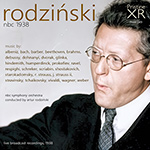
Cover artwork based on a photograph of Artur Rodziński
Total duration: 2hr 35:56
RODZINSKI NBC 1938, Volume 2
1. RADIO Introduction (1:25)
J. S. BACH (arr. Wertheim) Toccata and Fugue in D minor, BWV 565
2. Toccata (2:57)
3. Fugue (6:05)
R. STRAUSS Also Sprach Zarathustra, Op. 30
4. Einleitung (2:10)
5. Von den Hinterweltlern (3:38)
6. Von der grossen Sehnsucht (1:58)
7. Von den Freuden-und Leidenschaften (1:56)
8. Das Grablied (2:12)
9. Von der Wissenschaft (4:34)
10. Der Genesende (5:38)
11. Das Tanzlied (5:46)
12. Nachtwandlerlied (6:52)
SCHREKER Der Geburtstag der Infantin - Suite
13. 1. Reigen (1:47)
14. 2. Aufzug und kampfspiel (2:11)
15. 3. Die Marionetten (2:49)
16. 4. Minuett der Tanzerknaken (2:11)
17. 5. Die Tanze der Zwerges (0:15)
18. 6. Mit der Wind im Fruhling (0:53)
19. 7. In blauen Sandalen uber das korn (1:52)
20. 8. Im roten Gewand im herbst (1:23)
21. 9. Die Rose der Infatin (3:41)
22. J STRAUSS II Die Fledermaus - Overture (8:14)
23. J STRAUSS II Tales from the Vienna Woods (7:05)
NBC Symphony Orchestra
conducted by Artur Rodziński
XR remastering by: Andrew Rose
Live broadcast recording, 16 April 1938, Studio 8H, NBC Radio City, New York
Cover artwork based on a photograph of Artur Rodziński
Total duration: 77:31
RODZINSKI NBC 1938, Volume 3
disc one (75:27)
1. RADIO Introduction (1:52)
2. GLINKA Ruslan and Lyudmila - Overture (5:44)
TCHAIKOVSKY Symphony No. 5 in E Minor, Op. 64
3. 1st mvt. - Andante - Allegro con anima (14:10)
4. 2nd mvt. - Andante cantabile con alcuna licenza (13:05)
5. 3rd mvt. - Valse. Allegro moderato (5:48)
6. 4th mvt. - Finale. Andante maestoso - Allegro vivace (11:57)
STAROKADOMSKY Concerto For Orchestra [DOWNLOADS ONLY]
1 st mvt. - Sinfonia (3:41)
2 nd mvt. - Passacaglia (8:12)
3 rd mvt. - Toccata (6:34)
STRAVINSKY The Firebird (Suite)
7. Introduction (3:46)
8. Dance of the Firebird (1:15)
9. Dance of the Princesses (4:52)
10. The Infernal Dance of King Kashchei (3:51)
11. Berceuse (Lullaby of the Firebird) (3:25)
12. Finale (5:42)
disc two (79:39)
1. RADIO Introduction (1:52)
DVOŘÁK Symphony No. No. 8 in G major, Op. 88
2. 1st mvt. - Allegro con brio (9:45)
3. 2nd mvt. - Adagio (10:01)
4. 3rd mvt. - Allegretto grazioso – Molto Vivace (5:48)
5. 4th mvt. - Allegro ma non troppo (11:23)
HINDEMITH Mathis der Maler Symphony
6. 1st mvt. - Engelkonzert (9:07)
7. 2nd mvt. - Grablegung (4:31)
8. 3rd mvt. - Versuchung des heiligen Antonius (13:03)
9. R. STRAUSS Till Eulenspiegels lustige Streiche (14:09)
NBC Symphony Orchestra
conducted by Artur Rodziński
XR remastering by: Andrew Rose
Live broadcast recordings, 10 & 17 December 1938
Studio 8H, NBC Radio City, New York
Cover artwork based on a photograph of Artur Rodziński
Total duration: 2hr 55:37 (CDs: 2hr 35:07)
RODZINSKI NBC 1938, Volume 4
disc one (79:45)
1. RADIO Introduction to Christmas Eve Program (0:28)
2. HUMPERDINCK Hänsel und Gretel - Prelude (8:00)
BACH (arr. Respighi) Chorales from the Orgelbüchlein
3. Nun komm, der Heiden Heiland, BWV 659 (5:38)
4. Wachet auf, ruft uns die Stimme, BWV 645 (4:10)
BEETHOVEN Symphony No. 1 in C major, Op. 21
5. 1st mvt. - Adagio molto - Allegro con brio (6:46)
6. 2nd mvt. - Andante cantabile con moto (6:56)
7. 3rd mvt. - Menuetto: Allegro molto e vivace (3:27)
8. 4th mvt. - Finale: Adagio - Allegro molto e vivace (5:43)
BRAHMS (arr. Schoenberg) Piano Quartet No. 1 in G minor, Op. 25
9. 1st mvt. - Allegro (13:44)
10. 2nd mvt. - Intermezzo: Allegro ma non troppo - Trio: Animato (8:51)
11. 3rd mvt. - Andante con moto (8:35)
12. 4th mvt. - Rondo alla zingarese: Presto (7:26)
disc two (78:01)
VIVALDI (arr. Siloti) Concerto in D minor
from L’estro armonico, Op. 3 No. 11, RV 565
1. 1st mvt. - Allegro (5:33)
2. 2nd mvt. - Adagio e spiccato (4:37)
3. 3rd mvt. - Allegro (3:22)
SCRIABIN Symphony No. 3 in C minor, Op. 43 - Le Divin Poème
4. 1st mvt. - Lutte (17:05)
5. 2nd mvt. - Voluptés (8:11)
6. 3rd mvt. - Jeu divin (9:47)
7. RAVEL Pavane pour une infante défunte (6:17)
DEBUSSY Nocturnes
8. Nuages (8:35)
9. Fêtes (6:01)
10. R. STRAUSSDer Rosenkavalier Waltzes - First sequence (7:55)
11. RADIO Conclusion to New Year's Eve Program (0:38)
NBC Symphony Orchestra
conducted by Artur Rodziński
XR remastering by: Andrew Rose
Live broadcast recordings, 24 & 31 December 1938
Studio 8H, NBC Radio City, New York
Cover artwork based on a photograph of Artur Rodziński
Total duration: 2hr 37:46