

This album is included in the following sets:
This set contains the following albums:
- Producer's Note
- Full Track Listing
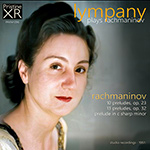
- Cover Art
When Moura Lympany recorded the complete Twenty-Four Preludes of Sergei Rachmaninov in January 1951, she was at the height of her powers and in full command of her artistic identity. Already recognised as one of Britain’s most formidable pianists, Lympany brought to this repertoire a rare combination of intellectual rigour, technical security, and a refusal to indulge in surface rhetoric. The result was a set that impressed on first release and has never slipped from view. Seventy-five years on, it remains one of the most convincing and durable accounts of the cycle ever recorded.
Rachmaninov’s Preludes span more than two decades of his creative life, from the famous early Prelude in C sharp minor to the more exploratory landscapes of Opp. 23 and 32. Too often they are treated as a sequence of atmospheric miniatures, selected individually as vehicles for colour or sentiment. Lympany hears them in broader terms. There is a strong sense of architecture, each prelude shaped not only for its own character but for its place within a larger argument. Even when the mood shifts rapidly, the line remains purposeful. You have the sense of a mind thinking in paragraphs rather than phrases.
That quality was recognised immediately. Reviewing the original issue, The Gramophone praised the “grand scale” of Lympany’s conception and the way she sustains momentum across contrasting moods without sacrificing clarity or proportion. Her playing was admired for its rhythmic strength, directness, and refusal to sentimentalise. These are exactly the qualities that still strike the listener today. Lympany trusts the music’s structure and allows the drama to emerge naturally, rather than imposing effects from without.
Central to this approach is her control of texture. In dense chordal writing, inner voices are clearly projected and bass lines firmly anchored. Even in the most crowded passages, she prevents the sound from thickening. The famous Prelude in C sharp minor, so often weighed down by portentous pacing, emerges here as taut, urgent, and unsentimental, its impact created by harmonic tension and forward motion rather than by theatrical lingering. Elsewhere, in preludes of greater intimacy, Lympany achieves warmth without blur. The piano can sing, but it can also speak with clarity and intent.
For all their artistic distinction, these recordings have long been compromised by technical limitations inherent in early tape-era piano recording and subsequent transfer history. The original issue exhibits noticeable pitch instability, a problem that subtly undermines the solidity of the instrument. In fast-moving or heavily chordal passages, the piano can seem to shimmer or drift, blunting the very qualities that define Lympany’s playing: precision, weight, and structural clarity.
The present XR remastering changes that picture. Using Celemony Capstan pitch stabilisation, the underlying pitch fluctuations have been corrected with great care, restoring the piano to a stable tonal centre. The improvement is musical rather than cosmetic. Chords now lock into place, bass lines carry their full harmonic weight, and the musical argument unfolds with a new sense of inevitability. Freed from technical distraction, Lympany’s rhythmic strength and tonal discipline form the foundation of a performance that feels newly present and newly persuasive.
Seventy-five years on, these readings emerge not as historical curiosities but as living music. They remind us that Rachmaninov can sound grand without grandstanding, poetic without indulgence, and passionate without haste. Above all, they confirm Moura Lympany’s stature as a Rachmaninov interpreter of uncommon seriousness and authority, restoring the full impact of performances that have always deserved to be heard in the best possible light.
LYMPANY RACHMANINOV 24 Preludes
1. RACHMANINOV Prelude in C sharp minor, Op. 3, No. 2 (4:31)
RACHMANINOV 10 Preludes, Op. 23
2. Prelude No. 1 in F sharp minor, Op. 23 (3:45)
3. Prelude No. 2 in B flat major, Op. 23 (2:56)
4. Prelude No. 3 in D minor, Op. 23 (3:26)
5. Prelude No. 4 in D major, Op. 23 (4:13)
6. Prelude No. 5 in G minor, Op. 23 (3:42)
7. Prelude No. 6 in E flat major, Op. 23 (2:26)
8. Prelude No. 7 in C minor, Op. 23 (2:14)
9. Prelude No. 8 in A flat major, Op. 23 (3:50)
10. Prelude No. 9 in E flat minor, Op. 23 (2:57)
11. Prelude No. 10 in G flat major, Op. 23 (4:26)
RACHMANINOV 13 Preludes, Op. 32
12. Prelude No. 1 in C major, Op. 32 (1:16)
13. Prelude No. 2 in B flat minor, Op. 32 (2:52)
14. Prelude No. 3 in E major, Op. 32 (2:23)
15. Prelude No. 4 in E minor, Op. 32 (2:56)
16. Prelude No. 5 in G major, Op. 32 (3:46)
17. Prelude No. 6 in F minor, Op. 32 (1:35)
18. Prelude No. 7 in F major, Op. 32 (2:00)
19. Prelude No. 8 in A minor, Op. 32 (3:08)
20. Prelude No. 9 in A major, Op. 32 (3:06)
21. Prelude No. 10 in B minor, Op. 32 (4:33)
22. Prelude No. 11 in B major, Op. 32 (2:06)
23. Prelude No. 12 in G sharp minor, Op. 32 (2:37)
24. Prelude No. 13 in D flat major, Op. 32 (4:56)
Moura Lympany, piano
XR remastering by Andrew Rose
Recorded at West Hampstead Studios, London, 9 & 11 January 1951
Producer: John Culshaw
Total duration: 73:20
Reviews
Fanfare — Richard A. Kaplan
Issue 50:1 (Sept/Oct 2026) · Read the original review
This is Moura Lympany’s second recording of the Rachmaninoff Preludes, made in 1951; she had recorded them a decade earlier on 78s, and that version has not to my knowledge been reissued. This one, originally published on two Decca/London LPs, has been available most of the time since its recording, most recently on Testament and Decca CDs. I have not heard those for comparison to Pristine’s remastering, which uses Andrew Rose’s XR system and Capstan pitch stabilization. The CD is also processed in Rose’s “Ambient Stereo,” although the effect is subtle.
Lympany was, as Rose’s notes state, at the height of her considerable powers when these recordings were made; there are no technical weaknesses, and the readings, predominantly straightforward, are mostly compelling. Lympany’s rhythmic freedom in the famous Prelude in C♯ Minor, op. 3/2 is noteworthy, as is the fast middle section. In the G-Minor Prelude, op. 23/5, the inner voices are good. On the other hand, the B♭-Major Prelude, op. 23/2 is lacking in inflection, there is no repeat in the D Minor, op. 23/3, and op. 23/8 in A♭ Major and op. 32/6 in F Minor seem rushed. The legato at the opening of op. 32/10 in B Minor is not sustained, and in op. 32/2 in B♭ Minor the tempo changes are disregarded. Overall, the sound of the piano, even with Rose’s ministrations, is lacking in depth, although it is respectable for a 75-year-old recording.
I believe Lympany’s two Decca versions of the Preludes were the first two complete recordings of the 24; as such, and despite the complaints in the previous paragraph, this represents a signal achievement. This CD will be of interest to Rachmaninoff completists and collectors of historical piano recordings. Richard A. Kaplan