

This album is included in the following sets:
This set contains the following albums:
- Producer's Note
- Full Track Listing
- Cover Art
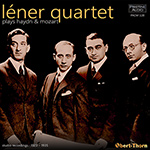
The present volume is the sixth in a series whose goal is to reissue all of the Léner Quartet’s electrical recordings along with the acoustic recordings they never remade, ultimately presenting their complete recorded repertoire. This release contains all the Haydn works they recorded, including two particularly rare acoustics which were never re-done electrically. The set is filled out with the first installment of the group’s Mozart recordings.
For the past half century, Haydn’s Op. 3 has generally been thought to be the work of Romanus Hoffstetter; but the story is complicated by Haydn’s inclusion of these quartets among his own for publication, as well as more recent studies that conclude Hoffstetter may have composed only the first two of the six in the series. Regardless of authorship, Op. 3, No. 5 remains one of the most popular of the string quartet literature, primarily due to its second movement. The Léners present it as though it were an ardent guitar-accompanied serenade from a lover to his lady in a performance which is remarkable in its rhythmic freedom.
The Léners never made a complete recording of Haydn’s “Lark” Quartet; but a three-quarters version has been assembled here from two sides of an acoustic single disc made in 1923 and an electric set down five years later. (It must have been a jinx for string quartets of the time, as the Flonzaleys recorded the work complete in the latter year only for it to remain unissued until a 1970s LP release.) The Menuetto was, oddly, issued as the filler sider for the Léners’ set of the Debussy Quartet, while the acoustic disc is one of their rarest releases.
Electrical recording was already well underway at Columbia’s American affiliate when the next quartet on our program was set down; but English Columbia did not begin to record using the new technology until the fall of 1925. As a result, the Léner’s Haydn Op. 76, No. 2 was already sonically obsolete when it was released in May 1926. It only remained in the catalog for a year and a half, and became their rarest album. When a chance arose to record a filler side for Haydn’s “Emperor” Quartet in 1935, they returned to the Andante of Op. 76, No. 2 in the version heard here after the complete recording.
To fill out our program, it seemed appropriate to include the Léners’ recordings of the first two quartets dedicated to Haydn by Mozart. The D minor quartet was one of the ensemble’s earliest electrical recordings. Its original release was marred by thin sound, obtrusive swish on several sides and recurrent low frequency resonance from the early carbon microphones, all of which has been addressed in the present restoration. Again, the group had an opportunity to re-record one of the movements years later in better sound (the Andante in 1932, for their entry in the Columbia History of Music series). Timing restrictions have not permitted its inclusion here, but it will appear in a later volume as our coverage of the Léners’ Mozart recordings continue.
Mark Obert-Thorn
LÉNER QUARTET plays Haydn & Mozart
CD 1
(76:02)
HAYDN String Quartet No. 5 in F major, Op. 3, No. 5,
“Serenade”, Hob.III:17
1. 1st Mvt. – Presto (4:21)
2. 2nd Mvt. – Andante cantabile (4:30)
3. 3rd Mvt. – Menuetto (3:17)
4. 4th Mvt. – Scherzando (3:01)
Recorded 7 December 1928
Matrix nos.: WAX 4433-2, 4434-1, 4435-2, 4436-3
First issued as Columbia 9658/9
HAYDN String Quartet No. 53 in D major, Op. 64, No. 5, “The
Lark”, Hob.III:63
5. 2nd Mvt. – Adagio cantabile (4:36)
6. 3rd Mvt. – Menuetto: Allegro (3:31)*
7. 4th Mvt. – Finale: Vivace (2:07)
Recorded 26 September 1923 and *15 March 1928
Matrix nos.: AX 151-2, *WAX 3385-1 & AX 165-3
First issued as Columbia L 1574 & *L 2144
HAYDN String Quartet No. 61 in D minor, Op. 76, No. 2,
“Fifths”, Hob.III:76
8. 1st Mvt. – Allegro (7:33)
9. 2nd Mvt. – Andante di molto più tosto allegretto (4:36)
10. 3rd Mvt. – Menuetto. Allegro non troppo (3:51)
11. 4th Mvt. –Vivace assai (3:54)
Recorded 9-10 March 1925
Matrix nos.: AX 916-2, 917-1, 918-1, 919-2 & 924-1
First issued as Columbia L 1740/2
12. 2nd Mvt. – Andante di molto più tosto allegretto (4:50)
Recorded 10 March 1935
Matrix nos.: CAX 7469-1
First issued as Columbia LX 454
HAYDN String Quartet No. 62 in C major, Op. 76, No. 3,
“Emperor”, Hob.III:77
13. 1st Mvt. – Allegro (7:00)
14. 2nd Mvt. – Un poco adagio; cantabile (9:51)
15. 3rd Mvt. – Menuetto. Allegro (4:47)
16. 4th Mvt. –Finale. Presto (4:17)
Recorded 10 & 23 March 1935
Matrix nos.: CAX 7462-2, 7463-6, 7464-1, 7465-1, 7466-1, 7467-1 &
7468-1
First issued as Columbia LX 451/4
CD 2 (73:11)
HAYDN String Quartet No. 64 in D major, Op. 76, No. 5,
Hob.III:79
1. 1st Mvt. – Allegretto (5:35)
2. 2nd Mvt. – Largo. Cantabile e mesto (7:43)
3. 3rd Mvt. – Menuetto. Allegro (3:17)
4. 4th Mvt. – Finale. Presto (3:47)
Recorded 7 November 1928
Matrix nos.: WAX 4261-2, 4262-2, 4263-4, 4282-1, 4283-1 & 4288-2
First issued as Columbia L 2257/9
MOZART String Quartet No. 14 in G major, K.387, “Spring”
5. 1st Mvt. – Allegro vivace assai (6:11)
6. 2nd Mvt. – Menuetto. Allegro (7:32)
7. 3rd Mvt. – Andante cantabile (8:42)
8. 4th Mvt. – Molto allegro (7:51)
Recorded 20-21 January 1930
Matrix nos.: WAX 4713-3, 4714-4, 4715-3, 4716-3, 4717-3, 4718-3, 4719-4
and 4720-4
First issued as Columbia LX 24/7
MOZART String Quartet No. 15 in D minor, K.421
9. 1st Mvt. – Allegro moderato (5:22)
10. 2nd Mvt. – Andante (6:18)
11. 3rd Mvt. – Menuetto. Allegretto (4:06)
12. 4th Mvt. – Allegretto ma non troppo – Più allegro (6:48)
Recorded 27 and 29 March 1926
Matrix nos.: WAX 1375-2, 1376-2, 1377-3, 1378-3, 1379-3 and 1380-2
First issued as Columbia L 1965/7
Léner String Quartet
Jenő Léner (violin I)
Josef Smilovits (violin II)
Sándor Róth (viola)
Imre Hartman (cello)
Recording venues (all in London): Clerkenwell Road Studio
(1923, 1925); Petty France Studio (1926, 1928 and 1930); Abbey Road Studio
No. 3 (1935)
Producer and Audio Restoration Engineer: Mark Obert-Thorn
Special thanks to the British Library, Nathan Brown, Richard Kaplan,
Charles Niss and David Schmutz for providing source material
Total duration: 2hr 29:13
Fanfare Review
Mark Obert-Thorn’s restorations are marvelous
Pristine continues its admirable series of restorations of recordings by the Léner String Quartet, one of the most important chamber ensembles in the dawn of the age of recordings. It was formed in 1918 and lasted until 1942. That year a rift occurred between founder Jenö Léner and the other three members, leading to the formation of two rival groups until 1947, when it all ended. They were the principal competition to the Budapest Quartet, and Léner was given the honor of making the first complete recorded cycle of the Beethoven quartets.
The Léner began making records before the dawn of electrical recording, and then remade some of the material in electrical versions. This two-disc set contains all of the Léner’s Haydn recordings and the first installment of what will ultimately include all their Mozart.
The Léner’s style is very out of fashion these days and was already considered somewhat old-fashioned at the time The Budapest Quartet was offering more modern performances. The Léner Quartet applies considerable rubato and portamento in its phrasing. Besides sounding outdated today, to those whose tastes have been formed by HIP standards the style will seem inauthentic. But this was an acceptable performance style in the first part of the 20th century, and if you allow yourself to enter its world, you might just find it appealing.
One issue that cannot be overlooked, however, is that first violinist Léner’s sound could turn wiry, and his intonation was less than perfect. I don’t find this a major detriment to my enjoyment, but it does require a bit of tolerance. In addition, his playing of the violin solo in Haydn’s “Serenade” Quartet, op. 76/5 is likely to strike even the most tolerant listener as too romanticized, even soppy. I will confess that I found it a guilty pleasure despite Léner’s taffy-pull approach to rubato and his pronounced vibrato.
That movement aside, the freedom of the performances is held within bounds, and if you are sympathetic, it is truly touching. The playing is at its most exquisite in the slow movement of Mozart’s “Spring” Quartet, where the careful balancing of voices and delicate tempo adjustments make you catch your breath.
Haydn’s “Lark” Quartet was not recorded in its entirety by the Léners. The second and fourth movements were recorded acoustically in 1923, and the Menuetto electrically in 1928. Quartet No. 61 was recorded at the tail end of the acoustical era (March, 1925). In 1935 the Léner rerecorded just the second movement as a filler disc for the “Emperor” Quartet. Pristine appends this as an extra track after the complete acoustical recording. The rest of the collection is entirely electrical.
I’ve encouraged looking at this release as a window into a very different world. However, to view this as merely a historical exercise would be to miss the point. This is deeply felt, noble music-making whose value does not diminish with age.
Mark Obert-Thorn’s restorations are marvelous. The richness of sound in the acoustical recordings is amazing. Pristine makes full scores available from their website, and the recordings are available as downloads or in a two-CD set with excellent notes.
Henry Fogel
Fanfare
