
This album is included in the following sets:
This set contains the following albums:
- Producer's Note
- Full Track Listing
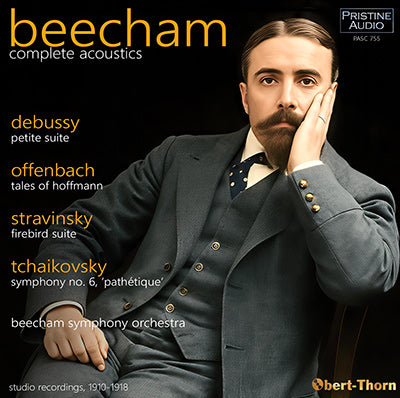
- Cover Art
This release brings together all of the acoustic recordings of Sir Thomas Beecham, which were omitted from the Warner Classics Beecham “Mono Era” CD box. They shed an invaluable light on the conductor’s activities in London during the 1910s, and feature 16 works that Beecham never re-recorded during his long career. They are presented here in matrix number order, based on the discography published by Michael Gray in 1979 for the conductor’s centenary.
When the 31-year-old Beecham entered the Gramophone Company’s London studios in July, 1910, he had already been conducting for eleven years, most recently with the ensemble he had founded the previous year, the Beecham Symphony Orchestra, whose ranks included such future luminaries as Albert Sammons, Lionel Tertis and Eric Coates. That summer, he was heavily involved with operatic productions held at His Majesty’s Theatre featuring his own Beecham Opera Company. Both Tales of Hoffmann and Die Fledermaus were given during this season.
Another session held a month later produced a recording whose attribution is somewhat controversial. On 31 August, a symphonic band recorded several titles for the Gramophone Company. Their matrix book identified the ensemble as the Black Diamonds Band, a group which recorded prolifically for the label, making recordings “for the Berlin branch”. They were released in Germany credited to the “Grammophon-Orchester”, which Gray described as “an all-purpose name used for orchestral recordings made outside Germany.”
One of the titles, however - a potpourri of tunes from Eugen d’Albert’s opera, Tiefland - was released in England credited to the Beecham Symphony Orchestra. Because Beecham was at the time preparing for the British première of the opera at Covent Garden, the attribution was accepted in Gray’s discography and reflected in some reissues of his early recordings. However, because several of the other titles made at the session were of non-Classical repertoire that Beecham would not have conducted, it seems likely that this was a misattribution by the Gramophone Company, perhaps an intentional one to link the record with Beecham’s production. (A similar potpourri from Verdi’s Nabucco, recorded directly after the Tiefland sides but credited only to the Grammophon-Orchester, is included in the download version of this release.)
The next group of recordings was made around two years later for the Odeon label, whose recordings were as crude sounding as their pressings were noisy, but whose rarity make them highly sought after by collectors. One can hear the increasingly tight ensemble work of Beecham’s orchestra, far above the average level of playing for London orchestras of the time, in such works as the William Tell Overture.
In 1915, Beecham signed with Columbia, the label for which he would make most of his recordings for the next couple decades. In contrast with other labels, Columbia for the most part did not reorchestrate to make recordings “register” more impactfully using the acoustic process. Timpani are clearly heard in the “Polovtsian Dances”, and double basses in the Bartered Bride Overture are discernable, if just barely. However, the bass drum is omitted from the Damnation of Faust’s “Hungarian March”.
Additionally, Columbia allowed relatively complete recordings of some overtures to be made. Beecham’s first Columbia disc, the Magic Flute Overture, is uncut; and their Oberon Overture, despite some internal cuts, was still allotted two sides. (The Roman Carnival Overture was apparently recorded complete as well, but only the second side was issued.)
These recordings again reflect some of Beecham’s recent productions. The conductor had given the British première of Der Rosenkavalier in 1913; but the selection of waltzes heard on the Columbia disc is not the familiar Otto Singer arrangement. That same year, Beecham produced a series of Russian ballets at the Drury Lane Theatre featuring Nijinsky among others. The excerpts from the first version of the Firebird Suite made three years later appear to be the earliest recording of any Stravinsky work, as well as Beecham’s only representation of the composer on disc.
Mark Obert-Thorn
BEECHAM The Complete Acoustics
CD 1 (78:46)
GRAMOPHONE COMPANY RECORDINGS (1910)
OFFENBACH Tales of Hoffmann
1. The Doll’s Song (3:12)
Recorded 27 July 1910 ∙ Matrix: 4340f ∙ First issued on Gramophone Concert Record 03193
Recorded 27 July 1910 ∙ Matrix: 4341f ∙ First issued on Gramophone Concert Record 02256
Recorded 27 July 1910 ∙ Matrix: 4347f ∙ First issued on Gramophone Concert Record 04505
Recorded 28 July 1910 ∙ Matrix: 4353f ∙ First issued on Gramophone Concert Record 02257
Recorded 28 July 1910 ∙ Matrix: 4360f (later 381 ac) ∙ First issued on Gramophone Concert Record 0627
Recorded 31 August 1910 ∙ Matrices: 4423/4f ∙ First issued on Gramophone Concert Record 0629/30
Caroline Hatchard (soprano) and Beecham Opera Chorus
2. Legend of Kleinsack (3:53)
Walter Hyde (tenor)
3. Drig, drig, drig (2:50)
Beecham Opera Chorus
4. When love is but tender and sweet (2:34)
Walter Hyde (tenor) and Beecham Opera Chorus
5. J. STRAUSS II Die Fledermaus - Overture* (3:51)
6. D’ALBERT Tiefland - Selections** (8:09)
ODEON RECORDINGS (c.1912)
7. ROSSINI William Tell Overture - March (2:59)
Recorded c.1912 ∙ Matrix: Lxg 30 ∙ First issued on Odeon 0795
Recorded c.1912 ∙ Matrix: Lxg 39 ∙ First issued on Odeon 0795
Recorded c.1912 ∙ Matrix: Lxg 40 ∙ First issued on Odeon 0772
Recorded c.1912 ∙ Matrix: Lxg 41 ∙ First issued on Odeon 0772
Recorded c.1912 ∙ Matrix: Lxx 3677 ∙ First issued on Odeon X-84
Recorded c.1912 ∙ Matrix: Lxx 3678 ∙ First issued on Odeon X-84
8. MISSA Muguette - Entr’acte** (3:13)
9. MASCAGNI Cavalleria Rusticana - Intermezzo* (3:02)
10. MENDELSSOHN The Bees’ Wedding (Songs Without Words, No. 34)* (1:46)
11. MOZART Le Nozze di Figaro, K.492-Overture (3:33)
12. WEBER Oberon Overture(3:58)
COLUMBIA GRAPHOPHONE RECORDINGS (1915 - 1918)
13. MOZART Die Zauberflöte, K.620-Overture (6:51)
Recorded 1915 ∙ Matrices: 6559-2 & 6560-2 ∙ First issued on Columbia L 1001
Recorded 1915 ∙ Matrices: 6561-2 & 6562-1 ∙ First issued on Columbia L 1002
Recorded 1915 ∙ Matrix: 6563-1 ∙ First issued on Columbia L 1020
Recorded 1915 ∙ Matrix: 6564-2 ∙ First issued on Columbia L 1020
Recorded 1915 ∙ Matrix: 6601-1 ∙ First issued on Columbia L 1011
14. BORODIN Prince Igor - Polovtsian Dances (6:46)
15. MASSENET Manon - Minuet* (2:33)
16. R. STRAUSS Der Rosenkavalier - Waltzes* (4:00)
17. BORODIN Prince Igor - Polovtsian March (4:04)
TCHAIKOVSKY Symphony No. 6 in B minor, Op. 74, “Pathétique”*
18. 2nd Mvt.: Allegro con grazia (3:57)
19. 3rd Mvt.: Allegro molto vivace (3:24)
Recorded 1915 ∙ Matrices: 6602-1 & 6603-1 ∙ First issued on Columbia L 1016
RIMSKY-KORSAKOV Antar - Symphonic Suite, Op. 9
20. 3rd Mvt.: Allegro risoluto alla marcia (4:01)
Recorded 1915 ∙ Matrix: 6604-1 ∙ First issued on Columbia L 1011
CD 2 (73:49)
STRAVINSKY The Firebird -Suite (1911 Version) - excerpts**
1. Dance of the Firebird (1:07)
2. The Princess’ Game with Golden Apples (2:28)
3. Infernal Dance of All of Koschei’s Subjects (3:45)
Recorded c.May 1916 ∙ Matrices: 6797-1 & 6799-1 ∙ First issued on Columbia L 1040
Recorded c.May 1916 ∙ Matrix: 6800-2 ∙ First issued on Columbia L 1075
Recorded 1916 ∙ Matrix: 6904-1 ∙ First issued on Columbia L 1132
Recorded 1916 ∙ Matrix: 6905-1 or -2 ∙ First issued on Columbia L 1075
Recorded 1916 ∙ Matrix: 6907-1 ∙ First issued on Columbia L 1105
Recorded 1916 ∙ Matrix: 6908-2 ∙ First issued on Columbia L 1115
Recorded 1916 ∙ Matrix: 6918-1 ∙ First issued on Columbia L 1162
Recorded 1916 ∙ Matrix: 6919-2 ∙ First issued on Columbia L 1115
Recorded 1916 ∙ Matrix: 6920-2 ∙ First issued on Columbia L 1132
Recorded 1916 ∙ Matrix: 6921-2 ∙ First issued on Columbia L 1162
Recorded 1916 ∙ Matrices: 6922-1 and 6923-1 ∙ First issued on Columbia L 1104
Recorded 1916 ∙ Matrix: 6924-1 ∙ First issued on Columbia L 1105
Recorded c. February/March 1917 ∙ Matrix: 75414-2 ∙ First issued on Columbia 7145
Recorded 1917 ∙ Matrix: 76036-1 ∙ First issued on Columbia L 1227
Recorded 1917 ∙ Matrix: 76037-2 ∙ First issued on Columbia L 1227
4. MENDELSSOHN A Midsummer Night’s Dream,Op. 61 - Scherzo (3:55)
5. MOZART Divertimento in D major, K.131 - Minuet (3:51)
6. ROSSINI The Barber of Seville - Overture* (4:17)
7. BERLIOZ Roman Carnival Overture, Op. 9 (3:43)
8. MOZART Le Nozze di Figaro, K.492-Overture (4:02)
9. SIBELIUS Kuolema, Op. 44-Valse triste (4:21)
10. SMETANA The Bartered Bride - Overture (4:06)
11. GRIEG Symphonic Dance No. 2, Op. 64 (4:14)
12. GOUNOD Romeo and Juliet - Processional March* (3:04)
13. WEBER Oberon - Overture (8:01)
14. BERLIOZ Damnation of Faust - Hungarian March (4:05)
15. GERMAN (text: Kipling) Have you news of my boy Jack?* (3:59)
Clara Butt (contralto)
16. BIZET La Jolie Fille de Perth - Minuet* (3:44)
17. MOZART Le Nozze di Figaro, K.492 - Fandango* (1:47)
18. LULLY Les Amants Magnifiques - Minuet** (2:16)
DEBUSSY (orch. Büsser) Petite Suite*
19. 1st Mvt. - En bateau (3:51)
20. 4th Mvt. - Ballet (3:04)
Recorded 15 August and 10 or 23 October 1918 ∙ Matrices: 76225-1 and 76226-2 ∙ First issued on Columbia L 1248
Recorded 31 August 1910 ∙ Matrices: 4426/7f ∙ First issued on Gramophone Concert Record 040653/4
Download Only
21. VERDI Nabucco – Selections* (6:45)
Grammophon-Orchester (Black Diamonds Band or Beecham Symphony Orchestra)
Sir Thomas Beecham ∙ Beecham Symphony Orchestra
* = Only Beecham recording of the work
** = Only Beecham recording of any work by that composer
Producer and Audio Restoration Engineer: Mark Obert-Thorn
Special thanks to Jolyon Hudson, Richard Kaplan, Dave Schmutz and the collection of the late Don Tait for providing source material

MusicWeb International Review
An important set – for the academic
This Pristine issue takes us to a much earlier period of recording history than is usual for this label. Over recent years, their issues have tended to get more and more recent, partly as more recordings come out of copyright and so are available to use, and partly because the rediscovery of previously-unknown live performances from earlier times becomes increasingly rare. The present issue is the first ever complete edition of Beecham’s published acoustic recordings; a glance at Michael Gray’s Centenary Discography of the conductor shows what a large number of other sides were never published. There have, of course, been a huge number of Beecham re-issues, especially since the introduction of the CD, but these have almost completely avoided his acoustics, for entirely understandable reasons. But one of the particular interests of this set is the number of pieces of which these acoustics are his only recordings. Most of these are comparatively trivial losses (I doubt that many people are devastated at the lack of an electrical recording of Missa’s Muguette Entr’acte), but there are a couple of real surprises. I was astonished to discover that the two cut movements from Tchaikovsky’s Pathétique on this set are the only commercial recordings he ever made of this warhorse. How on earth can he never have recorded this piece complete? Was it, like the odd-numbered Beethoven symphonies, simply “not his thing”? Perhaps less surprising is that the two sides of fragments from the Firebird Suite are his only recordings of anything by Stravinsky, though it must not be forgotten that in the early part of his career he was famous for his championship of avant garde pieces such as Strauss’s Salome and Elektra . From the evidence of these fragments, he would have given a superb performance of the complete Firebird .
For antiquarians like myself, it is especially fascinating to have his complete pre-Columbia recordings. The six Odeon sides are exceptionally rare (I don’t recall ever having seen one in my sixty years of collecting), though the HMVs are somewhat more common. The majority of his first recording session are of excerpts from Offenbach’s Tales of Hoffmann , a run of which he had conducted at His Majesty’s Theatre from May 12 th 1910 (the opening had to be delayed from the 9 th because of the death of Edward VII). These are fine performances; Caroline Hatchard gives a very good performance of the Doll Song with excellent coloratura and trills, though her diction is surprisingly poor for a singer of this period. Beecham allows her considerable tempo fluidity and the chorus comes over surprisingly well. Walter Hyde (a tenor I’m very fond of) sings the Kleinsack aria, which starts off at a speed which makes articulation of the text almost impossible. Whether this was Beecham’s over-excitement, or the necessity to get the aria onto one side, is impossible to know, but fortunately the tempo becomes more relaxed later on, allowing Hyde to characterise the piece very well. His “When love is but tender” is similarly well-characterised with some splendid high notes. The “Drig, drig” chorus is, of course, no match for any modern chorus (choral singing of all kinds has improved beyond recognition during the last 50 years), but it is at least not of the toe-curlingly appalling standard that most acoustic-period choruses are, and the short solo passage is very effectively done. The Fledermaus Overture is a very fine performance (and another surprising only recording of the piece by Beecham) with very crisp playing from the strings (I wonder if Albert Sammons is leading the violins here), though the entirely vibrato-free woodwind are rather a trial to my ears. The performance has real panache and the recording is remarkably vivid for its date.
The Odeons begin with final Allegro vivace of Rossini’s William Tell Overture in a very vigorous and exciting performance – exactly as one would expect from this conductor. The string paying is remarkably fine. The cut Figaro Overture is very lively and quite a modern performance, as is the Oberon Overture (shorn of its introduction). The other pieces are unremarkable.
We now come to the extensive Columbia series. I intend to be selective in my comments here or this review would be the length of War and Peace . Entirely appropriately for one of the greatest of Mozart conductors, it begins with an uncut Magic Flute Overture, recorded over two sides. The introduction is quite restrained with much less portamento than might have been expected, and the allegro is not turned into a virtuoso showpiece, as it can be today – very satisfying. The Polovtsian Dances are unremarkable, as is the gavotte from Massenet’s Manon . More unexpectedly so are the Waltzes from Rosenkavalier . Beecham had given the first UK performance of the opera in 1913, but here they come over as very strait-laced and lacking any Viennese lilt or rubato. The two cut movements from Tchaikovsky’s Pathétique come next. In the Allegro con grazia we find again that the Beecham of this period did not seem to possess the lightness of touch or grace which he had later, and it is really quite a stolid performance with little contrast between the sections. The March is much better, with real excitement, and, interestingly, no slowing down for the final statement of the tune. The final track on CD1 is the thirdthird4 movement of Rimsky-Korsakov’s Antar , a work which I did not know at all. It seems to be another lively and convincing performance with a nice contrast between the risoluto first section and the lyrical middle one. The orchestral playing is again very fine.
The second CD begins the most historically interesting track: the Firebird excerpts. These are not only Beecham’s only Stravinsky recording but almost certainly the first recording of any of that composer’s music. The “Dance of the Firebird” is perhaps not as snappy and tightly articulated as a performance of today, but it is very far from sloppy, and the start has a really menacing atmosphere. The sharp fortissimo chords come over with remarkable effect, and the technical quality of the playing if astonishingly good for what must have been very strange, even incomprehensible, music to many members of the orchestra. It is certainly far better than that of the French orchestra which Stravinsky himself conducted in his 1928 recording of the suite. The Mendelssohn and Mozart which follow are rather heavy-handed, though the horn playing is adept. The Barber of Seville Overture has plenty of “go”, and more portamento than other recordings in this set had led me to expect. Berlioz’s Carnival Romain overture (or, more precisely the second half of it – all of it was recorded, but only side 2 issued. This sort of thing happened remarkably often during the gramophone’s first quarter century). It has particularly heavy surface noise, and the performance doesn’t even come close to Beecham’s 1936 recording. A second recording of the Figaro Overture follows which is a tad slower that the Odeon one, but better articulated. The slow introduction to the complete Oberon Overture recording does not have the extraordinary poetry and sensitivity of the more-or-less contemporary Nikisch recording, but is still very fine, and the allegro is a cracking performance which is more exciting than that of Nikisch. Beecham gets really crisp playing from the orchestra here and the central section is beautiful lyrical. There is considerably more rubato in the final section than we would expect today.
The only vocal recording in the Columbias is of Edward German’s setting of Kipling’s “Have you news of my boy Jack?”. I really want this piece to be a moving memento of the Great War’s effect on those left in Britain (Kipling’s poem was written after the death of the son whom he had virtually forced to sign up, and who was killed three weeks after being sent to France), but I’m afraid German’s music is utterly inadequate to it, and not even Clara Butt’s wonderful story-telling genius can save it. The minuet from Bizet’s Jolie Fille de Perth is another that suffers from the square playing and the flat-footed, vibrato-less flautist. He uses some rubato, but very little phrasing and virtually no dynamic shading. The final tracks are two movements from Büsser’s orchestration of Debussy’s Petite Suite , recorded in 1918. The final “Ballet” is a lively and exhilarating end to the CD, but the preceding “En bateau” brings to my mind a comment which Felix Aprahamian made in a television documentary which the BBC broadcast in 1979 to mark the centenary of Beecham’s birth. He said “He was a conductor entirely without eroticism” – and this immediately crystalised for me exactly why it was that I could never rave over his recordings of Richard Strauss, as so many others could. There is exactly this lack of sensuality in “En bateau”.
I need now to come to the technical side of this issue. Making acoustic orchestral recordings sound acceptable to today’s ears is a very difficult task. I wonder what the future (which is possibly quite close, given the astonishing speed of development over the last five years) may bring with AI. Will this technology be able to extrapolate the frequencies missing on early recordings and “put them back in”? If it could, it would be a real game changer for historical recordings. I have always been highly impressed and complimentary about the transfers by Mark Obert-Thorn which have been issued on Pristine, but this issue has been a considerable, and surprising, disappointment. The problem is the very intrusive high frequency surface noise on pretty-well every track, which even I, who have been acclimatised to crackly old 78s of acoustic recordings for decades, found extremely distracting and wearying. All the recordings in this set would have been originally issued before Columbia made a huge leap forward in terms of its pressings. The pressings during and immediately after WW1 were extremely noisy, but in about 1921 the company adopted laminated pressings, which became formalised in 1923 as the “No Noise” process. These pressings really were of exceptional quality and quietness. These laminated pressings were standard until the merger with HMV (the Gramophone Company) to form EMI on 1931. The Gramophone Co. considered itself to be the dominant partner, and simply insisted that Columbia changed many of its practices to those of HMV, including its pressing methods. This was the most terrible arrogance, as British HMV pressings from 1926 to the mid-1930s were probably the worst of any important company in the world and are notorious among collectors.
The reason I have gone into all this is that all of these Beecham recordings were first issued on old-style, noisy pressings. However, I have looked up the deletion dates of all these recordings: Oberon (L1104) was deleted in 1922, and the Clara Butt side (7245) in 1924, but every one of the others was still available until at least 1926, and many, including the Stravinsky, until 1928/9. This means that the new almost-silent pressings were issued for all but three of the sides. In my own collection I have copies of seven of these discs (i.e.14 sides) – four in the earlier noisy pressings and three in the later quiet pressings. I have just played all three of my laminated pressings to make sure that I was not exaggerating their qualities. Obviously I cannot know what sort of pressings Mark Obert-Thorn used, but I cannot believe that, for example CD1 tr. 20 (Antar) was other than an early, noisy pressing. Transferring 78s is, of course, a process where the taste of the engineer plays a very important part in the way that the transfer sounds. Transfer engineers can range from those who simply play the 78s with minimal equalisation and no filtering to give a sound which is, in effect, exactly that of a simple copy of the sound of that particular copy of record (these is a Japanese company whose name, I’m afraid, escapes me who takes this route). The other extreme is where all the computer technology now available (pitch stabilisation, de-clicking, re-equalisation, Cedar, etc) is applied. This can make a wonderful difference , but runs the risk of making the sound over-manipulated – for example, I have recently reviewed CDs from the Dutch Mengelberg Society where any moments of silence in the music have been so filtered that this silence has become an anechoic chamber deadness which is utterly unnatural and very disconcerting ( review ). I have almost always been very happy with Mark Obert-Thorn’s approach in the past, but this time he seems to me to have fallen on the wrong side of the fence. On the positive side, he has greatly enhanced the sense of immediately and presence of the instruments (they leap out much more vividly and naturally than in a straight playing of the 78), but the resultant increase in surface noise has been, for me, too high a price to pay. As I said, this is very much a matter of personal taste, and you may find that the results are well within your tolerance threshold, but it might be worth trying to sample the contents first, though unfortunately the Pristine website does not seem to allow this.
While this is an important set for its academic interest, regretfully I think that it can only really be seen as being of archaeological interest to performance practice nerds like myself. Few general listeners will be able to put up with the sound quality, or find anything of exceptional musical value (as opposed to historical interest) in the performances.
Paul Steinson
MusicWeb International, April 2026