

This album is included in the following sets:
This set contains the following albums:
- Producer's Note
- Full Track Listing
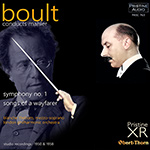
- Cover Art
Mahler’s Lieder eines fahrenden Gesellen occupies a unique place in his output, standing at the threshold between song and symphony and revealing, in concentrated form, many of the emotional and musical ideas that would later unfold on a larger canvas. Written in the mid-1880s, the cycle sets four poems that chart the inner life of a rejected lover, moving from outward simplicity to inward desolation. Folk-like melodies, direct rhythms and a deceptively transparent orchestral texture combine to create music that appears artless on the surface, yet is tightly controlled and deeply expressive beneath.
In this recording, which was omitted from Warner's Boult Mono box, Blanche Thebom brings a warmly centred mezzo-soprano voice to the cycle, shaping Mahler’s long melodic lines with poise and restraint. Her singing avoids operatic display in favour of clear diction and an inward, narrative tone, allowing the emotional trajectory of the songs to unfold naturally. Sir Adrian Boult’s accompaniment is notable for its balance and clarity. Rather than treating the orchestra as a purely supportive backdrop, he draws out Mahler’s subtle instrumental commentary, ensuring that voice and orchestra exist in a finely judged partnership. The result is a reading that highlights the cycle’s lyrical intimacy while maintaining a strong sense of structural continuity across the four songs.
The close relationship between Lieder eines fahrenden Gesellen and the First Symphony has long been recognised. Themes from the songs appear directly in the symphony, most notably in the first movement and the Funeral March, while the emotional world of the cycle – youthful optimism, irony, grief and eventual resignation – permeates the larger work. Hearing the songs alongside the symphony restores this connection in a way that Mahler himself would have understood, revealing the symphony not as an abstract orchestral statement but as an expansion of the same personal narrative.
Boult’s approach to the First Symphony is distinctive and, at the time of its release, stood apart from prevailing expectations. He was never regarded as a specialist Mahler conductor, and his interpretation resists many of the rhetorical gestures that later became associated with the composer’s music. Instead, Boult treats the symphony as a rigorously structured work, emphasising forward motion, clarity of texture and careful control of tempo relationships. Transitions are handled with particular skill, giving the impression of a continuous, purposeful flow rather than a sequence of episodic contrasts.
In the opening movement, Boult allows the music to unfold with an unforced naturalness, the pastoral elements emerging without exaggeration. The driving allegro passages are energetic and alert, yet never indulgent, maintaining tension through momentum rather than weight. The Ländler-based Scherzo is robust and earthy, its dance rhythms firmly articulated, while the Trio avoids sentimentality, keeping the line moving even at moments of apparent repose. In the Funeral March, Boult resists overt grotesquerie, presenting the parody with a straight-faced gravity that underscores its darker implications. The finale, taken at a purposeful pace, builds excitement through cumulative energy rather than sheer volume, bringing the work to a conclusion that is exultant without bombast.
This interpretation inevitably challenged listeners accustomed to more overtly “Mahlerian” readings, and early reactions reflected that unease. With the passage of time, however, Boult’s refusal to overstate the music has come to sound increasingly persuasive. Heard today, his Mahler emerges as lean, direct and unsentimental, allowing the composer’s ideas to speak without adornment. The stereo recording, made at a time when such presentation was still a novelty, enhances this impression, offering clarity of orchestral detail and a sense of space that serves Boult’s architectural view of the score.
Taken together, the songs and the symphony reveal a consistent artistic outlook. In both, Boult favours balance over excess, structure over rhetoric, and musical honesty over theatrical display. The Wayfarer songs introduce Mahler’s world in miniature; the First Symphony expands it to symphonic scale.
Heard in the context of Boult’s complete Mahler discography, which amounts to only a handful of surviving documents, including several accounts of Lieder eines fahrenden Gesellen, a Kindertotenlieder, and a small number of symphonic performances preserved from live broadcasts earlier in his career [Pristine PASC 709], this restraint appears not as limitation but as conviction. Boult approached Mahler selectively and on his own terms, bringing to the music the same disciplined clarity he applied throughout his repertoire.
Presented side by side, these performances offer a compelling portrait of a conductor whose Mahler may once have seemed unconventional, but whose integrity and musical insight continue to reward attentive listening.
BOULT conducts Mahler
MAHLER Songs of a Wayfarer (Lieder eines fahrenden Gesellen)
1. Wenn mein Schatz Hochzeit macht (3:34)
2. Ging heut' Morgen über's Feld (4:06)
3. Ich hab' ein glühend Messer (3:03)
4. Die zwei blauen Augen von meinem Schatz (4:49)
Blanche Thebom, mezzo-soprano
London Philharmonic Orchestra
Sir Adrian Boult, conductor
Recorded in mono, 17–18 July 1950 · Abbey Road Studio No. 1, London · Matrices: 2EA 14912/5 · First issued HMV DB 21224/5 (78 rpm) and RCA Victor LM-1203 (LP)
MAHLER Symphony No. 1 in D major
5. I. Langsam, schleppend – Wie ein Naturlaut (14:32)
6. II. Kräftig bewegt, doch nicht zu schnell (5:54)
7. III. Feierlich und gemessen, ohne zu schleppen (9:05)
8. IV. Stürmisch bewegt (16:55)
London Philharmonic Orchestra
Sir Adrian Boult, conductor
Recorded in stereo, 10–13 August 1958 · Walthamstow Assembly Hall, London · First issued as Everest SDBR-3005
Songs of a Wayfarer
Producer and Audio Restoration Engineer: Mark Obert-Thorn
Symphony No. 1
XR Remastered by Andrew Rose
Total duration: 61:58
MusicWeb International Review
A highly satisfying and logical pairing, well-remastered and showcasing both Boult’s and Thebom’s eminence in Mahler
“Mahler is not the first composer associated with Sir Adrian Boult but he was quite familiar with the music and one should not be surprised to find him at home with Mahler’s eclectic idiom. Slightly more surprising is the ease and virtuosity shown by the LPO here. Their playing is superb, especially the lovely horns and woodwind, who nail both the notes and the style as if they were as familiar with the music as the VPO. At times, their playing is deliberately slightly raw, so there is no danger of too “English-sounding” a refinement.
This, by any standards, is a swift, direct performance. The next fastest I know is just under fifty minutes from Paul Kletzki with the Israel Philharmonic recorded four years earlier and of much less quality – but that also has cuts in the last movement; Steinberg is very swift, too. Otherwise, the tendency over the years has been to get slower, thus most recordings clock in at around the mid-fifties mark, so Boult is pacy by any standards.
That approach pays dividends in the excitement of this recording but that is not to say that Boult is in any way monotonously driven or negligent of the more reflective sections of the music. The opening, for example, is suitably mystical and otherworldly before relaxing into a genial and even humorous account. He then moves on from his relaxed mode to crank up the tension, driving on to a wonderfully exuberant conclusion.
The Scherzo could have turned out to be manically fast in the wrong hands but its high spirits never spill over into hysteria and Boult makes telling use of dynamic contrasts between sections. He presses on in the famous Forest Funeral March of the Animals, slyly accentuating the dance rhythms. The Finale positively explodes with nervous energy.
This is Boult just getting on with it, providing the antithesis to the reverential, “spiritual” approach to Mahler which does not in fact really suit this deeply ironic symphony. As such, it constitutes a refreshing alternative interpretation.
This is one of a whole series of newly re-mastered re-issues of the famous Everest LP catalogue. Consequently, they are short-measure compared with new recordings but priced accordingly. There is some slight hiss and at first the sound seemed to me to be a little “papery” but otherwise it still sounds terrific. The Walthamstow Assembly Hall provides a big, resonant acoustic without obscuring detail.”
I would also draw your attention to the views expressed by my esteemed colleague Lee Denham in his comprehensive survey of recordings of the symphony – eventually, I believe, to be updated to include the ever-burgeoning catalogue:
“For many reasons, Sir Adrian Boult is regarded as principally an exponent of English music, but his few forays into Mahler also show him to be excellent with this composer too. This First Symphony is no exception and lasting a fraction over 46 minutes you will need to hold onto your hats with this one, for Sir Adrian is in the fast lane here! Throw in a very good Everest recording from 1958 and this is a very worthwhile listen with the LPO on electrifying form, with ensemble much, much better than you would have thought. In the first movement, Boult’s “stiff upper-lip” means there’s no hanging around as the mists rise, but there’s genial good humour here too that’s most affecting. The second movement’s landler is despatched at a pace to test the fittest of dancers, yet this isn’t glib nor slick; instead, it is characterised by rollicking good humour and, at the end especially, real brilliance. There’s no hanging about in the third movement either, Boult clearly not feeling that sympathetic to the Huntsman whose funeral it is, nor in the final one, the central string lament despatched slightly tersely maybe. But there is also tremendous excitement too and the performance generates much white heat in the final pages, with the final bass drum roll astonishingly caught for 1958.”
As you see, LD and I hardly differ and I see no reason to alter my response to its interpretative qualities but obviously my observations in the last paragraph regarding the sound require comparison between it and this new Pristine remastering – and of course, unlike the short-measure Everest issue, we are also given the song cycle, which makes a logical and satisfying pairing, as the works are thematically linked. The Everest sound was always very good for its era and although I concede that this XR Remastering by Andrew Rose reduces the hiss and rounds out the amplitude a little, I cannot say that you need rush to jettison your Everest recording and buy this – unless, that is, you want that pairing with the Lieder eines fahrenden Gesellen – which, incidentally, wasn’t included in the recently issued mono box set from Warner, perhaps for contractual reasons. It is certainly a fine performance, even if I am used to a more affectionate and indulgent treatment of these songs than Boult is prepared to give it. Thebom was a true Wagnerian singer, rich and ample of tone with a fully developed lower register; most collectors will know her as Brangäne in the famous 1952 recording of Tristan und Isolde conducted by Furtwängler, a piece of casting insisted upon by Flagstad, not only because it was Thebom’s signature role but also because she owed Blanche a favour. She is by no means all heft; she sings with great charm and delicacy in “Ging heut’ Morgen”, her cries of “O Weh” in “Ich hab’ ein glühend Messer” are poignant and she lavishes her dark expressive timbre on “Die zwei blauen Augen”, floating her voice engagingly in the Romantic “Lindenbaum” section. Boult is a sensitive but unsentimental accompanist, bringing out the dark undertones of these songs and they have been remastered by Mark Obert-Thorn very successfully but not in an over-interventionist manner, such that one hardly notices that they are in mono.
Ralph Moore
MusicWeb International, April 2026