
This album is included in the following sets:
This set contains the following albums:
- Producer's Note
- Full Track Listing
- Cover Art
Do composers gain from posthumous anniversaries? If their greatness is well enough established, the playing of their lesser-known works may further enhance their reputation; if unduly neglected, they may be helped out of their oblivion. Those afflicted by a history of chronic misrepresentation, pervasive malice, and lingering doubt stand the slimmest chance. Celebrating the 100th anniversary of Liszt’s death and the 175th of his birth, a plethora of Liszt festivals, marathons, and competitions this year may well prove to have further obscured the stature of a man who has to be defended on several fronts: against some of his champions and partisan admirers, against the crowd of skeptics and adversaries, and, to a lesser extent, against himself.
When Liszt died, he made the mistake of leaving behind an unusual legacy of envy. There is a relation between envy and posthumous fame. Liszt’s early European success as virtuoso and improviser equaled that of Mozart; a few years later, his “genius of expression” (Schumann) and boundless pianistic skill made him, as a player, superior even to Chopin, Mendelssohn, or Clara Schumann. The combination of a lively mind, personal magnetism, masculine beauty, the social triumphs enjoyed by a privileged parvenu, and a love life bordering on scandal turned out to be, within one human being, barely forgivable. There was a conspicuous absence of mitigating circumstances such as Mozart’s or Schubert’s early death, Mozart’s alleged impoverishment and unmarked “pauper’s grave,” Schubert’s syphilis, Beethoven’s deafness, Chopin’s consumption, or Schumann’s mental disorder—features that make the fame of a genius a great deal more gratifying, and guarantee its solidity. (Wagner’s monstrous egotism and merciless promotion of his own ends, while not stimulating compassion or malicious glee, present a frame of mind many people enjoy sharing.)
Arguably, Liszt and Haydn are the most frequently misunderstood among major composers; their biographers afford little food for pity. (The insufferable bigotry of Haydn’s wife and the senility of his last years do not, it seems, sufficiently atone for his achievement in being the first great symphonist and the grand master of the string quartet.) In old age, Haydn reigned over the musical world as its undisputed leading light. For this, the nineteenth century punished him—as it punished Liszt for his undisputed supremacy as a performer. Haydn was branded the ingenious classicist (something he rarely was), “the family friend who is always welcome but has nothing to say that is new” (Schumann). Liszt, in his compositions, was seen as a poseur and charlatan (which he only occasionally was), the embodiment of a superficial and bombastic romanticism. Not until our century did a greater number of composers—from Richard Strauss, Ravel, and Busoni to Schoenberg, Bartók, and Boulez—appreciate Liszt by taking him seriously.
– Alfred Brendel, The New York Review of Books, 20 November 1986 (introduction - full article available here)
Alfred Brendel has long championed the music of Franz Liszt: his recording career began in 1952 with a recording of Liszt's "Weihnachtsbaum" - its première recording - and he continued to record and perform the composer's music throughout his lengthy career. The 1950s saw Brendel make a good number of Liszt recordings on the Vox label prior to signing to Philips, where he was to spend the rest of his career. Vox were, in many ways, a pioneering label at the time, but technically their recordings sometimes fell short of the best of the era. In this selection of I hope to demonstrate the genius of the young Brendel's Liszt interpretations in sound quality that does full justice to his playing, addressing not only tonal issues but also pitch instability and unwanted background noises, thus offering the finest possible representation of these exquisite performances.
Andrew Rose
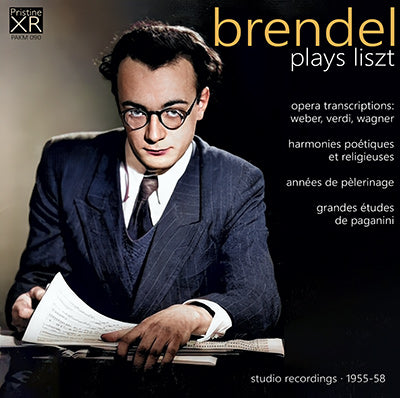
BRENDEL plays Liszt
LISZT Harmonies poétiques et religieuses III, S.173
1. No. 10 - Cantique d'Amour (6:24)
2. No. 3 - Bénédiction de Dieu dans la solitude (15:35)
3. No. 7 - Funérailles (10:57)
Recorded Mach 1955
4. WEBER (arr. Liszt) Oberon - Overture, S.574 (9:09)
5. VERDI (arr. Liszt) Il trovatore - Miserere du Trovatore, S.433 (8:17)
6. WAGNER (arr. Liszt) Tristan und Isolde - Isoldes Liebestod, S.447 (6:14)
Recorded 1958
LISZT Années de pèlerinage II, S.161
7. No. 4 - Sonetto 47 del Petrarca (5:57)
8. No. 5 - Sonetto 104 del Petrarca (6:07)
Recorded 1957
LISZT Grandes études de Paganini, S.141
9. No. 2 - Andante (5:42)
10. No. 3 - La Campanella. Allegretto (5:03)
Recorded 1958
Alfred Brendel, piano
XR Remastered by Andrew Rose
Cover artwork based on a photograph of Alfred Brendel
Original recordings made by Vox
Total duration: 79:25
Classical Review
If you want unadulterated Liszt, it has to be as virtuosic and exciting as he was at the time. Brendel succeeds at this for a memorable program
These superbly remastered recordings were made in 1955–58 when Brendel was in his twenties. The stated goal here is to offer stunning examples of the pianist’s early and emerging genius with sound quality vastly improved over the original Vox LPs. I have enjoyed and referenced so many of his recordings over the years that hearing this early collection was a reaffirmation of my collegiate LP listening choices. I had his huge LP box of all of Beethoven’s piano music and many individual discs and tapes. His Russian disc from 1955 ( Pictures at an Exhibition, Petrouchka, Islamey ) remains my reference recording of these pieces (SPJ Vox 97203; see Fanfare 22:6, July/Aug 1999).
This release gave me a chance to check up on the 92-year-old pianist born in Czechoslovakia (1931), who retired in 2008 and has lived in London since 1971. He is one of the few pianists from this era that I never saw live in concert. Fortunately there have been some video interviews and performances, along with a fascinating DVD of a Winterreise rehearsal and performance with Fisher-Dieskau (Arthaus 109317, Fanfare 40:6, Jul/Aug 2017). I was surprised to learn that he is mostly self-taught, not having any further formal training beyond the age of 16. He says he doesn’t have a phenomenal memory and is not a good sight-reader. Yet his first recording in 1950 was Prokofiev’s Piano Concerto No. 5, at age 19! What a musical mind this man has, and the fingers to back it up.
Brendel’s Liszt recordings have always been considered quite good, but often criticized as being too intellectual and not as exciting as they should be. All one needs to do is read his analysis of Liszt’s Sonata to realize all that he finds in that score. Yet his recorded performance of a piece I hear on a weekly basis is not one that I return to with any regularity. This generous program is different in its excitement level and great variety. Selections from three of Liszt’s major collections alongside three operatic arrangements make for a very satisfying disc. Hats off to Andrew Rose, who is responsible for the remastering that addresses the tonal issues of the original 1950s recordings. He also removes some unwanted background noise and corrects some pitch instabilities, along with being the one to select the pieces and order the program.
My college music history advisor used Brendel’s recordings as examples in many classes. He said essentially that when you listened to Beethoven as played by Brendel, you got the unadulterated Beethoven. I bring this same thought to the Liszt here, most of which was composed when Liszt was in his 20s or 30s and the most renowned pianist in the world. If you want unadulterated Liszt, it has to be as virtuosic and exciting as he was at the time. Brendel succeeds at this for a memorable program.
The short booklet essay is a wonderful quote from Brendel ( The New York Review of Books , 1986) that pretty much sums up Liszt and his changing legacy. Given the performances and sound, this is a must have for any Liszt aficionado.
James Harrington
Classical review
