This album is included in the following sets:
This set contains the following albums:
- Producer's Note
- Full Track Listing
- Cover Art
This remarkable historic document demonstrates just how good a recording it was possible to make as long ago as 1942. It must surely rate as one of, if not the best sounding recordings I have ever encountered from that era. Things would improve dramatically in the years immediately after the end of the Second World War, but it is unusual to find such fidelity during the war years, especially outside Germany.
The source for this recording was a set of acetate discs apparently prepared for South American broadcasters which, by the sound of them, were never actually played. Comparisons to other sources, such as those used for a previous issue of this concert, indicate just how quickly and badly these delicate discs deteriorated with use. Indeed the bonus track on this release gives the listener some indication of the difference - taken from the English language acetates we hear the familiar indicators of wear and tear even after extensive declicking and cleaning up in the extended commentary that preceded the NBC broadcast .
By contrast the mint acetates which provide the musical content offer a fidelity one might normally expect from a good late-1950s mono vinyl pressing. For the most part they provided me with a very straightforward task, with XR remastering bringing out the full tonal range of the orchestra, with very low surface noise and an exceptionally full frequency range for an early 1940s recording. As is common with disc recordings there was some gradual loss of treble towards the end of each side, and side changes were pretty brutally chopped, with no overlap to allow for cross-fading. But this aside, the only other challenge was the missing first note! This was ultimately patched in from another "digitally aged" recording of more recent vintage, as my other sources of the Stokowski performance were of such lower sonic quality. The result is a seamless patch and and entirely convincing opening.
It is a shame, but entirely understandable, that we have no 1942 photo of Stokowski and Shostakovich together. As our sleevenotes detail, it's amazing that Stokowski (and a number of other major US-based conductors) were even able to get their hands on a copy of the score. I am very grateful though to Edward Johnson for digging out and sending me the 1958 photograph of composer and conductor which grace the cover of this release. Stokowski was a great champion of the Soviet composer's work. Now at last we have his only recording of the "Leningrad" Symphony in sound which truly does justice both to the work and to the performance.
Andrew Rose
These two 1944 recordings continue to astound me weeks after I first heard them. Culled from the same source which provided us with Stokowski's 1942 Shostakovich "Leningrad" Symphony (PASC527) they again confound expectations as to what a recording of this vintage should sound like.
Here we find Stokowski conducting the brilliant NBC Symphony Orchestra in stunning renditions of Tchaikovsky's 6th Symphony and Romeo and Juliet fantasy overture - made all the more so by the frankly incredible sound quality of the recordings. At times, stereo aside, one might be forgiven for thinking some of these recordings had been made last week, rather than nearly three-quarters of a century ago.
Naturally they weren't originally quite this good. Pitch jumps in the symphony had to be corrected, clicks and scratches evened out, and Pristine's XR remastering system employed to accurately re-equalise the sound and bring out the full glory of the NBC orchestra.
With a full frequency range, exceptionally quiet sides allowing an extraordinarily wide dynamic range, and very little in the way of other flaws or audience noise to get in the way of the listening experience, one is almost immediately drawn into the performances - and they are white hot, as Edward Johnson's excellent sleevenotes explain.
Andrew Rose
"It was a rousing performance ... Mr. Stokowski led a dramatic performance that had special drive and crispness in the scherzo and that built up into a series of big climaxes in the last movement." - New York Times, 1941
Exactly one month prior to the entry of the United States into World War II, on Armistice Day 1941, Leopold Stokowski conducted the NBC Symphony Orchestra in a rare performance for him of Beethoven's Symphony No. 9. As the NY Times reviewer pointed out, "he chose a solemn day in a momentous time to set forth once more Beethoven’s affirmation of the brotherhood of man."
It's a performance that has never been heard in full since. A scheduling anomaly meant that whilst Stokowski performed the entire work before a packed house, radio listeners were treated only to the final choral movement. The first three movements were never broadcast, and as far as we can tell, have not been issued before.
They were however captured in a line recording, from which the present release is largely drawn, and preserved in stunning sound quality for the day. Indeed the finale, which was drawn from a recording of the broadcast (complete with closing commentary), whilst also of fine sound quality, struggles to quite match that heard in the opening three movements.
It should at this point be noted that a very short section at the end of the third movement was missing from the original source recording. We assume that the time recording was faded out at this point in order for the commentator to be heard on NBC radio. For this I have patched in a later recording by Stokowski, digitally aged to match the sound of the 1941 recording and spliced in so seamlessly that two Stokowski experts who heard it prior to release were unable to detect the change. It helped enormously that Stokowski's later performance matched the 1941 tempo almost exactly during that third movement. I have also reconstructed a shorter pause between third and fourth movements than was heard by the audience on the night - an extra delay was caused by the need to go "on air" prior to commencing the finale, as the Times' reviewer noted the following day.
And so we present an entirely new Stokowski performance of the Choral Symphony. As you'll hear from the sample movement (the second) on this page, it really is a stunning sounding performance - and one you won't wish to be without.
Andrew Rose
STOKOWSKI
conducts a British Music programme at the NBC
British-born Leopold Stokowski came into the world in what is now called New Cavendish Street in London, just a block away from the BBC's Broadcasting House. He attended St. Marylebone School, just up the road, and sang in the choir of the adjoining St. Marylebone Parish Church. It was here, as a 12-year-old choirboy, that he took over the performance of a church service, perhaps choral evensong, when the regular choirmaster failed to show up. The experience gave him a sleepless night and instilled in him an overwhelming desire to become a conductor. He related these early conducting ambitions when choosing his 'Desert Island Discs' for the BBC radio show of that name in 1957 (it's readily available on YouTube!).
His musical precocity took him to the Royal College of Music in 1895 where, at the age of 13, he was the youngest student at the time to be admitted. Two of his fellow organ students, both a few years older, were Gustav Holst and Ralph Vaughan Williams. These two were already firm friends, both having a strong interest in English folk music. Stokowski's teachers at the RCM included Sir Hubert Parry and Sir Charles Villiers Stanford. Needless to say Stokowski could not remotely have anticipated that one day he would be performing works by all four of these composers for American audiences.
In 1902, the young Leopold became the organist at St. James's, Piccadilly. Here he attracted the attention of the rector of St. Bartholomew's in New York City. He had come to England to find a new music director for this immensely fashionable church and was so impressed with the colourful individuality of Stokowski's organ playing that he immediately offered him the post of choirmaster.
Stokowski duly took up the appointment in 1905 and it was in the USA that he made his career and where in 1915 he became an American citizen. During those early years he spent his summers in Europe studying conducting. As a result, his ambition to become an orchestral conductor was fully realised in 1909 when he made his debut in Paris. The Cincinnati Orchestra was looking for a new conductor and their representatives who heard the concert were so impressed by the youthful maestro's "remarkable qualities" that he was immediately offered the job.
Stokowski's three-year apprenticeship in Cincinnati found him starting as he meant to go on. He studied and learnt the basic repertoire but he also included much that was being written by living composers. When it came to English music, Elgar's made its first appearance in a Stokowski / Cincinnati concert with the Pomp and Circumstance March No. 1 in 1911. Later that year, on 24 November 1911, came one of Stokowski's innumerable US Premieres when he introduced Elgar’s 2nd Symphony to America. The Cincinnati Times-Star was unpersuaded of the work’s merits: “The composition is pleasant and interesting; but it is not great, nor in any sense convincing.” Maybe that view still holds good even today, since none of the great American orchestras have yet made a commercial studio recording of the work!
In 1912, Stokowski left Cincinnati for Philadelphia where he conducted Gustav Holst's music for the first time with a performance of the Japanese Suite on 15 October 1925 in yet another US Premiere. He returned to Holst's music in 1934 when, on learning of the composer's death, he conducted The Planets by way of a tribute.
His next performance of The Planets came about during his three-season appointment as the NBC Symphony's chief conductor following Toscanini's temporary withdrawal in 1941. The war had its own influence on Stokowski’s NBC programmes and he often advocated music from the Allied countries. England was duly represented on 14 February 1943 by what the New York Times described as “a remarkable performance of Holst’s great mystical tone-poem.” The critic from the daily Brooklyn Eagle added that "Stokowski knew, of course, how to show The Planets their orchestral brilliance most graphically, while the orchestra lent its virtuosity to a good cause."
A previous incarnation of this same NBC performance several years ago elicited from critic Andrew Achenbach that it was “a Planets crammed full of interpretative incident, superbly played by a legendary orchestra ... Stokowski’s broadcast evinces a giant theatricality and abundant zeal that prove hypnotically compelling.”
Stokowski returned to the work in 1956 when he made its first stereo recording in Capitol's 'Full Dimensional Stereo Sound' with the Los Angeles Philharmonic. This reading proved controversial in several ways and was given short shrift in the Gramophone by Trevor Harvey who in any case confessed in print that he was no admirer of Stokowski. Even so, the LP's total sales, on the original Capitol label together with its Music for Pleasure reissue, reached nearly half-a-million copies in the UK which wasn't bad going!
Stokowski's next traversal of The Planets took place in the Royal Albert Hall in 1963 with the London Symphony Orchestra. The programme was all-British, with John Addison's Carte Blanche Ballet Suite and Vaughan Williams's Tallis Fantasia occupying the first half and Holst coming after the interval. This time, as was often the case in those days, the critical reactions to a "live" Stokowski performance could be quite different to the reviews of one of his LPs. For example, one commentator wrote of his LSO performance of The Planets that "Stokowski evoked, with scarcely a vehement gesture, gusts and storms, winged chatter, whimsical heartiness and the mystery of voices dying in space," while another described him as "a marvellous conductor; individual certainly, eccentric even on occasion; but capable of achieving unique, exciting and vastly stimulating results."
But to return to the war-time NBC seasons and A Shropshire Lad by George Butterworth. Doubtless Stokowski had heard Sir Adrian Boult's performance in an all-British NBC broadcast in 1938 and decided to revive it himself. Butterworth's idyllic orchestral rhapsody was to prove highly influential on several British composers but as with the seven performances on Pristine's "Wartime NBC Premieres" release (PASC 536) this was the only occasion on which Stokowski conducted the work.
So to Vaughan Williams. Stokowski was - as with so many living composers at the time - something of an RVW champion as far as American audiences were concerned. He introduced A Pastoral Symphony (RVW's 3rd) to his fellow Philadelphians in 1924 and followed that with the Tallis Fantasia two years later. He gave a blazing performance of the 4th Symphony with the NBCSO in 1943 and made the first recording of the 6th with the New York Philharmonic in 1949. He performed the Sinfonia Antartica in Houston in 1954 and played No. 8 in London's Royal Festival Hall in 1957 in the delighted composer's presence. The following year, on hearing of Vaughan Williams's death, he paid tribute by conducting the US Premiere of RVW's last Symphony, his Ninth.
This leads us to the final work in this NBC selection and something of a rarity it is too! The original score of the Fantasia on Christmas Carols requires a baritone soloist, a choir and an accompanying orchestra. However, it was also published in other formats, including a version with a string orchestra and organ supplying the accompaniment, or just an organ or a piano on its own.
Vaughan Williams's Serenade to Music had also been published in several formats, the original being for 16 voices and orchestra, though the work can also be performed by orchestra alone. We can only speculate on Stokowski's decision in the run-up to his Christmas 1943 concert but it seems likely that he took his cue from RVW's own orchestral version of theSerenade to Music and adopted the same procedure with the Carols Fantasia. It therefore seems probable that he asked an NBC 'house copyist' to cue the vocal parts into the orchestral ones. Thus, for example, the baritone solo at the start is played by a bassoon, while the first choral entry is taken over by the strings. This orchestral version proves an effective alternative to the choral original and one wonders why Stokowski's idea hasn't been adopted and published, so that other orchestras can play it in their own Christmas concerts!
To conclude, when it came to English music, Stokowski probably performed more of it than any of his equally illustrious States-side podium colleagues. In addition to those mentioned above, he played compositions by Richard Arnell, Malcolm Arnold, Arnold Bax, Arthur Bliss, Havergal Brian, Benjamin Britten, Henry Walford Davies, George Dyson, Edward German, Kenneth Leighton, Ermest Moeran, Roger Quilter, Alan Rawsthorne, Edmund Rubbra, Cyril Scott, Arthur Sullivan, Michael Tippett, William Walton and David Wooldridge. Happily, broadcasts such as the ones presented here have survived, thus giving us an opportunity to hear Stokowski's "remarkable qualities" for ourselves!
Edward Johnson
When Stokowski visited London in 1957 to make his annual appearances in the capital, he was invited onto 'Desert Island Discs.' This is the BBC's long-running radio programme in which well-known persons are asked to choose 8 recordings to take with them, should they be marooned on a desert island. Among Stokowski's choices was "Sirènes" from Debussy's Three Nocturnes. "I am a great lover of Debussy," he told the presenter, "and when I was a student in Paris a long time ago I heard him play the piano and I also heard him conduct. I think he was a great genius."
Stokowski's devotion to Debussy's music was exemplified in his orchestral arrangements of "The Engulfed Cathedral" and "Night in Granada," both presented here. He also transcribed "Clair de lune," his 1937 Philadelphia Orchestra 78rpm disc becoming a huge best-seller in its day.
However, the one Debussy piece that Stokowski conducted the most, both on record and in the concert-hall, was "Prelude to the Afternoon of a Faun." He performed it for the first time in Cincinnati in 1912, made the first American recording acoustically in 1924 (PASC 441) and played it for the last time in 1972 at the age of 90. In his notes to a 1958 Capitol LP featuring the work, he wrote: "This music is a miracle of delicate, erotic beauty, suggesting a dream world of pagan loveliness, utterly original, in every way perfect."
One of the many interesting aspects of Stokowski's three-season tenure with the NBC Symphony was the extraordinary amount of new music he programmed. Perhaps even more remarkable was that he played many such works just once for a single radio broadcast but never returned to them. The selected 'Symphonic Fragments' from Debussy's "Le Martyre de Saint Sebastien" are a case in point, as is Darius Milhaud's 1st Symphony in what was its New York premiere.
The Milhaud family had fled to the USA in early 1940, following the Nazi invasion of France. The Symphony No. 1 had just been completed, having been commissioned by the Chicago Symphony as one of the works marking its 50th Anniversary celebrations that year, and it was conducted by Milhaud himself on 17 October 1940. Commentators have said that this is one of his finest works, with Stokowski's performance having been called "highly idiomatic" and the composer himself declaring it "very powerful."
Our final selection, the 2nd Suite from Ravel's "Daphnis and Chloe," was also the concluding work on that particular day's programme. Listening to it, one wonders if the great maestro had glanced at the studio clock and wanted to make sure the broadcast didn't over-run. At any rate, in the final dance he pushed the NBC players to their utmost limits and duly brought the house down. One thing can safely be said of Stokowski: he was seldom if ever dull!
Edward Johnson
When the 88-year-old Leopold Stokowski conducted a work by Charles Ives with the London Symphony Orchestra in 1970, one critic referred to the maestro as "the man who has done more for contemporary music in America than all the rest of his generation put together." Indeed, The New York Times once estimated that Stokowski had given around 2,000 "first performances" (World Premieres, US Premieres, first broadcasts and so on) and we begin with one of them.
Alan Hovhaness, American-born of Armenian-Scottish descent, was a highly prolific composer who found in Stokowski his foremost presenter of several World Premieres. These included "Mysterious Mountain," especially written - in the composer's own words - for "a very great and wonderful man." For his part, in his 1957 appearance on the BBC Radio show "Desert Island Discs" (you'll find the programme on YouTube!) Stokowski singled Hovhaness out as a considerable talent among the younger composers of the time.
The "Exile" Symphony was premiered in England in 1939 by the BBC Symphony under Leslie Heward and was introduced to America by Stokowski in 1942. The music evokes the terrible sufferings of the Armenian people during the First World War. Years later, Hovhaness was to replace the middle movement, here entitled "Conflict," with a completely new one called "Grazioso." Stokowski's NBC premiere broadcast remains the only complete extant recording of the "Exile" Symphony as first conceived.
Although Stokowski was renowned for conducting numerous premieres, he was equally keen to perform new works introduced by others. He was already a staunch advocate of Stravinsky's music, having presented to America several of the composer's major works. These included "The Rite of Spring" in its concert and ballet presentations, as well as its first US recording. He also featured it, somewhat abridged and rearranged, in Walt Disney's "Fantasia," thus ensuring its continuing popularity in concerts and on records.
The Symphony in C was premiered in Chicago in 1940 by Stravinsky himself. He was to conduct it several times with other American orchestras before it was taken up by Stokowski, who said of the work: "It is remarkable for its simplicity and flowing cadence and has a certain 18th century flavour, with a wonderful expression of rhythm and counter-rhythm." The NBC radio premiere heard here was praised by Virgil Thomson for its "detailed clarity and overall comprehension."
Like so many other German musicians in the 1930s, Paul Hindemith fell foul of the Nazis and in 1940 had to settle in America. The Symphony in E flat was the first of his major works to be composed in the USA and was introduced by Mitropoulos and the Minneapolis Symphony in November the following year. The work consists of a vigorous first movement, a dirge-like second, a 'danse macabre' scherzo and a martial finale. Stokowski was sufficiently taken with the work to play it again with the Hollywood Bowl Symphony and the New York Philharmonic, doubtless revelling in its triumphant closing pages.
Edward Johnson
Technical note
Despite their age, these wonderfully preserved acetate disc recordings reveal an astonishing level of detail and sound quality and a full frequency response. It's easy to forget, when hearing them, just how old they are - at the time of writing nearly 80 years has passed since these performances took place. Not all of their imperfections have been eradicable, but these minor surface noises pale into insignificance against the majesty of Stokowski's 1942/3 NBC orchestra and the sound quality captured here. Indeed these are some of the very finest quality recordings I've ever heard from this era. I would have liked to preserve the announcements from each of the performances, but to do so would have taken more space than is available on a single disc. In this instance therefore they have been cut and instead a short amount of applause left at the end of each work.
Andrew Rose
Although Stokowski never recorded a complete Beethoven cycle, several of the nine symphonies remained firmly in his repertoire during his long conducting career. He played a Beethoven work for the first time in 1909 when, at the age of 27, he conducted the Cincinnati Orchestra in the 5th Symphony. Sixty-five years later, aged 91, he performed Beethoven's music for the last time when he gave an LSO concert that included the 8th Symphony and the "Eroica," both hailed by one critic for their "striking and imaginative performances."
Stokowski was among the first conductors to record many works that were - and are - part of the regular concert repertoire. His first Beethoven disc, recorded acoustically in 1920, was of the 8th Symphony's "Allegretto Scherzando" (PASC192). With the advent of electrical recording, he and his Philadelphians made the first American 78s of the 7th Symphony, an exhilarating performance described by Mark Obert-Thorn as "a reading of immense vitality and rhythmic propulsion" (PASC483).
Next came the Beethoven 5th in another American "first" - a specially recorded performance designed to introduce RCA's "Program Transcription" LPs in 1931. They couldn't have been worse timed and as a result of the great depression soon died a death. Then in 1934, Stokowski made the first American recording of the "Choral" Symphony. Seven years later, in 1941, he was given a three-season contract to take over the NBC Symphony during Toscanini's temporary withdrawal and it was Beethoven's 9th Symphony which featured in his second NBC concert (PASC541).
The NBC Symphony's players were of course used to performing Beethoven under Toscanini's direction and after his year's absence, the great Italian maestro returned as Stokowski's co-conductor. This arrangement prompted critic David Hall to comment that "the most spectacular combination of performances and programming were the two Toscanini-Stokowski seasons."
"Spectacular" is a word that can readily be applied to the performances heard here, particularly the Beethoven 5th. The "Pastoral" Symphony in this 1942 broadcast is now the earliest complete Stokowski performance on record, the "Fantasia" soundtrack version having been much abridged. As to the 7th Symphony, Stokowski felt that something stated strongly just once could be weakened by repetition, so he followed the precedents set in other Beethoven symphonies by omitting the second appearance of the Trio in the third movement.
Finally to Wagner, whose "Prelude and Liebestod" followed the Beethoven 7th in the 1942 broadcast heard here. A one-time church organist, Stokowski clearly enjoyed pulling out all the stops! 'Parsifal' was the only Wagner opera that he conducted complete, with a Philadelphia concert presentation in 1933. He also began making "Symphonic Syntheses" of Wagner's music dramas and the "Good Friday Spell" is followed by one of these arrangements. It is music from Act 3 evoking the world of the Knights of the Holy Grail and in this 'live' broadcast, Stokowski brings in a chorus from the opera's final pages. It is a wonderful effect not realised in his three orchestral recordings of the 'Parsifal' "Synthesis" and thus makes this performance unique in his immense discography.
Edward Johnson
"I'm very fond of Russian music" Stokowski would often say in interviews and, as with so many contemporary composers during his long career, he was a foremost champion of the Russians, frequently performing works by Rachmaninoff, Shostakovich, Prokofiev, Khachaturian, Scriabin and many others. He was also an advocate of Stravinsky's music, withThe Rite of Spring, Les Noces, Oedipus Rex,The Song of the Nightingale and the Symphonies of Wind Instruments all receiving their US premieres under his direction.
On Philadelphia Orchestra 78s too, he made the first US recordings of The Rite of Spring and Petrushka, from which he devised the colourful Suite heard here. However, it was The Firebird Suite which appealed to Stokowski the most. He recorded this work no fewer than eight times, starting with an acoustic set in 1924 (PASC192, also featuring Fireworks). Incidentally, he occasionally added the effective clang of a tubular bell at the start of the "Infernal Dance," as in the brilliantly played NBC performance on this CD.
Tchaikovsky's 4th Symphony also featured in Stokowski's list of numerous disc premieres, its first American recording having been made with the Philadelphia Orchestra in 1928. He was to re-record it for Victor two days after the broadcast heard here in a 78rpm set that has been described as "fiery and impetuous" and even "wilful," words that are also applicable to the preceding live performance.
Rimsky-Korsakov was also much in Stokowski's repertoire, with Scheherazade excerpted on acoustics (PASC476) and recorded five times thereafter. He made the first American 78s of the Russian Easter Festival Overture in 1929 and this he also re-recorded with the NBC Symphony for Victor shortly after its 1942 broadcast. However, for this performance he made a colourful emendation. About half-way through, Rimsky-Korsakov directs a solo trombone to depict the chanting of a Russian Orthodox priest during an Easter service. At this point, Stokowski decided on what might be called the "authentic" touch and engaged Nicola Moscona to intone the Old Slavonic text instead. On the other hand, in the case of the dazzling Spanish Caprice, Stokowski rather curiously didn't get round to recording this work commercially until 1973, a few months before his 91st birthday!
However, it is Tchaikovsky who occupies a major portion of Stokowski's discography and we conclude with the 5th Symphony. He recorded the second movement acoustically in 1923 (PASC441) and one of his commercial LPs - taped in 1953 with his own special team of top-flight New York musicians - can be found on PASC188. The same adjectives that have described Stokowski's reading of the 4th Symphony can also be applied to the 5th. Small cuts in both will be noted, though abridging Tchaikovsky in those days was quite common - witness Toscanini's deletion of over 100 bars from the Manfred Symphony's finale! Nevertheless, in Stokowski's hands, the NBC Symphony gives these Tchaikovsky symphonies virtuosic performances as visceral, intense and as passionate as they come.
Edward Johnson
conducts Brahms at the NBC
"Joy!" exclaimed W. R. Anderson in the Gramophone of July 1930, "Brahms's Third at long last. Our prayers have prevailed." He was reacting with delight to the first complete 78rpm set of the work in which Leopold Stokowski conducted the Philadelphia Orchestra. The review concluded enthusiastically: "This is a grand orchestra and a constructive conductor; and in this music of fine nerve and developed muscle we find fullness of joy."
Stokowski began his 60-year recording career in 1917 with acoustic 78s of Brahms's Hungarian DancesNos. 5 and 6 (PASC192). In 1921 he made the first recording of any of the movements in Brahms's symphonies, the 3rd Symphony's Allegretto (PASC476). With the advent of electrical recording, the Philadelphians under his direction became the first orchestra to record a complete cycle of all four symphonies (1927-1933). (No. 1: PASC500; No.3: PASC540; Nos 2 & 4: PASC562).
Stokowski once confessed that he "always wanted to be first" and Brahms featured in quite a few of his first engagements over the years. He played a Brahms symphony for the first time - the 3rd - in his debut season with the Cincinnati Orchestra in 1909. Three years later, he conducted the London Symphony in another debut, this time featuring the 1st Symphony. Also in 1912 came another new appointment, as the Philadelphia Orchestra's chief conductor, and the Brahms 1st was played in his debut concert with them.
Fast forward to 1941 and Stokowski's three-season appointment as the NBC Symphony's chief conductor following Toscanini's temporary withdrawal. In his first NBC concert, it was Brahms who yet again featured in a Stokowski debut, with the 3rd Symphony presented here. In his introduction, he spoke of the work's contrasting moods: "Fiery agitation, melancholy, tranquillity, childlike simplicity." Following a genuine Allegro con brio at the start, these moods were then illustrated by some extreme tempo changes. Various musicologists consider this work "difficult to bring off" but for his part, Stokowski's somewhat rhapsodic approach, as evidenced in his two commercial recordings and also this broadcast, was notably consistent.
In the case of the Brahms 4th Symphony, Stokowski's performances were invariably speedy, with the codas to the Allegro movements having the stringendo pedal forcefully applied each time. As it happens, it was the Brahms 4th which Stokowski conducted in his final UK public concert in 1974. "A performance to set one cheering" wrote Edward Greenfield in The Guardian, "as indeed the audience did after the first movement."
Even at the age of 95, Stokowski hadn't quite finished with Brahms. In 1977 he recorded the 2nd Symphony with the National Philharmonic Orchestra. Mortimer Frank in Fanfare hailed it as "a great Brahms Second," while in Classic Record Collector, Robin Golding remarked: "For me, Stokowski has suddenly become a conductor of world class." Some of us knew he was that the first time we heard him!
Edward Johnson
When Stokowski died at the age of 95 in 1977, the vast 60-years discography of his commercial recordings revealed three composers heading the list: Bach, mostly in his own orchestral transcriptions; Tchaikovsky, whom he once declared was his favourite Russian composer; and Wagner, whose music Stokowski also frequently performed both in the concert hall and recording studio.
Born in 1882, his first experience as a conductor came when he sang in the choir at St. Marylebone's Parish Church in London. One evening the regular choirmaster was unable to take a rehearsal, so the 12-year-old Leopold stood in for him. He was later to confess that he had a sleepless night, as he suddenly realised that conducting was something he wanted to do above all else. His musical precocity led him the following year to become the youngest student at that time to enter the Royal College of Music. His work as a youthful organist and choirmaster in several London churches led in 1905 to a similar appointment at St. Bartholomew's in New York. Here his brilliantly played organ recitals drew large and fashionable crowds, entranced not only by his playing of Bach but also by his own organ arrangements of orchestral music, including many works by Wagner.
His musical direction of church services also stood him in good stead for the time when he could fulfil his ambition to be an orchestral conductor. That day arrived in 1909 when he made his official conducting debut with the Colonne Orchestra. The Cincinnati Orchestra was looking for a new conductor and two of their representatives were in the Paris audience. Stokowski received an ovation and the representatives' description of him as "a magnetic conductor" ensured his immediate Cincinnati appointment.
His first concert with them the following November included works by Mozart, Weber and Beethoven. The programme ended with music by Wagner - the Siegfried Idyll and the Ride of the Valkyries - and with these two works Stokowski conducted Wagner's orchestral music for the very first time. The Siegfried Idyll, an eloquent birthday present from Wagner to his wife Cosima, was originally scored for a small ensemble and later expanded for larger forces. Although Stokowski recorded numerous works by Wagner commercially, the Siegfried Idyll was not among them, so this NBC broadcast is something of a rarity.
Like Brahms, the music of Wagner was to pop up in a number of Stokowski debuts. For example, his first concert with the London Symphony Orchestra in 1912 began with the Mastersingers Overture. Later that year, his appointment as the Philadelphia Orchestra's new chief conductor found the Tannhäuser Overture concluding his opening concert with them. In 1917, when he and his Philadelphians began making 78s, Wagner was naturally included. (All the Stokowski / Wagner acoustics have been issued on Pristine Audio: PASC 192, PASC 441 and PASC 471).
As it happens, the concert listings for Stokowski's Philadelphia seasons reveal that when it came to single-composer programmes, Wagner topped the bill. The first of these, in December 1912, included the Siegfried Idyll again. However, Stokowski never conducted a complete Wagner music-drama in the opera house. The nearest he came was when he gave a concert performance of Parsifal, its three acts given over successive evenings during Easter Week in 1933. It was also around this time that he began creating "Symphonic Syntheses" of Wagner's operas and his own arrangement of music from Act 3 of Parsifal was duly recorded by his Philadelphians in 1934 and repeated for his NBC audience in 1942 (PASC 591).
Tristan and Isolde was also given the "Symphonic Synthesis" treatment, though it exists in more than one version. His first recording, made in 1932, began with the Act 1 Prelude and lasted 35 minutes. He was to record this "long version" again for a 1950 LP with his ad hoc 'Symphony Orchestra' (PASC 167). Later, he utilised music just from Acts 2 and 3, originally entitled "Liebesnacht" and "Liebestod," and this became the "Love Music" from Tristan and Isolde. Stokowski wrote: "All through the three acts of Tristan is sounding the despair and ecstasy of love, but its supreme expression is in the garden scene of the second act and in the last scene of the third act ... This love music continues its overpowering eloquence when words cannot continue. It is the supreme and ultimate of the poetry of love."
The Prelude to Lohengrin was one of the many orchestral works that Stokowski transcribed for organ during his St. Bartholomew's period. He conducted it for the first time in Cincinnati during his opening season there and recorded it acoustically in 1924 with the Philadelphia Orchestra. He also recorded an acoustic 78 of a hugely abridged version of Wotan's Farewell and Magic Fire Music, actually its closing pages, though his later recordings with the New York Philharmonic and Houston Symphony were both complete. The musical evocation of Wotan, ruler of the gods, putting his disobedient daughter Brünnhilde to sleep on a rock surrounded by flickering flames is well realised in Stokowski's grandiloquent arrangement and provided a splendid addition to that evening's NBC Symphony concert.
Edward Johnson
It was in 1951 that Stokowski became an international maestro, his conducting career up to then having been spent almost exclusively in America. In fact, he'd been hard at work during the post-war period as one of the New York Philharmonic's guest conductors and would dearly have liked to become its principal music director. However, that position went to Dmitri Mitropoulos instead. This left Stokowski free to make annual appearances all over the world, conducting many of the great orchestras in Europe and elsewhere.
His concerts in England were notable highlights of each season and were invariably sold out. One such occasion occured in June 1970, when he conducted the London Symphony Orchestra in an adventurous programme which included the first performance outside America of Charles Ives's 2nd Orchestral Set. Music critic Peter Heyworth wrote: "That astonishing old wizard, now in his eighty-ninth year, showed that those supremely eloquent hands have lost none of their cunning ... And how characteristic it is that a man who has done more for contemporary music in America than all the rest of his generation put together should choose to advocate this problematic score."
Ives was among the countless American composers whom Stokowski championed, his 1965 performance of the Ives 4th Symphony being just one of the innumerable World Premieres he presented over his six-decades conducting career. In particular, his three-season appointment as the NBC Symphony's chief conductor from 1941-44 found him performing the works of nearly two dozen contemporary American composers. (Several have already been issued on Pristine CDs - Copland, Lavalle, Hanson and Antheil on PASC 536, and Hovhaness on PASC 587 - all 'first performances' of one sort or another.)
The present selection of Americana starts with A Symphonic Patrol by Lamar Stringfield (1897-1959). It dates from 1931 and was described by the composer as a memorable event in a little Southern village with the sound of beating drums drawing near. "People - black and white alike - turn their heads and listen to the approaching procession. It is their day. The strutting drum and bugle corps passes in review, sounding a barbaric rhythm of proud hearts." It has also been suggested that the piece portrayed the marching of slaves towards freedom, the slow middle section evoking their singing of a gospel-like hymn.
Morton Gould (1913-1996) was another composer much championed by Stokowski. His Chorale and Fugue in Jazz had been given its World Premiere in Philadelphia in 1936, while the Dance Variations of 1953 were given their first recording that same year by Stokowski and the San Francisco Symphony (PASC 274). The Spirituals heard here were first performed under the composer's baton in 1941. He wrote: "The songs range from strictly spiritual ones that are escapist in feeling, to those having tremendous depth and impact. My idea was to get five widely contrasted moods. 'Proclamation' has a dramatic religious intensity. 'Sermon' is a sort of lyrical folk tale. 'A Little Bit of Sin' is humorous and good-natured. 'Protest' is grim and crying out, while 'Jubilee' is a festive dance-like piece." When Stokowski reached the age of 90 in 1972, numerous musicians from all over the world sent him birthday greetings. Morton Gould wrote: "We are in your debt for having explored, stimulated, enhanced and guided the sound of our music with your genius."
Paul Creston (1906-1985) also found in Stokowski a considerable advocate of his music, notably when the maestro included his Toccata in a special concert marking his 50 years as a conductor in 1958. The 'Scherzo' from Creston's 1st Symphony of 1940 was recorded the following year by the All-American Youth Orchestra and it was often included in Stokowski's concerts as a separate number. The Chant of 1942 was the composer's "personal reaction to the tragic events of that year - an expression of sadness and indignation but also hope," this last feeling being portrayed at the end by a triumphant marching section. Stokowski's NBC performance was its radio premiere.
William Schuman (1910-1992) similarly had a wide range of emotions in mind when he composed his Prayer, 1943. "This work is not programme music," he wrote, "there is no story, nor any realistic event being depicted. The title is merely some indication of the kind of feeling that went into the composition." Solemnity characterises the work for the most part, though it is not without energetic moments that introduce a confident mood. However, it ends not in triumph but in a chant-like prayerful close.This was in fact the first time Stokowski conducted any of Schuman's music and he was to play the work again, under its new title Prayer in Time of War, with the New Orleans Philharmonic-Symphony in 1955.
Robert Kelly (1916-2007) began his studies at the Juilliard School of Music in 1935 and was accepted as a composition student by the Curtis Institute of Music in Philadelphia three years later. His Adirondack Suite dates from 1941 and its atmospheric 'Sunset Reflections' movement was included by Stokowski in a programme that ended with the Brahms 4th Symphony (PASC 602). Kelly's little piece was receiving its first performance and was described by Stokowski as "impressions of sunset in the mountains, lyrical and poetic, with a quick vibrating rhythm like the pulsations of light."
Virgil Thomson (1896-1989) was noted both as a music critic and a composer of symphonies, operas, ballets and film scores. In 1936 he was commissioned to write the music for The Plow that Broke the Plains, a short documentary which revealed the disastrous effect that uncontrolled farming was having on the American and Canadian prairies at the time. Thomson's score for the soundtrack was the basis of a concert suite that the composer himself premiered in Philadelphia in 1943. It consists of six short movements, their titles reflecting what was seen on the screen. Stokowski's NBC broadcast the following year was succeeded in turn by the work's first recording, a set of RCA Victor 78s on which he conducted the Hollywood Bowl Symphony, one of several orchestras that Stokowski himself created. In fact, he was sufficiently taken with the work to re-record it with the Symphony of the Air for Vanguard in 1961. With its mixture of folk music, popular melodies and religious themes, it is probably the most 'American' work in this compendium.
Carlton Cooley (1898-1981) was one of America's foremost viola players. He joined the Philadelphia Orchestra at the age of 21, became Principal Violist of the Cleveland Orchestra in 1922 and took up a similar position with the NBC Symphony in 1937. He also authored a number of compositions, the Eastbourne Sketches being three musical reminiscences of "a holiday spent at that delightful resort on the English Channel during the summer of 1924." The work was scored for strings and the opening 'Promenade' heard here, in which the composer himself led the viola section, evokes "the care-free spirit along the boardwalk, the pranks of the bathers, a small band and the town crier."
Roy Harris (1898-1979) composed an enormous number of works in every category imaginable, making him one of the most prolific of American composers. However, it was his 3rd Symphony, premiered by Koussevitzky in 1939, which made his name and for which he is probably still best known. His Folk Rhythms of Today was another of those war-time works that Stokowski championed during his NBC tenure. It had its origins in a ballet called What So Proudly We Hail and its rambunctious nature provides a suitably bright and breezy finale to this colourful all-American programme.
Edward Johnson
With acknowledgements to Adrien Strugeon for his help in researching the above composers.
In his 1947 collection of essays entitled Mi Contra Fa, the self-styled 'Machiavellian Musician' Kaikhosru Shapurji Sorabji had this to say about 'The Art of the Arranger': "The great transcriber expounds, enlarges and amplifies matter and thought inherent in the original text and makes the original a point de départ for a great new creation." Sorabji went on to discuss the great piano transcriptions of such masters as Godowsky, Liszt and Busoni but his words could equally apply to many of the orchestral arrangements which have stood the test of time, headed naturally enough by Ravel's orchestration of Mussorgsky's Pictures at an Exhibition for solo piano but also including many of Leopold Stokowski's famous "Symphonic Transcriptions."
In considering the Bach arrangements heard here, we should not forget that JSB was himself the foremost borrower of many of his contemporaries' works. Indeed, his reworkings of the music of Buxtehude, Telemann, Corelli, Couperin, Albinoni, Marcello and others were often very free adaptations, rather than straightforward arrangements. A classic example is Bach's Concerto for Four Harpsichords and Orchestra in A minor, a technical tour de force based on Vivaldi's Concerto for Four Violins in B minor.
Stokowski was of course familiar with Bach's keyboard works from his early days as a church organist, both in London and New York. His recitals were said to have dazzled listeners, not only with his playing of Bach but also assorted orchestral pieces arranged for the organ. Indeed, on one occasion, at the end of a St. Bartholomew's recital, he let rip with The Ride of the Valkyries, only to be sternly admonished by a local critic for playing music of such "unchurchliness"!
However, Stokowski soon moved with alacrity from the organ console to the conductor's podium, learning the basic repertoire during his three years with the Cincinnati Orchestra. A few of Bach's instrumental works found their way into his concerts there but with his move to Philadelphia in 1912, his repertoire became much more extensive and widespread.
With much nostalgia, he looked back to his church organist days, recollected the Bach works he played in his youth and decided to transcribe them for his new Philadelphia audience. The most popular orchestration of any of Bach's organ works is undoubtedly Stokowski's transcription of the Toccata and Fugue in D minor. This received its premiere on 8 February 1926, its first recording being made the following year. That 78rpm shellac disc was a phenomenal best seller and was hailed in the Gramophone as "one of the most exciting achievements of the American orchestra ... the only word is 'magnificent.' Every organist has his ideal conception of how he would like this arranged for orchestra but I do not think any will withhold very high praise indeed to the transcriber and the players."
Stokowski's transcription was to find even larger world-wide fame when it was featured in Walt Disney's Fantasia. As a result, many conductors have included it their concert repertoire and it has been commercially recorded by Wolfgang Sawallisch and Yannick Nézet-Séguin, former and present conductors of the Philadelphia Orchestra, as well as José Serebrier and Matthias Bamert, Stokowski's associates during his time with the American Symphony Orchestra.
Less well known perhaps is the Prelude in Eb minor from Book 1 of the Well-Tempered Clavier. This arrangement was given its first performance as well as its first recording in 1927. It was also the opening item on Stokowski's debut concert with the NBC Symphony in 1941 and is one of his most solemn and reflective Bach transcriptions.
As is well-known, Bach himself often re-used his own music in different works and we have an example in the Arioso heard next. It is the slow movement from his Keyboard Concerto No. 5 in F minor as well as the opening "Sinfonia" to the Cantata No. 156 Ich steh mit einem Fuß im Grabe. In the "Sinfonia," Bach gives the melody to the solo oboe throughout but in Stokowski's version, it is played by the massed strings.
Bach used the Lutheran chorale Ein Feste Burg on a number of occasions and Stokowski made three versions of it himself. The first one - a "short" version - was recorded on a 10" Philadelphia Orchestra disc in 1933. It was this arrangement that he used to mark his movie debut in The Big Broadcast of 1937. He then expanded it to a longer version and this had its first recording in 1939. Two years later, in a New York Philharmonic concert, he introduced a third version which he played again with the NBC Symphony in 1942. It's a real curiosity, in which the Lutheran chorale is interspersed with an assortment of woodwind cadenzas. Evidently Stokowski decided that the second "long" version was the best of the three and it was that which he re-recorded on two further occasions. The NBC performance of the third version is presented here in its only extant recording.
When Stokowski was invited onto the BBC's long-running radio programme "Desert Island Discs" in 1957, the first of the eight records he chose to be marooned with was a Bach Chorale Prelude. He transcribed several of these and of Wir glauben all' an einen Gott, he wrote: "In giving this music orchestral expression, I have tried to imagine what Bach would do if he had the vast resources of the modern orchestra as his instrument, instead of the more limited instrumental means of his time." Stokowski added that the music is an organ fugue and that the pedal theme "has the sound of giant-like strides up and down the octave - from which comes the familiar name of the 'Giant Fugue'." This performance began the NBC broadcast of 6 December 1942 and was immediately followed by the next piece without a pause.
It is the middle movement of the organ Toccata, Adagio and Fugue in C major and features what Stokowski described as "the balance between the intellectual and emotional sides of Bach's personality. It has the improvisational freedom of so much of Bach's music. Possibly the germ of its themes and the mood of its feeling stem from an occasion when Bach was improvising on the organ." Stokowski and his Philadelphians made the first recording of the piece in 1933 but he never re-recorded it commercially, thus making his NBC performance something of a rarity.
Es is vollbracht comes from the second part of the St. John Passion where it is a solo aria for alto. The opening words translate as "It is accomplished; what comfort for suffering human souls. I can see the end of the night of sorrow." With the words "The hero from Judah ends his victorious fight!" the music brightens up and a solo trumpet emulates the alto part, the music then reverting to the grave solemnity with which the piece began.
Christ lag in Todesbanden is another of the organ Chorale Preludes which Stokowski transcribed for orchestra. Bach based it on an Easter Hymn by Martin Luther which itself was derived from earlier examples of the melody. Stokowski's arrangement is sombrely scored and was another of the Bach transcriptions which he recorded commercially only once, on a Philadelphia 78 in 1931.
To complete the entire selection of Bach arrangements which Stokowski performed, and in some cases introduced, during his three seasons as the NBC Symphony's chief conductor, we hear the mighty Passacaglia and Fugue in C minor. By a remarkable coincidence this was the very last work that he played on his final NBC Symphony programme and - rather like a pair of bookends - it mirrored the Prelude in Eb minor with which he opened his first NBC concert three years earlier!
This was in fact one of Stokowski's earliest Bach transcriptions and it had its premiere on 10 February 1922. As with the Toccata and Fugue in D minor, he recorded it several times over the years, the first occasion with the Philadelphia Orchestra in 1929 and the last with the Czech Philharmonic shortly after his 90th birthday in 1972. In his published score he wrote: "Bach's Passacaglia is in music what a great Gothic cathedral is in architecture - the same vast conception - the same soaring mysticism given eternal form. Whether played on the organ, or by the greatest of all instruments - the orchestra - it is one of the most divinely inspired creations ever conceived."
To conclude, we turn from arranged Bach to an appropriate non-transcribed finale - the closing chorus from the St Matthew Passion, sung in an English edition: "Here yet awhile, Lord, Thou art sleeping, Hearts turn to Thee, O Saviour blest; rest Thou calmly, Thou calmly, calmly rest." This was a work Stokowski conducted several times over the years, starting in 1907 when he was organist and choirmaster at New York's St Bartholomew's Church. His biographer Oliver Daniel was to remark that "it was surely one of the earliest American performances of the complete work." Stokowski also featured it in his very last concerts with the Philadelphia Orchestra in 1941, following his resignation from an ensemble he had built into one of the world's finest. This NBC performance of the final chorus is again something of a rarity, insofar as Stokowski's discography is concerned, but it makes a suitable conclusion to a compendium of music by the maestro's declared favourite composer.
Edward Johnson
STOKOWSKI The Pristine NBC Symphony Series (1941-1944)
SHOSTAKOVICH Symphony No. 7 in C, Op. 60 "Leningrad"
1. 1st mvt. - Allegretto (28:17)
2. 2nd mvt. - Moderato (poco allegretto) (10:50)
3. 3rd mvt. - Adagio (17:51)
4. 4th mvt. - Allegro non troppo (15:55)
5. Bonus track: Radio Introductory Commentary (6:41)
NBC Symphony Orchestra
conducted by Leopold Stokowski
XR remastering by Andrew Rose
Cover artwork based on a photograph of Stokowski and Shostakovich, taken in 1958
Live concert broadcast, 13 December 1942
Carnegie Hall, New York City
Total duration: 79:34
STOKOWSKI conducts Tchaikovsky
1. TCHAIKOVSKY Romeo and Juliet - Fantasy Overture (20:34)
TCHAIKOVSKY Symphony No. 6 in B minor, Op. 74 "Pathétique"
2. 1st mvt. - Adagio - Allegro non troppo (19:39)
3. 2nd mvt. - Allegro con grazia (8:04)
4. 3rd mvt. - Allegro molto vivace (8:20)
5. 4th mvt. - Adagio lamentoso (10:52)
NBC Symphony Orchestra
conducted by Leopold Stokowski
Total duration: 67:29
XR remastering by Andrew Rose
Cover artwork based on a photograph of Stokowski
Tchaikovsky Romeo & Juliet
Broadcast of 16 January 1944
Tchaikovsky Symphony No. 6
Broadcast of 30 January 1944
Live broadcast concerts from RCA Studio 8H, Radio City, New York City
Total duration: 67:29
STOKOWSKI Wartime NBC Premières
DISC ONE
COPLAND Short Symphony (Symphony No. 2)
1. 1st mvt. - quarter note = 144 (4:31)
2. 2nd mvt. - half note = 44 (4:51)
3. 3rd mvt. - quarter note = 144 (6:04)
Broadcast of 9 January 1944 - US Première
MOHAUPT Concerto for Orchestra based on Red Army Songs
4. 1st mvt. - Allegro (6:39)
5. 2nd mvt. - Largo (8:30)
6. 3rd mvt. - Vivace (6:29)
Broadcast of 19 December 1943 - World première
7. LAVALLE Symphonic Rhumba (5:21)
Broadcast of 6 December 1942 - World première
HANSON Symphony No. 4, 'Requiem', Op. 34
8. 1st mvt. - Kyrie: Andante inquieto (7:08)
9. 2nd mvt. - Requiescat: Largo (4:38)
10. 3rd mvt. - Dies irae: Presto (2:14)
11. 4th mvt. - Lux aeterna: Largo pastorale (7:57)
Broadcast of 2 January 1944 - Radio première
DISC TWO
1. AMFITHEATROF De profundis clamavi (19:53)
Broadcast of 20 February 1944 - World première
ANTHEIL Symphony No. 4, '1942', W.177
2. 1st mvt. - Moderato - Allegretto (10:11)
3. 2nd mvt. - Allegro (8:46)
4. 3rd mvt. - Scherzo: Presto (4:29)
5. 4th mvt. - Allegro non troppo (8:37)
Broadcast of 13 February 1944 - World première
6. STOKOWSKI Introduction to Schoenberg Piano Concerto (0:25)
SCHOENBERG Piano Concerto, Op. 42
7. 1st mvt. - Andante (4:37)
8. 2nd mvt. - Molto allegro (2:36)
9. 3rd mvt. - Adagio (6:15)
10. 4th mvt. - Giocoso (Moderato) (6:11)
Eduard Steuermann, piano
Broadcast of 6 February 1944 - World première
NBC Symphony Orchestra
conducted by Leopold Stokowski
XR remastering by Andrew Rose
Cover artwork based on a photograph of Aaron Copland and Leopold Stokowski in 1942
Total duration: 2 hr 16:23
BEETHOVEN Symphony No. 9 in D minor, Op. 125, 'Choral'
1. 1st mvt. - Allegro ma non troppo, un poco maestoso (13:51)
2. 2nd mvt. - Scherzo. Molto vivace - Presto (10:09)
3. 3rd mvt. - Adagio molto e cantabile (15:08)
4. 4th mvt. - Presto - Allegro assai (24:37)
5. RADIO Closing announcements (2:19)
Anne Brown. soprano
Winifred Heidt. contralto
William Horne. tenor
Lawrence Whisonant. bass
The Westminster Choir
NBC Symphony Orchestra
conducted by Leopold Stokowski
Cosmopolitan Opera House, New York City
Movements 1-3 not broadcast
Live broadcast recording, 11 November 1941
XR remastering by Andrew Rose
Cover artwork based on a photograph of Leopold Stokowski
Total duration: 66:04
1 RADIO Introduction (0:19)
HOLST The Planets Op. 32
2. 1. Mars, the Bringer of War (6:54)
3. 2. Venus, the Bringer of Peace (8:50)
4. 3. Mercury, the Winged Messenger (3:40)
5. 4. Jupiter, the Bringer of Jollity (7:06)
6. 5. Saturn, the Bringer of Old Age (9:05)
7. 6. Uranus, the Magician (5:48)
8. 7. Neptune, the Mystic (10:40)
9 BUTTERWORTH A Shropshire Lad (9:33)
10. VAUGHAN WILLIAMS Fantasia on Christmas Carols (orchestral version) (9:33)
NBC Symphony Orchestra
conducted by Leopold Stokowski
XR remastering by Andrew Rose
Cover artwork based on a photograph of Stokowski
HOLST The Planets
Broadcast 14 February 1943
BUTTERWORTH A Shropshire Lad
Broadcast 13 February 1944
VAUGHAN WILLIAMS Carols Fantasia
Broadcast 14 December 1943
Live performances broadcast from Studio 8H, Radio City, New York
Total duration: 71:28
STOKOWSKI conducts French Music: Debussy, Milhaud, Ravel
1. RADIO Introduction to The Engulfed Cathedral (0:24)
2. DEBUSSY (arr. Stokowski) La cathédrale engloutie (7:29)
Broadcast of 13 February 1944
3. RADIO Introduction to Prelude to the Afternoon of a Faun (0:30)
4. DEBUSSY Prélude à l'après-midi d'un faune (11:53)
Broadcast of 9 January 1944
5. RADIO Introduction to The Martyrdom of Saint Sebastian (0:30)
DEBUSSY Le martyre de saint Sébastien
6. I. La Cour des lys (4:39)
7. II. Danse extatique et Final du 1er Acte (7:16)
Broadcast of 28 March 1943
8. RADIO Introduction to Milhaud Symphony No. 1 (0:13)
MILHAUD Symphony No. 1, Op. 210
9. 1st mvt. - Pastoral. Modérément animé (5:55)
10. 2nd mvt. - Très vif (3:40)
11. 3rd mvt. - Très modéré (5:43)
12. 4th mvt. - Final. Animé (5:51)
Broadcast of 21 March 1943
13. RADIO Introduction to Night in Granada (0:45)
14. DEBUSSY (arr. Stokowski) - Estampes - 2. La soirée dans Grenade (7:13)
15. RADIO Introduction to Daphnis and Chloe (1:05)
RAVEL Daphnis et Chloé Suite No.2
16. 1. Lever de jour (5:11)
17. 2. Pantomime (6:53)
18. 3. Danse générale (2:48)
19. RADIO Final applause and conclusion (1:28)
Broadcast of 21 February 1943
NBC Symphony Orchestra
conducted by Leopold Stokowski
XR remastered by Andrew Rose
Cover artwork based on a photograph of Leopold Stokowski
Total duration: 79:26
STOKOWSKI conducts Twentieth Century Symphonies
HOVHANESS Symphony No. 1, Op. 17, "Exile"
1. 1st mvt. - Lament (7:40)
2. 2nd mvt. - Conflict [original version] (3:29)
3. 3rd mvt. - Triumph (7:29)
Broadcast of 6 December 1942
STRAVINSKY Symphony in C
4. 1st mvt. - Moderato alla breve (9:08)
5. 2nd mvt. - Larghetto concertante (7:07)
6. 3rd mvt. - Allegretto (4:24)
7. 4th mvt. - Largo; Tempo giusto, alla breve (7:43)
Broadcast of 21 February 1943
HINDEMITH Symphony in E flat major
8. 1st mvt. - Sehr lebhaft (5:09)
9. 2nd mvt. - Sehr langsam (9:18)
10. 3rd mvt. - Lebhaft (6:27)
11. 4th mvt. - Mäßig schnelle Halbe (8:48)
Broadcast of 28 February 1943
NBC Symphony Orchestra
conducted by Leopold Stokowski
XR remastered by Andrew Rose
Cover artwork based on a photograph of Leopold Stokowski with Alan Hovhaness in 1958
Live broadcast concerts from NBC Studio 8H, Radio City, New York
Total duration: 76:42
STOKOWSKI conducts Beethoven & Wagner
DISC ONE
BEETHOVEN Symphony No. 5 in C minor, Op. 67
1. 1st mvt. - Allegro con brio (6:33)
2. 2nd mvt. - Andante con moto (11:42)
3. 3rd mvt. - Scherzo. Allegro - Trio (5:36)
4. 4th mvt. - Allegro (8:37)
Broadcast of 26 December, 1943
BEETHOVEN Symphony No. 6 in F major, Op. 68, 'Pastoral'
5. 1st mvt. - Erwachen heiterer Empfindungen bei der Ankunft auf dem Lande. Allegro ma non troppo (8:53)
6. 2nd mvt. - Scene am Bach. Andante molto moto (15:49)
7. 3rd mvt. - Lustiges Zusammensein der Landleute. Allegro (2:44)
8. 4th mvt. - Gewitter. Sturm. Allegro (3:15)
9. 5th mvt. - Hirtengesang. Frohe und dankbare Gefühle nach dem Sturm. Allegretto (10:00)
Broadcast of 24 March, 1942
DISC TWO
BEETHOVEN Symphony No. 7 in A major, Op. 92
1. 1st mvt. - Poco sostenuto - Vivace (11:37)
2. 2nd mvt. - Allegretto (10:13)
3. 3rd mvt. - Presto (4:53)
4. 4th mvt. - Allegro con brio (7:07)
Broadcast of 22 November, 1942
5. WAGNER Tristan und Isolde - Prelude and Liebestod (17:16)
Broadcast of 22 November, 1942
WAGNER Parsifal
6. Good Friday Spell (11:31)
7. Act 3: Symphonic Synthesis (Arr. Stokowski) (16:51)
Collegiate Choir
Broadcast of 31 March, 1942
NBC Symphony Orchestra
conducted by Leopold Stokowski
XR Remastered by Andrew Rose
Live broadcast recordings from NBC Studio 8H, Radio City, New York
Cover artwork based on a photograph of Leopold Stokowski
Total duration: 2hr 32:37
CD1: 73:10
CD2: 79:27
STOKOWSKI conducts Russian Music
DISC ONE
1. STOKOWSKI Introduction to Firebird Suite (1:06)
STRAVINSKY The Firebird - Suite
2. I. Introduction (3:08)
3. II. The Firebird and its Dance (1:15)
4. III. The Princesses' Round (5:33)
5. IV. Infernal Dance of King Kashchei (3:46)
6. V. Lullaby (3:58)
7. VI. Finale (2:37)
Concert of 7 April 1942
8. STRAVINSKY (arr. Stokowski) Petrushka - Suite (15:33)
Eduard Steuermann, piano
Concert of 20 February 1944
9. STOKOWSKI Introduction to Tchaikovsky Symphony No. 4 (1:32)
TCHAIKOVSKY Symphony No. 4 in F minor, Op. 36
10. 1st mvt. - Andante sostenuto - Moderato con anima (15:52)
11. 2nd mvt. - Andantino in modo di Canzona (10:01)
12. 3rd mvt. - Scherzo. Pizzicato ostinato. Allegro (5:09)
13. 4th mvt. - Finale. Allegro con fuoco (9:31)
Concert of 25 November 1941*
DISC TWO
1. STOKOWSKI Introduction to Russian Easter Overture (0:35)
2. RIMSKY-KORSAKOV Russian Easter Festival Overture, Op. 36 (12:39)
Nicola Moscona, bass
Concert of 31 March 1942
3. RADIO Introduction to Capriccio Espagnol (0:15)
4. RIMSKY-KORSAKOV Capriccio Espagnol, Op. 34 (14:21)
Concert of 20 February 1944
5. RADIO Introduction to Tchaikovsky Symphony No. 5 (0:43)
TCHAIKOVSKY Symphony No. 5 in E minor, Op. 64
6. 1st mvt. - Andante - Allegro con anima (14:04)
7. 2nd mvt. - Andante cantabile con alcuna licenza (13:08)
8. 3rd mvt. - Valse. Allegro moderato (5:56)
9. 4th mvt. - Finale. Andante maestoso - Allegro vivace (11:25)
Concert of 29 November 1942
NBC Symphony Orchestra
conducted by Leopold Stokowski
XR Remastered by Andrew Rose
Live broadcast recordings from NBC Studio 8H, Radio City, New York
except *Cosmopolitan Opera House, New York
Cover artwork based on a photograph of Leopold Stokowski
Total duration: 2hr 32: 06
CD1: 79:00 CD2: 73:06
STOKOWSKI conducts Brahms
1. STOKOWSKI Introduction to Brahms Symphony No. 3 (1:17)
BRAHMS Symphony No. 3 in F, Op. 90
2. 1st mvt. - Allegro con brio (9:24)
3. 2nd mvt. - Andante (10:22)
4. 3rd mvt. - Poco allegretto (5:59)
5. 4th mvt. - Allegro (8:40)
Concert of 4 November 1941
6. STOKOWSKI Introduction to Brahms Symphony No. 4 (1:50)
BRAHMS Symphony No. 4 in E minor, Op. 98
7. 1st mvt. - Allegro non troppo (10:50)
8. 2nd mvt. - Andante moderato (11:18)
9. 3rd mvt. - Allegro giocoso (5:40)
10. 4th mvt. - Allegro energico e passionato (9:38)
Concert of 18 November 1941
NBC Symphony Orchestra
conducted by Leopold Stokowski
XR Remastered by Andrew Rose
Live broadcast recordings from the Cosmopolitan Opera House, New York
Cover artwork based on a photograph of Leopold Stokowski
Total duration: 74:58
STOKOWSKI conducts Wagner
1. WAGNER Siegfried Idyll (18:43)
Concert of 6 December 1942
WAGNER (arr. Stokowski) Tristan und Isolde
2. Love Music (22:19)
Concert of 28 February 1943
WAGNER Lohengrin
3. Prelude (10:00)
Concert of 23 January 1944
WAGNER (arr. Stokowski) Die Walküre
4. Wotan's Farewell (13:17)
5. Magic Fire Music (4:48)
Concert of 23 January 1944
NBC Symphony Orchestra
conducted by Leopold Stokowski
XR Remastered by Andrew Rose
Live broadcast recordings from NBC Studio 8H, Radio City, New York
Cover artwork based on a photograph of Leopold Stokowski
Total duration: 69:07
STOKOWSKI conducts 20th Century American Composers
LAMAR STRINGFIELD
1. A Symphonic Patrol (8:38)
Broadcast of 7 April 1942
MORTON GOULD
Spirituals for String Choir and Orchestra
2. I. Proclamation (4:01)
3. II. Sermon (3:42)
4. III. A Little Bit of Sin (2:07)
5. IV. Protest (2:24)
6. V. Jubilee (4:19)
Broadcast of 15 November 1942
PAUL CRESTON
7. Chant for 1942 (9:53)
Broadcast of 26 December 1943
WILLIAM SCHUMAN
8. Prayer, 1943 (13:26)
Broadcast of 12 December 1943
ROBERT KELLY
9. Adirondack Suite - Sunset Reflections (5:28)
Broadcast of 18 November 1941
VIRGIL THOMSON
The Plow That Broke The Plains, Suite
10. Prelude (1:46)
11. Pastorale (Grass) (1:28)
12. Cattle (2:43)
13. Blues (Speculation) (2:36)
14. Drought (1:05)
15. Devastation (5:36)
Broadcast of 16 January 1944
CARLTON COOLEY
16. Eastbourne Sketches - Promenade (4:18)
Broadcast of 24 March 1942
ROY HARRIS
17. Folk Rhythms of Today (6:08)
Broadcast of 19 December 1943
NBC Symphony Orchestra
conducted by Leopold Stokowski
XR Remastered by Andrew Rose
Cover artwork based on a photograph of Morton Gould and Leopold Stokowski
Special thanks to Edward Johnson and Adrien Strugeon
Total duration: 79:38
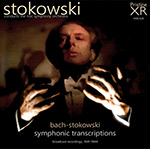
BACH-STOKOWSKI Symphonic Transcriptions
1. Toccata and Fugue in D minor (9:57)
Broadcast of 12 December 1943
2. Prelude in E flat minor (from The Well-Tempered Clavier, Book 1) (7:02)
Broadcast of 4 November 1941
3. Arioso (Largo from Harpsichord Concerto No. 5 in F minor) (8:35)
Broadcast of 25 November 1941
4. Prelude on Ein Feste Burg (6:54)
Broadcast of 7 April 1942
5. Wir Glauben all' an Einen Gott (Chorale-Prelude 'Giant Fugue') (3:09)
6. Adagio (from Toccata, Adagio and Fugue in C minor) (5:32)
Broadcast of 6 December 1942
7. Es ist Vollbracht (from the St. John Passion) (9:23)
Broadcast of 28 March 1943
8. Christ lag in Todesbanden (Chorale-Prelude) (3:57)
Broadcast of 12 December 1943
9. Passacaglia and Fugue in C minor (13:50)
Broadcast of 27 February 1944
Bonus track:
10. St. Matthew Passion - Final Chorus (8:52)
"Here yet awhile, Lord, Thou art sleeping, Hearts turn to Thee, O Saviour blest"
Collegiate Chorale
Broadcast of 31 March 1942
NBC Symphony Orchestra
conducted by Leopold Stokowski
XR Remastered by Andrew Rose
Cover artwork based on a photograph of Leopold Stokowski
Special thanks to Edward Johnson
Total duration: 77:11