
This album is included in the following sets:
This set contains the following albums:
- Producer's Note
- Full Track Listing
- Cover Art
The chief source for this release was a c.1957 Westminster LP. A particularly good copy of an excellent set of recordings, it was further enhanced by XR remastering. The final Trio, No. 23 in E flat, was sourced from a British HMV release, licensed by EMI from Westminster (it appeared on XWN 18611) as a side-two filler to the ensembles recording of Schubert's Trio No. 2 in E flat.
If anything, the earlier Westminster pressing was superior to the HMV disc, though both were pretty immaculate. The main difficulty faced here was simple identification of the trios - Haydn wrote a good number, and as with much of his output there is confusion both in terms of numbering, order of composition, and possibly even how many he actually wrote.
The numbering here is based on renowned Haydn scholar H. Robbins Landon's ordering, which bears no relation to the numbering on the LPs (which did not list the Hoboken numbers) - Westminster numbered these in the following order::, No 1, No. 28, No. 30 and No. 17. Finally, the first movement of Trio No. 23 is listed here as Allegro moderato, which is how it appears on a recent issue by the Beaux Arts Trio. It is marked on HMV's LP as Andante - yet the present tempo is noticeably swifter than that of the Beaux Arts...
Andrew Rose
FOURNIER, JANIGRO & BADURA-SKODA Haydn: Four Piano Trios (1952)
HAYDN Piano Trio No. 39 in G major, HOB XV:25
1. I. Andante (7:03)
2. II. Poco adagio (5:39)
3. III. Rondo all'ongarese — Presto (3:31)
Recorded in 1952
Transfers from Westminster XWN18610 9) and HMV XLP 20067
Transfers and XR remastering by Andrew Rose at Pristine Audio, May-July 2010
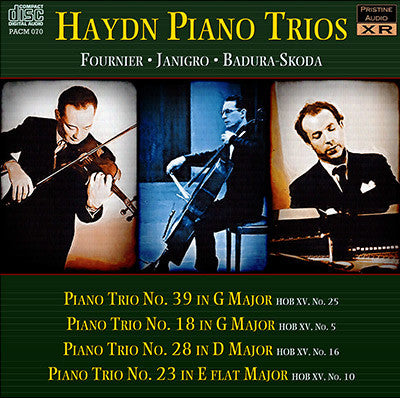
Cover artwork based on photographs of Fournier, Janigro and Badura-Skoda
HAYDN Piano Trio No. 18 in G major, HOB XV:5
4. I. Adagio non tanto (4:11)
5. II. Allegro (6:50)
6. III. Allegro (3:08)
HAYDN Piano Trio No. 28 in D major, HOB XV:16
7. I. Allegro (5:40)
8. II. Andantino più tosto Allegretto (3:48)
9. III. Vivace assai (4:34)
HAYDN Piano Trio No. 23 in E flat major, HOB XV:10
10. I. Allegro moderato (5:17)
11. II. Presto (4:15)
Total duration: 53:56
Jean Fournier, violin
Paul Badura-Skoda, piano
Antonio Janigro, cello
Fanfare Review
These
are the recordings from which I first learned Haydn trios, on
Westminster LPs XWN 18610 and 18611. Which means, of course, that I am
biased toward the performances. But let’s try to be analytical about
them. These three artists all had important solo careers in Europe,
where they were considered among the top rank. They also had much
experience as an ensemble, as testified by their Westminster recordings
of much of the piano trio repertoire: Mozart, Haydn, Beethoven,
Schubert, and Brahms. Aided by natural-sounding Westminster recordings,
their “Archduke” and Schubert trios were the preferred recordings of the
1950s; I still have two of those three LPs on my shelves and have never
found a preferable Schubert E♭.
These late mono recordings,
c.1957, do not yet reflect the period-instrument movement, which had
begun to make waves in Vienna with H. C. Robbins Landon’s Haydn Society
productions. Nevertheless, these artists were sensitive musicians, and
their Haydn is consistent with the period; in Hob. XV:25 perhaps closer
to Beethoven than to Mozart. Paul Badura-Skoda’s playing has something
of the joie-de-vivre of Menahem Pressler of the Beaux Arts Trio. But
Pressler’s pearly tones dominate those performances, whereas all three
artists contribute equally here. Only in Haydn’s late trios does the
cello become a full partner, but Antonio Janigro makes the most of his
part in every one.
Pristine’s Andrew Rose has replicated
Westminster’s trademarked “Natural Balance” honestly and accurately.
Although this disc may be most appreciated by those with nostalgia for
the originals, no serious record collector could go wrong with it. For
those who prefer “complete” sets, I recommend Haydn Trio Eisenstadt—also
on modern instruments—on eight inexpensive Phoenix Edition CDs
(Fanfare 32:5). James H. North
