
This album is included in the following sets:
This set contains the following albums:
- Producer's Note
- Full Track Listing
- Cover Art
“A third pianist who has been more and more active on the recording scene is the Czech-born Rudolf Firkušný, whose latest Capitol disk is devoted to popular pieces by Debussy.
The word that comes to mind to describe Firkušný’s playing here is "fresh.” He is poised, rhythmically alert and completely to the point. Never does he over-pedal, and never does he hold back or resort to a dubious emotional effect. There is something absolutely dewy about these clean-sounding performances and the ultra-efficient, tasteful manner in which Firkušný makes his points. The quality of recorded sound, too, is extraordinarily lifelike.
It might be well to point out that Firkušný’s Debussy is quite different from that of a great exponent like Gieseking. Gieseking was the impressionist par excellence, and he probably knew more about pedal technique than any living pianist. Firkušný eschews pedal effects and relies more upon finger work and a sparer texture. He does not achieve the color effects that Gieseking obtained, but what he does achieve adds up to some of the most natural-sounding and pianistic Debussy playing that this listener has heard in a long time.”
Harold C. Schonberg, The New York Times, 26 October, 1958
“Gieseking has cornered the market in Debussy recordings. Firkušný, a versatile and often subtle pianist, plays the Estampes very attractively, with an excellent grasp of their diverse rhythms and motions, using a subdued, delicate but not dull palette. But his readings are not fired by the genius that informs Gieseking’s performance (on Columbia 33CX1137), which is compound of beauties in pedalling, touch, and inflection, and sounds far more evocative. Firkušný’s Children's Corner Suite is slightly lacking in imaginative flair (lasting only 15½ minutes, it takes one whole side, which is pretty poor value for a 12-inch LP), Gieseking’s superlative account of the Suite Bergamasque, issued on 78s and then withdrawn, still awaits microgroove publication. Impatient people, who already have the Children’s Corner and Estampes, will probably be tempted by the Decca MP, LW5278, on which Friedrich Gulda plays the Suite in a shapely way. Firkušný, like Gulda, makes the elements of claveciniste pastiche the starting-point of his interpretation, but he comes nearer than the Austrian pianist to finding the sudden romantic flecks and gleams which Gieseking realised so perfectly. He plays Clair de lune very well. Admirable recording.”
Andrew Porter, The Gramophone, November 1957
Rudolf Firkušný made two LP sets of music by Debussy in the 1950s for Capitol. Alas despite making these recordings in 1956 and 1958, both were mono, and to modern ears sound somewhat flat and dull as a result both of this and of the microphone used at the time. These Ambient Stereo XR remasters offer significant sonic improvements to both sets of recordings, as well as correcting some wavering pitch issues which affected both releases.
Andrew Rose
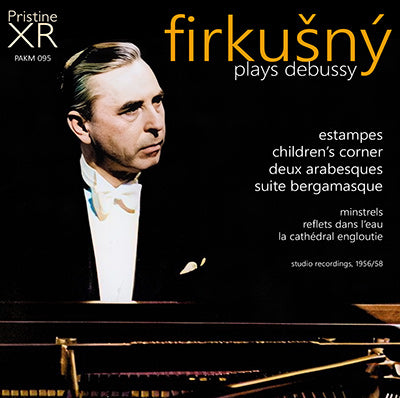
FIRKUŠNÝ plays Debussy
DEBUSSY Suite Bergamasque
1. Prélude (3:48)
2. Menuet (3:39)
3. Clair de lune (4:37)
4. Passepied (3:37)
DEBUSSY Estampes
5. Pagodes (4:49)
6. La soirée dans Grenade (5:12)
7. Jardins sous la pluie (3:50)
DEBUSSY Children's Corner
8. Doctor Gradus ad Parnassum (2:16)
9. Jimbo's Lullaby (3:31)
10. Serenade for the Doll (2:46)
11. The Snow Is Dancing (2:11)
12. The Little Shepherd (2:16)
13. Golliwog's Cake-walk (2:46)
14. DEBUSSY Images, livre 1 - 1. Reflets dans l'eau (4:28)
DEBUSSY Deux arabesques
15. 1. Andantino con moto (3:45)
16. 2. Allegretto scherzando (3:14)
DEBUSSY Préludes, livre 1
17. 10. La cathédrale engloutie (6:38)
18. 12. Minstrels (1:58)
Rudolf Firkušný, piano
XR remastering by Andrew Rose
Cover artwork based on a photograph of Rudolf Firkušný
Recorded Studio A, Capitol 46th St. Studios, New York City
Tracks 1-13: 10, 11, 22 May 1956
Tracks 14-18: 23, 24, 27 January 1958
Total duration: 65:21
MusicWeb International Review
This release should play a major role
Rudolf Firkušný (1912-1994) studied with Cortot and Schnabel, and was a protégé of Janáček, of whom he said: “It was not piano but music I studied with him.” In 1939, he fled to Paris and then New York. He became an American citizen.
Firkušný’s extensive discography includes Mozart, Beethoven, Schumann, Brahms, Dvořák, Debussy, Janáček, Mussorgsky, Barber and Martinů. With such breadth of taste and repertoire, he may be regarded as not a specialist in any area: an all-rounder with no distinctive voice or special affinity with composers or periods. This would be a sad mistake. If one is as fine a musician as Firkušný, “all-rounder” can only be a compliment.
From the opening Prélude of Suite Bergamasque , I am struck by the musical intelligence, the unfussy artistry. Clair de lune , played without languor or sentimentality, observes the tempo marking of Andante très espressif. If we take the successive movements of Children’s Corner , we hear delicacy, lucidity, naturalness, subtlety, undemonstrative musicianship, then ruggedness in Golliwog’s Cakewalk .
In the first of the Arabesques , Firkušný plays the opening bars with fluidity and grace. I cannot remember feeling the same “breath of fresh air” quality in other performances. One might wish for a more overwhelming climax in La cathédrale engloutie , but this is a richly satisfying performance.
Firkušný’s keyboard artistry makes one forget technical aspects. One simply appreciates the seemingly effortless and quietly authoritative relationship with the instrument. All performances on this valuable disc are rewarding, all distinguished by that “to live with” quality which invites repeated listening. Why, then, do I feel that Firkušný is generally overlooked?
Obviously, the many pianists of today who might be described as technically dazzling will always attract more excitement seekers. Those who prefer Michelangeli’s steely magnificence cannot be scorned. But, as with any great composer, there is more than one valid approach. Without drawing attention to himself, Firkušný allows us to listen to Debussy in pure, unadorned performances free from mannerism. The Cypriot Martino Tirimo, who has recorded the complete Préludes, comes to mind as another pianist who exudes selfless authority and admirable musicianship.
In my Debussy collection I have – and would not be without – Cortot, Gieseking, Michelangeli, Tirimo, Weissenberg and Jacobs, and a few others less indispensable. Firkušný will belong in the first group.
Pristine Audio have achieved their usual transformation in a fine remastering of recordings from the 1950s. I happily recommend this disc, and feel sure that it will awaken or reawaken many to the outstanding qualities of a great musician.
Philip Borg-Wheeler
MusicWeb International
