
This album is included in the following sets:
This set contains the following albums:
- Producer's Note
- Full Track Listing
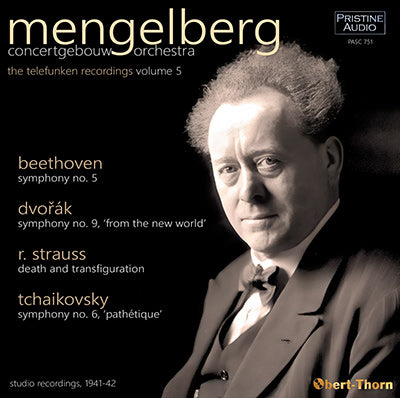
- Cover Art
In celebration of the 150th anniversary of the birth of Willem Mengelberg (28 March 1871), Pristine continues its series of releases surveying the conductor’s recordings with the Concertgebouw Orchestra for Telefunken, the label for which he made the bulk of his commercial discs. They are being presented in roughly chronological order, with this fifth and penultimate volume featuring recordings Mengelberg made in 1941 and 1942. Due to timing limitations on the CD version of this release, Death and Transfiguration is presented following the Tchaikovsky symphony rather than just before the Beethoven, which was its original recording order.
Our present program begins the day following the recording session for Strauss’ Ein Heldenleben which concluded our previous release (PASC 719). The Tchaikovsky Pathétique was a remake of one of Mengelberg’s earliest Telefunken sets (reissued in PASC 624). The biggest interpretational difference between this version from 1937 and the one presented here is in the final movement, which is nearly a minute longer in the later recording, and more appropriately “lamentoso”. Another reason for wanting to remake the set may have been a prominent 50 Hz mains hum, removed from the Pristine restorations, which afflicted all of the conductor’s 1937 Telefunken sessions.
The two days following the Tchaikovsky session were devoted to Mengelberg’s only commercial recording of a work by Dvořák, the New World Symphony (although a 1943 air check exists of a live performance of the composer’s Violin Concerto with soloist Maria Neuss). This very individualized interpretation features an extraordinarily expansive Largo movement. Unfortunately, it suffers from a higher-than-usual complement of surface noise, probably inherent in the masters, as it appears on all copies of which I am aware.
That defect may have been the reason for the non-release of two other tantalizing titles from this group of sessions: a complete recording of the Beethoven Second Symphony, made immediately following the Dvořák on April 24th; and what would have been Mengelberg’s only Sibelius recording, Finlandia, set down the following day. Just before the Sibelius came the recording of Borodin’s In the Steppes of Central Asia, a title common on American Capitol’s dubbed 78 rpm version, but rare in its original Telefunken appearance, used for transfer here.
It would be another year before Mengelberg and the Concertgebouw Orchestra recorded for Telefunken again, and this time their efforts were more consistently successful from a technical point of view. The 1942 sessions began on April 14th with Richard Strauss’ Death and Transfiguration. It is odd that one of Strauss’ greatest interpreters, the one to whom the composer dedicated Ein Heldenleben, left so few recordings of his works. Besides two versions of Heldenleben (New York and Amsterdam), there was only a studio and a live version of Don Juan to attest to his abilities with this repertoire.
The following day, Mengelberg set down a remake of his first recording for Telefunken, the Beethoven Fifth Symphony (PASC 624). In addition to the hum in the 1937 version, there were also a couple ensemble issues that the conductor might have wanted to clean up. Like the previous year’s Beethoven Second and Finlandia, Telefunken never issued it on 78 rpm; but unlike those lost recordings, a release was made by the American Capitol label in the early 1950s on all three formats then in use (78, 45 and LP), dubbed from vinyl test pressings.
However, there was no indication on the Capitol releases that it was the remake from 1942; and as late as 1994, it continued to be reissued on CD by Telefunken, erroneously identified as the 1937 recording. The confusion has only been sorted out in the past couple decades as correctly-attributed reissues of both versions have allowed for comparison. The present transfer has been made from the original Capitol LP, while all other restorations on this release have come from original Telefunken 78s.
Mark Obert-Thorn
MENGELBERG Telefunken Recordings, Volume 5
CD 1 (67:40)
TCHAIKOVSKY Symphony No. 6 in B minor, Op. 74 ‘Pathétique’
1. 1st Mvt.: Adagio – Allegro non troppo (16:58)
2. 2nd Mvt.: Allegro con grazia (8:19)
3. 3rd Mvt.: Allegro molto vivace (8:49)
4. 4th Mvt.: Adagio lamentoso (9:36)
Recorded 22 April 1941 ∙ Matrices: 022666-IV, 022667-III, 022668-III, 022669-II, 022670-II, 022671-III, 022672-IV, 022673-III, 022674-II & 022675-III ∙ First issued on Telefunken SK 3176/80
5. R. STRAUSS Death and Transfiguration, Op. 24 (23:55)
Recorded 14 April 1942 ∙ Matrices: 026403/8 ∙ First issued on Telefunken SK 3738/40
CD 2 (77:48)
DVOŘÁK Symphony No. 9 in E minor, Op. 95 ‘From the New World’
1. 1st Mvt.: Adagio – Allegro molto (8:36)
2. 2nd Mvt.: Largo (12:59)
3. 3rd Mvt.: Scherzo: Molto vivace (7:29)
4. 4th Mvt.: Finale: Allegro con fuoco (10:26)
Recorded 23-24 April 1941 ∙ Matrices: 025649/58 ∙ First issued on Telefunken SK 3190/4
5. BORODIN In the Steppes of Central Asia (7:11)
Recorded 25 April 1941 ∙ Matrices: 025667/8 ∙ First issued on Telefunken SK 3198
BEETHOVEN Symphony No. 5 in C minor, Op. 67
6. 1st Mvt.: Allegro con brio (7:51)
7. 2nd Mvt.: Andante con moto (9:13)
8. 3rd Mvt.: Allegro (5:12)
9. 4th Mvt.: Allegro (8:48)
Recorded 15 April 1942 ∙ Matrices: 022110-II, 022111-II, 022112-II, 022113-I, 022114-I or VII, 022115-II or VI, 022116-I or X & 022117-I or III ∙ First issued on Capitol P-8110 (LP)
Concertgebouw Orchestra of Amsterdam
conducted by Willem Mengelberg
Producer and Audio Restoration Engineer: Mark Obert-Thorn
Special thanks to Nathan Brown and Charles Niss for providing source material
All recordings made in the Grote Zaal, Concertgebouw
Total duration: 2hr 25:28
Fanfare Review
The pace never drags, and the visceral intensity of the string playing in particular is unique
Willem Mengelberg made most of his studio recordings with the Concertgebouw Orchestra for the Telefunken label. In 2021, in honor of the 150th anniversary of the conductor’s birth, Pristine began a project of releasing all the Telefunken material. This fifth volume includes records made in 1941 and 1942.
For serious Mengelberg collectors I can report that Mark Obert-Thorn’s restorations are, in a word, stunning. I have these recordings in a variety of prior releases, ranging from Capitol LPs to CDs on Teldec, Q-Disc, and Naxos. Obert-Thorn has surpassed even his own earlier work for Naxos, because the technology keeps improving. The sound on these two discs has impact, richness of color, and warmth of string tone exceeding earlier versions. If you are a Mengelberg enthusiast, this release becomes self-recommending.
The Tchaikovsky Sixth Symphony and Beethoven Fifth are remakes of Telefunken recordings he made with the Concertgebouw in 1937. As performances both seem to me superior to the earlier versions, perhaps because Mengelberg was becoming more comfortable with the recording process. Certainly the sound quality is significantly better as engineers developed greater knowledge about microphone placement. The Strauss, Dvořák, and Borodin are Mengelberg’s only recordings of those pieces.
All of these recordings have been reviewed in Fanfare and appear in the magazine’s online Archive. No doubt most readers have already formed their opinions about Mengelberg. Some find his interpretive interventions excessive and willful; others find his interpretations vital, imaginative, and deeply engaging. I am firmly in that second category. No one, however, can argue with the fact that he molded the Concertgebouw into one of the world’s greatest orchestras over his 50 years of leadership.
Mengelberg’s interpretive idiosyncrasies are most apparent here in the Beethoven Fifth. Modern listeners are not used to the kind of dramatic tempo changes and underlining of key phrases that he brings to the score. For me, his ideas work because they are executed with utter conviction and because the symphony’s dramatic momentum is never broken. Yes, Mengelberg employs considerably more rubato in the second movement than usual, but he imparts a certain beauty while creating a strong contrast with the first movement.
I’m not convinced that this is antithetical to Beethoven’s intentions. The rest of the performance is dramatic, even theatrical, but never excessively so. Mengelberg’s handling of the transition from the Scherzo to the finale is explosive. His tendency to slow down before big moments will upset purists and others, but if you are open to the old-fashioned Romanticism that permitted such freedom, you just might find it exhilarating. This remake is from April 15, 1942. The 1937 recording has already been issued in this series (PASC 624). By comparison the orchestral playing is crisper and neater, and the overall sound is richer.
The remaining works are typically viewed as being more accommodating to Mengelberg’s approach. The Tchaikovsky “Pathétique” remake is from 1941. It is more flexible than the 1937 recording, particularly in the finale, which might well be the result of Telefunken providing longer sides for the 78-rpm sets. Mengelberg’s conducting is slower and less rigid here, and the strings are captured with a warmer sonority.
The Dvořák “New World” Symphony receives a performance here of great flexibility. The Largo is on the slow side, but not excessively so, and is treated with a yearning lyricism and a greater degree of rubato than is the norm. The rest of the work is played with drama and urgency, a sense of involvement that is not always the case in an oft-played work. Obert-Thorn’s transfer is in a completely different league than either the Andromeda or the Teldec CDs.
Mengelberg was a friend and supporter of Richard Strauss, but he recorded surprisingly little of his music: two versions of Ein Heldenleben and one each of Don Juan and Tod und Verklärung . There is also a live Don Juan and some acoustical fragments of Tod und Verklärung . This 1942 Tod und Verklärung is shattering in its power. At 23:55 minutes the timing is slower than most recordings but similar to Furtwängler and even Solti. The pace never drags, and the visceral intensity of the string playing in particular is unique. Borodin’s In the Steppes of Central Asia is a lovely extra, supple and colorful.
It is important that these historical documents of an earlier style of orchestral playing and conducting are preserved and restored at the highest possible technical level. Pristine deserves enormous credit for the quality of their work. Their recordings are available from their website, pristineclassical.com, as CDs and in various digital formats for downloading.
Henry Fogel
Fanfare, Mar/Apr 2026
