
This album is included in the following sets:
This set contains the following albums:
- Producer's Note
- Full Track Listing
- Cover Art
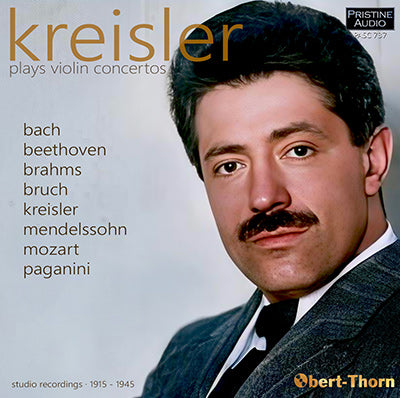
This release celebrates the 150th anniversary of the birth of Fritz Kreisler (February 2, 1875 –January 29, 1962) by presenting his complete repertoire of violin concertos recorded for release on disc. While he was to remake the Mozart, Beethoven, Mendelssohn and Brahms works in London during the latter half of the 1930s, the earlier versions offered here are generally considered to be his best.
Kreisler’s first concerto recording, the Bach “Double”, made a month before he turned forty, has the distinction of being the first violin concerto recording ever made. Only slightly cut to fit three 12-inch 78 rpm sides, it was much more complete than the only previous attempt at a concerto recording, Wilhelm Backhaus’ 1909 version of the Grieg, which had been slashed to two sides. Although the work was then hardly known, it seemed a perfect fit for the limitations of the time: it was short, and could be recorded nearly complete with minimal forces. The one-to-a-part string quartet backing even had the advantage, in hindsight, of having rather HIP proportions. Partnering Kreisler here was the 25-year-old Russian-born, Auer-trained Efrem Zimbalist, whose style made for an interesting contrast with Kreisler’s Viennese tradition.
It would be nearly a decade before Kreisler returned to the studio for another concerto recording, which turned out to be two within the course of a month. Sir Landon Ronald’s backing for the Mozart seems overly-romanticized by today’s standards, but matches Kreisler’s portamento-laden solo performance – beautiful, if more than a little anachronistic. The Bruch Concerto fares better from the violinist’s approach, which makes it doubly regrettable that it remained unissued until the 1970s. The only surviving test pressings of the set, given by Kreisler to Elgar, are now housed in Yale University, which was the source used for the present restoration.
Following these recordings are two frustrating “might-have-beens”: movements from the Tchaikovsky Concerto and Lalo’s Symphonie espagnole which were recorded with piano accompaniment and which, like the Bruch Concerto, were never issued, possibly for the same reason. The Lalo was recorded the month after the Bruch, just as electrical recording was beginning to take hold; and the hope might have been that Kreisler would get around to recording the entire works using the new technology, which unfortunately never occurred.
The Beethoven and Mendelssohn concertos were made almost exactly two years later, at the end of 1926 in Berlin. Although electrical recording was now the norm, the practice of reinforcing the timpani and string basses using a tuba to support the lower frequencies on early playback devices continued, as can be heard in the Beethoven, particularly during the opening of the first movement and just after the third movement cadenza.
Nevertheless, and despite the somewhat recessed placement of the orchestra, the new technology captured a great deal of detail and presence. Blech’s accompaniment is leisurely on both concertos; but this pays dividends in Kreisler’s performance, particularly in the first movement section of the Beethoven starting around 12:27, where time seems to stand still during Kreisler’s plaintive, sehnsucht-filled playing. The Brahms from eleven months later was the last recording Kreisler made with Blech. While from a technical standpoint the sound is less clean and clear compared to the 1926 sessions, the performance itself is quite fiery and intense.
Kreisler’s next concerto sessions, delayed due to the ensuing Depression, moved to London, where he remade the Mendelssohn under Ronald in April, 1935, and the Beethoven and Brahms under Barbirolli in June, 1936. In December of the latter year, he was in Philadelphia for Eugene Ormandy’s first recording session with the orchestra to which he had been named co-conductor with Stokowski. On the program was Kreisler’s arrangement of the first movement of Paganini’s First Concerto into a self-contained single movement work. Victor’s relative inexperience at the time with concerto recording was actually an advantage here, as Kreisler was not spotlight-miked, but recorded with the same balance as he would have been heard by an audience in the Academy of Music. Kreisler’s arrangement turns the work into the kind of delightful Viennese confection he might have composed from scratch himself.
Kreisler made one more concerto recording in London (a remake of the Mozart, done with Malcolm Sargent in February, 1938) before focusing the remainder of his recording activities in America. His last concerto set was made in May, 1945 when he was seventy years old, with his frequent collaborator from The Telephone Hour radio program, Donald Voorhees, conducting.
Earlier in his career, Kreisler had become somewhat infamous for his “musical forgeries” of works attributed to then little-known Baroque composers which were in fact his own concoctions, a practice which he had begun in an attempt to avoid filling his recital programs with his own name, and which he had owned up to in 1935 to the amusement of many and the outrage of some (mainly critics). His 1927 concerto originally credited to Vivaldi we now know sounds very little like the Italian composer, although that familiarity postdates even this late recording. Although Kreisler’s technique was beginning to falter at this stage in his career (as can be heard on some of his radio recordings of the time), especially after his injuries due to a 1941 car accident, he acquits himself well in this final concerto performance on disc.
Mark Obert-Thorn
KREISLER plays Violin Concertos
Disc 1: Acoustic Recordings, 1915 – 1925 (69:39)
J. S. BACH Concerto in D minor for two violins, BWV 1043
1. 1st Mvt. – Vivace (3:48)
2. 2nd Mvt. – Largo ma non tanto (4:59)
3. 3rd Mvt. – Allegro (4:57)
Efrem Zimbalist, violin 2 / String Quartet (Howard Rattay, violin 1;
Pasqualli Bianculli, violin 2; John Fruncillo, viola; Rosario Bourdon, cello) conducted by Walter
B. Rogers
Recorded 4 January 1915 in the Victor Studios, Camden, New Jersey ∙
Matrices: C 15560-4, 15561-3 & 15562-2 ∙ First issued on Victor 76028/30
MOZART Violin Concerto No. 4 in D major, K218 (Cadenzas: Kreisler)
4. 1st Mvt. – Allegro (9:11)
5. 2nd Mvt. – Andante cantabile (8:32)
6. 3rd Mvt. – Andante grazioso – Allegro ma non troppo (8:37)
Orchestra conducted by Sir Landon Ronald
Recorded 1-2 December 1924 in the HMV Studios, Hayes ∙ Matrices: Cc 5396-2,
5397-1, 5398-3, 5399-1, 5400-1, 5401-2, 5408-1 & 5409-1 ∙ First issued
on HMV DB 815/8
BRUCH Violin Concerto No. 1 in G minor, Op 26
7. 1st Mvt. – Introduction: Allegro moderato (7:20)
8. 2nd Mvt. – Adagio (7:32)
9. 3rd Mvt. – Finale: Allegro energico (6:38)
Orchestra conducted by Eugene Goossens
Recorded 29-30 December 1924 and 2 January 1925 in the HMV Studios, Hayes ∙
Matrices: Cc 5508-3, 5509-1, 5510-3, 5511-3, 5512-7 & 5513-4 ∙ Unissued
on 78 rpm
TCHAIKOVSKY Violin Concerto in D major, Op. 35
10. 2nd Mvt. – Canzonetta (4:02)
Carl Lamson, piano
Recorded 24 January 1924 in the Victor Studios, Camden, New Jersey ∙ Matrix:
C 29401-2 ∙ Unissued on 78 rpm
LALO Symphonie espagnole in D minor, Op. 21
11. 2nd Mvt. – Scherzando (3:57)
Carl Lamson, piano
Recorded 13 February 1925 in the Victor Studios, New York City ∙ Matrix: C
31947-3 ∙ Unissued on 78 rpm
Disc 2: Electric Recordings, 1926 (71:41)
BEETHOVEN Violin Concerto in D major, Op. 61 (Cadenzas: Kreisler)
1. 1st Mvt. – Allegro ma non troppo (24:03)
2. 2nd Mvt. – Larghetto (10:26)
3. 3rd Mvt. – Rondo: Allegro (10:20)
Berlin State Opera Orchestra conducted by Leo Blech
Recorded 14-16 December 1926 in the Singakademie, Berlin ∙ Matrices: CwR
631-1A, 632-2, 633-1A, 634-4A, 635-2, 636-3A, 637-2A, 638-2, 639-3A, 640-2
& 641-2A ∙ First issued on HMV DB 990/5
MENDELSSOHN Violin Concerto in E minor, Op. 64
4. 1st Mvt. – Allegro molto appassionato – Presto (12:10)
5. 2nd Mvt. – Andante (7:48)
6. 3rd Mvt. – Allegretto non troppo – Allegro molto vivace (6:52)
Berlin State Opera Orchestra conducted by Leo Blech
Recorded 9-10 December 1926 in the Singakademie, Berlin ∙ Matrices: CwR
614-2A, 615-1A, 616-1A, 617-1A, 618-2A, 619-2A & 620-3 ∙ First issued on
HMV DB 997/1000
Disc 3: Electric Recordings, 1927 – 1945 (66:12)
BRAHMS Violin Concerto in D major Op. 77 (Cadenzas: Kreisler)
1. 1st Mvt. – Allegro ma non troppo (20:50)
2. 2nd Mvt. – Adagio (7:48)
3. 3rd Mvt. – Allegro giocoso ma non troppo (8:14)
Berlin State Opera Orchestra conducted by Leo Blech
Recorded 21, 23 & 25 November 1927 in the Singakademie, Berlin ∙
Matrices: CwR 1355-3, 1356-3, 1357-1, 1358-4, 1366-2, 1367-4, 1368-2, 1369-3
& 1376-5 ∙ First issued on HMV DB 1120/4
4. PAGANINI (arr. Kreisler) Concerto in One Movement (17:32)
(Arranged from the first movement of Violin Concerto No. 1 in D major, Op.
6)
The Philadelphia Orchestra conducted by Eugene Ormandy
Recorded 13 December 1936 in the Academy of Music, Philadelphia ∙ Matrices:
CS 03149-1, 03150-1, 03151-2 & 03152-2 ∙ First issued on Victor 14420/2
in album M-361
KREISLER Violin Concerto in C major (in the style of Vivaldi)
5. 1st Mvt. – Allegro energico ma non troppo (4:49)
6. 2nd Mvt. – Andante doloroso (4:04)
7. 3rd Mvt. – Allegro molto (2:52)
Victor String Orchestra conducted by Donald Voorhees
Recorded 2 May 1945 in the Lotos Club, New York City ∙ Matrices:
D5-RC-949-2A, 950-2 & 951-2A ∙ First issued on RCA Victor 11-9264/5 in
album M-1070
Fritz Kreisler, violin
Producer and Audio Restoration Engineer: Mark Obert-Thorn
Special thanks to Ward Marston and the Yale Collection of Historical Sound
Recordings (Mark Bailey, director) for providing source material
Total duration: 3hr 27:33
Review
The reading from Kreisler is predictably magnificent. He actually played chamber music with Brahms so we are hearing real authenticity here
Have you missed one of the major musical anniversaries of 2025? Viennese violinist Fritz Kreisler, born 150 years ago, a major recording artist in the acoustic and electrical ages. Historic remastering experts Pristine Classical celebrate with Kreisler's complete recorded concerto repertoire, and where there are repeats, they've gone with the earlier ones from the 1920s, confident that Mark Obert-Thorn's restorations of Kreisler in his prime can compensate for the recording technology.
We end up with a portrait of one of the first 'moderm' violinists, from ther Bach Double with Efram Zimbalist in 1915 - the first violin concerto recording ever made - to Kreisler's own concerto in the style of Vivaldi in 1945, aged 70, his technique diminished but not the powerful charm of his playing. Old-fashioned Mozart from 1924, the Bruch Concerto from the test pressings Kreisler gave to Elgar, plus tantalising movements of Tchaikovsky and Lalo recorded with piano. We leap into the electrical age with Beethoven and Mendelssohn in Berlin in 1926, and fiery Brahms a year later. Remarkably good sound, and a fitting tribute to one of the greats. ****
Record collectors in the pre-LP days were brought up to hold certain creeds dear. Pablo Casals for Bach, Artur Schnabel in Beethoven, Cortot for Chopin’s Preludes and Ballades, Rubinstein for the Nocturnes and Scherzi; yes, it could get rather complicated! The great Fritz Kreisler was the senior of all these greats and his Beethoven and Brahms concerti in the HMV catalogue were self-recommending. Record aficionado, engineer and music lover Mark Obert-Thorn has worked on the Kreisler concerto records before but never as effectively and with such great results as here in this new set published by Pristine to coincide with the sesquicentennial of the great violinist.
Born in 1875, his huge talent on the violin was spotted early and he was admitted to the Vienna Conservatory at the age of seven. As part of his studies, he took classes in composition with Bruckner. At the age of ten, he won a scholarship to study in Paris where alongside working with some inspiring violinists he took further theoretical study with Delibes. In his teens, he toured America before returning to Austria. As with many child prodigies, he was pulled away from music at times in his late teens, flirting with medicine for a while. By his early twenties, however, Fritz Kreisler was back in the zone and ready to establish himself on the concerto circuit around Europe.
Kreisler played in the greatest concert halls of the world and in 1910 he premiered the Elgar Violin Concerto which had been written for him. At the outbreak of war in Summer 1914, he was commissioned into the army of the Austro-Hungarian Empire and served near Lviv (then Lemberg) in Galicia, fighting the Russians. He was bayoneted and discharged. It had been indeed, quite an eventful career when in 1915, Kreisler relocated to New York (at that stage the US were neutral in the European conflict).
That year in the Victor studios in Camden, New Jersey, he played in the first ever concerto recording, a Bach work, with fellow violinist Efrem Zimbalist. Zimbalist was Kreisler’s junior by 14 years and the husband of the soprano Alma Gluck (an adorable voice). Zimbalist was trained in the school of Leopold Auer (alumni includes Elman, Heifetz and Milstein). The three sides containing Bach’s concerto for two violins and “orchestra” are obviously acoustically recorded. The process involved the musicians crowding around a large horn, the other end of which, in response to sonic vibrations was cut laterally a master disc. The acoustic process, which worked well for singers and reasonably for mid-frequency instruments, was not so great with higher or lower frequencies. The violin’s timbre was always problematic.
The two soloists blend really well together despite their differing temperaments. There is just too much portamento for me especially in the slow movement. They are joined by a string quartet in place of the orchestral accompaniment. Although, not strictly fair in this case, as it is a much later electrical recording (and is uncut), English Columbia recorded in 1937 a version with Hungarians Joseph Szigeti and Carl Flesch (his only major recording). That version made in London with Walter Goehr is my favourite version on 78s. It is available on a Naxos CD transferred by the same Mark Obert-Thorn (review) or in a later Pristine transfer by him. Ward Marston is responsible for the HMV’s of Menuhin and Enescu also on Naxos, a very famous pre-war version of the work. It is good to have this new tidied up version of the Kreisler/Zimbalist Bach Double though, it is an important historic document.
There are more acoustics to come, but they date from a good deal later and the sound is much better. In 1924, at HMV Hayes, Kreisler made Mozart’s Violin Concerto No. 4 in D. The following year the recording industry started recording electrically (microphones). This set of four 12-inch records (HMV DB 815/8) was soon deleted in the mad-dash to get records out in the new format. Copies are thus rare and Pristine have found some really nice sources here. Kreisler is elegance personified. His phrasing is exquisite and the violin is captured remarkably well. Obviously, Kreisler remade the record electrically in 1939, again in London for HMV. That time, they managed to squeeze it onto six sides. In between, Joseph Szigeti (as Kreisler’s main competitor on record, you’ll see his name a few more times in this review) recorded it with Sir Thomas Beecham’s new LPO in 1934 for Columbia. It is a lovely version.
Since Mark Obert-Thorn originally worked on these Kreisler records for Naxos 25 years ago, the technology available to transfer engineers has improved markedly. For Pristine he used a de-clicking software that allowed him to edit the sources within specific frequency bands. This means that extraneous noises and bumps from the studio or the pressing can be removed without touching the musical picture at all. He also used a snazzy module to eliminate swish from those rapidly spinning shellacs. Mark estimates that in the next record of the Bruch concerto he manually removed at least 1600 swishes (21.5 minutes of music x 78 revolutions per minute = 1677). That’s what I call job commitment!
Perhaps the motivation to work so diligently by hand on the Bruch Violin Concerto No. 1 may have been due to the legendary status of that record. It exists in only one known copy in the whole world. The six sides were never approved for release, the metals scrapped and the test copies given by Kreisler to Elgar. They now reside at Yale. I compared this transfer with the Naxos and it is far cleaner now. The tiny groove slip (2:22) seems vanished now too. Kreisler’s lovely warm subtle vibrato and his magical rubato is well caught and the seemingly easeful manner of his bowing is a marvel to hear. Kreisler played the Bruch 2 regularly in concert as well as its more popular cousin. There was never any realistic chance that HMV would have risked the expense of recording that however. In fact, Kreisler never remade the first concerto in the electric era, making this unique version all the more special.
The other complete works on this set are all electrics and Pristine present the three classic concertos by Beethoven, Mendelssohn and Brahms in their first Berlin versions. Connoisseurs of the violinist always did prefer these earlier records to their remakes. For me personally, with these electrically recorded 78s, it is as if a window has been opened and I can now experience the Kreisler sound as it really was with no recession and with all the frequencies audible.
Kreisler’s Beethoven came out on HMV DB 990/5 (11 sides with a Bach solo as filler). It is a generously paced performance. Leo Blech is in no rush at all leading his Berlin Staatsoper forces in an account 45 minutes in length. Kreisler sounds completely relaxed and his playing is effortless. Truly this is the art which conceals art. Listen to his quiet phrasing of the passages beginning at 12:35. His bel canto style seduces one, as if a spell has been cast and any aversion you may have to the odd sweep or slide here and there, soon transfigures into a moment that brings a little twinkle to your eye. Kreisler played this concerto numerous times under the baton of Mahler. I doubt he would have been immune to this magic either.
The cadenzas are Kreisler’s own and listeners will be familiar with them even if you weren’t aware of their authorship (we even get the little one at the end of the slow movement). His rendition of the first of them in this record is immense and must be heard, and what about those trills? The larghetto is pure Viennese class; a sublime, beautifully shaped song of tenderness. You wouldn’t get away with the portamento these days but we can forgive him with playing of this quality. The old Penguin Guide praised its “rapt, Elysian quality”. The finale is all you would expect it to be.
This recording, like the Mendelssohn that follows it, is nearly 99 years old now. Allowances do need to be made; there is some overloading, especially in tutti passages and the bass booms at times. In so many places however, one more often is left marvelling at how well these old records come over in these remasterings. Kreisler’s HMV remake of 1936 was made with the LPO and Barbirolli (review) . The sound is undoubtedly finer and Sir John was always extremely proud of it. I do love it and will not give away my preference for now. The 1926 Berlin version has for sure, never sounded better than here in this new set. In 1932 Szigeti’s rival version on Columbia LX 174/8 was recorded neatly onto 10 sides. Bruno Walter collaborated on that one with a pick-up London orchestra (review) .
The Mendelssohn concerto came out on HMV DB 991/1000 (7 sides with May Breezes as a little bonus). Throughout this work I was stuck by the softness of Kreisler’s tone. He always kept his bow hair incredibly tight and some say he only used three-quarters of the bow length, keeping it in constant motion and avoiding undue pressure. His fingertips too were said to be like soft pads. He certainly sustains a beautiful line in this work, which evidently meant so much to him. It is a well-considered reading in the romantic tradition with a wonderful finale. Like the Beethoven and Brahms, he remade it for HMV as technology improved (Elgar would have done the same with some of his early electricals I am sure, had he lived). The sound is possibly even better in this work than in the Beethoven, woodwind cuts through more and the surface noise is almost nothing. Pristine have done a sterling job. Szigeti’s version was made with the LPO and Beecham in 1933. You really need that version as well.
Nearly a year later, Kreisler was back with Blech and the Staatsoper musicians to lay down the Brahms Violin Concerto. This was released by HMV on 5 records (DB 1120/4, 9 sides with a Schumann Romance filler). Blech’s orchestra have a bit more fire in their belly than in the previous year’s sessions. The sound however is not as fine as in the Mendelssohn, the grooves sound a little less clean to me. You may hear this particularly in the cadenza. The reading from Kreisler is predictably magnificent. He actually played chamber music with Brahms so we are hearing real authenticity here. The playing is relaxed yet what nobility there is. The rhapsodic beauty of Brahms’ writing after the first movement cadenza, before the coda, is just to die for.
The Berlin Staatsoper had a very fine principal oboe in the late 1920s (but read on for more on that). Kreisler follows his solo in the adagio with violin playing that exemplifies how his style was so revolutionary to contemporaries. Every phrase glows with a soft vibrato that came from his left hand constantly moving and responding to the music. Casals played his cello in this way too. Nowadays, music colleges teach this as standard but it was novel at the time. Kreisler is exquisite in the slow movement and sparkles in the finale.
In the case of the Brahms, I will declare a preference for the later performance with Barbirolli (1936). Much more contemporaneous with this Berlin version though was Szigeti’s on Columbia. As a boy of Lancashire and a lifelong Hallé man, I cannot neglect the chance to promote it. Sir Hamilton Harty recorded this with the great Szigeti in the Free Trade Hall in 1928. It is for me sui generis for this work. The adagio features oboist Alec Whittaker (a legendary player and man; he even got one over on Toscanini once when he visited the BBC SO in the 30s). You-know-who transferred it for Naxos in 2002 and later for Pristine (review) . The original 5 shellac set is one of my prized possessions.
Pristine include two later concerto recordings made in America for Victor. In 1936 in Philadelphia with Eugene Ormandy, Kreisler recorded a Paganini set based on his first concerto with all the reworkings done by Kreisler himself. The sound is tremendous with real concert hall ambience. From 1945 we hear a little concerto composed by Kreisler himself in the style of Vivaldi. The violinist had been involved in a serious car accident a few years earlier and was still wobbly. I cannot hear any deterioration in his technique but keener ears might.
The 3 CD set also includes a couple of tiny, might-have-been morsels I have never heard before. They are both acoustics and will please completists. Perhaps Mark Obert-Thorn might be persuaded to return to those remade electrics of Kreisler for Pristine one day. Don’t forget as well that Fritz Kreisler made records of all the Beethoven sonatas for a society issue in the mid-30s (review) . For now, I am mightily glad to have had this opportunity to hear the immortal artist in his prime in these stunning new transfers. You should try and do likewise.
Philip Harrison
