
This album is included in the following sets:
This set contains the following albums:
- Producer's Note
- Full Track Listing
- Cover Art
The present release is the fifth and last in a series devoted to Eugene Ormandy’s early recordings with the Philadelphia Orchestra for the Victor and World’s Greatest Music labels from 1936 through 1942, with one additional Victor recording from 1945. While the recordings he made during this period with such legendary soloists as Rachmaninov, Kreisler, Heifetz, Feuermann, Rubinstein, Flagstad, Melchior and others have deservedly remained in the catalog for decades, this series has focused on his purely orchestral recordings, which have been rather overlooked in reissues. Among the items included in the present program, only the Brahms has seen a previous LP reissue, while none of the recordings have been released on CD.
The “World’s Greatest Music” label was begun by the Publishers Service Company (a distribution arm of the New York Post) to market recordings of standard Classical repertoire at prices which substantially undercut the majors. Neither the conductors nor the orchestras were named on the labels; but subsequent research has identified albums recorded by Fritz Reiner and the New York Philharmonic and Artur Rodziński with the NBC Symphony, among others. The recordings were made by RCA Victor and were pressed by them as well, with nothing on the discs or packaging to betray their origins. The recordings were phenomenally successful, with Time magazine reporting in 1940 that over one million records in the symphonic series had been sold.
In order to keep production costs down, reduced forces were used for the sessions (here, 49 players for the Bach and Mozart works, and 74 for the remainder). The chamber-sized forces work to the advantage of the earlier music, with the Bach in particular losing the bloated, Romanticized approach of Stokowski’s 1928 recording of the Second Brandenburg with the same ensemble. While no one will confuse Ormandy’s Bach with an “H.I.P.” reading, the approach here was part of an interim step (exemplified by the Busch Chamber Players’ 1935 set of the Brandenburgs) to move past the slow tempi and massive sound that characterized many orchestral Bach performances up through the early 1930s. Alone among the standard repertoire “greatest hits” on this release, the Bach items were never later re-recorded by Ormandy during his long career.
Although he inherited Stokowski’s orchestra with its lush sound, Ormandy’s conducting idol was Toscanini; and that connection informs his approach to the Classical and Romantic era works here. The Mozart (even with its slight portamento on the opening phrase, heard also in some Toscanini performances), Beethoven and Schubert might almost be mistaken for the work of The Maestro, save for a reluctance to fully press the vehemence of the louder passages, opting instead for a more rounded, “beautiful” sound. In some of the recordings (the first movement of the Beethoven and the Brandenburg Second in particular), the lack of rehearsal for the sessions can occasionally be heard in slight off-beat ensemble irregularities, albeit ones from which the orchestra quickly recovers.
The Brahms is a particularly successful interpretation in this series – a glowing, full-hearted reading which finds Ormandy avoiding the temptation to accelerate toward the ending. It was re-recorded for release on Victor nine months later, in a version lavishly spread over twelve sides (as opposed to the ten for WGM), a reading which was actually a few seconds faster than the one presented here. (The later one has been reissued in Volume Three of this series, PASC 634). As one might expect, there are no great differences between the two; yet, oddly, the WGM version was chosen by RCA for reissue in its Camden LP series (CAL-236), where it was credited to the “Claridge Symphony Orchestra”, the only such attribution given.
Prefacing the WGM releases here is a Victor recording inadvertently left out of previous volumes in our series. The arranger, Charles O’Connell, was Victor’s Red Seal director, and made recordings as a conductor and organist for the label. As producer for the Philadelphia Orchestra’s sessions, he was intimately familiar with Stokowski’s Bach orchestrations, and was able to replicate his “formula” of introducing various orchestral choirs in succession very closely in the excerpt from the St. Matthew Passion presented here. O’Connell also persuaded other conductors to record his transcriptions, including Monteux and Stokowski himself.
Mark Obert-Thorn
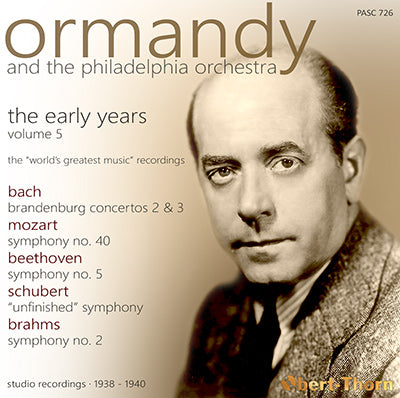
ORMANDY and The Philadelphia Orchestra - The Early Years ∙ Volume 5
CD 1 (79:45)
1. J. S.BACH (arr. O’Connell):
“Herzliebster Jesu” from St. Matthew Passion, BWV 244 (3:05)
Recorded 27 March 1940 ∙ Matrix: CS 047825-1 ∙ First issued on Victor 18166
J. S. BACH: Brandenburg Concerto No. 2 in F major, BWV 1047
2. 1st Mvt. – [Allegro] (4:47)
3. 2nd Mvt. – Andante (4:39)
4. 3rd Mvt. – Allegro assai (2:49)
Alexander Hilsberg, solo violin; Saul
Caston, solo trumpet; William Kincaid, solo
flute; Marcel Tabuteau, solo oboe
Recorded 12 November 1938 ∙ Matrices: CS 028831-2, 028832-1 & 028833-1
∙ First issued on World’s Greatest Music SR-14/15
J. S. BACH: Brandenburg Concerto No. 3 in G major, BWV 1048
5. 1st Mvt. – [Allegro] (6:24)
6. 3rd Mvt. – Allegro (3:23)
Recorded 12 November 1938 ∙ Matrices: CS 028840-1, 028841-1 & 028842-1
∙ First issued on World’s Greatest Music SR-15/16
MOZART Symphony No. 40 in G minor, K.550
7. 1st Mvt. – Molto allegro (7:13)
8. 2nd Mvt. – Andante (7:49)
9. 3rd Mvt. – Menuetto. Allegro – Trio (4:00)
10. 4th Mvt. – Finale. Allegro assai (4:25)
Recorded 12 November 1938 ∙ Matrices: CS 028834-1, 028835-1, 028836-1,
028837-1, 028838-1 & 028839-1 ∙ First issued on World’s Greatest Music
SR-8/10
BEETHOVEN Symphony No. 5 in C minor, Op. 67
11. 1st Mvt. – Allegro con brio (7:39)
12. 2nd Mvt. – Andante con moto (9:45)
13. 3rd Mvt. – Scherzo: Allegro (5:07)
14. 4th Mvt. – Allegro – Presto (8:33)
Recorded 17 October 1938 ∙ Matrices: CS 027814-2, 027815-1, 027816-1,
027817-1, 027818-1, 027819-1, 027820-1 & 027821-1 ∙ First issued on
World’s Greatest Music SR-4/7
CD 2 (61:39)
SCHUBERT Symphony No. 8 in B minor, D.759 “Unfinished”
1. 1st Mvt. –Allegro moderato (10:50)
2. 2nd Mvt. – Andante con moto (11:33)
Recorded 17 October 1938 ∙ Matrices: CS 027808-2, 027809-1, 027810-1,
027811-1, 027812-1 & 027813-1 ∙ First issued on World’s Greatest Music
SR-1/3
BRAHMS Symphony No. 2 in D major, Op. 73
3. 1st Mvt. – Allegro non troppo (14:31)
4. 2nd Mvt. – Adagio non troppo (9:53)
5. 3rd Mvt. – Allegretto grazioso (quasi andantino) (5:38)
6. 4th Mvt. – Allegro con spirito (9:10)
Recorded 26 March 1939 ∙ Matrices: CS 035400-1, 035401-2, 035402-1,
035403-2, 035404-2A, 035405-1, 035406-2, 035407-1, 035408-1 & 035409-1 ∙
First issued on World’s Greatest Music SR-28/32
Eugene Ormandy ∙ The Philadelphia Orchestra
Producer and Audio Restoration Engineer: Mark Obert-Thorn
Special thanks to Nathan Brown and Charles Niss for providing source
material
All recordings made in the Academy of Music, Philadelphia
Total duration: 2hr 21:24
Review
An attractive series which has filled gaps and explored discographic vistas previously untouched since the late 30s
This is the final volume in a series devoted to Ormandy’s ‘early years’ Philadelphia recordings and almost all the material was issued on the World’s Greatest Music in 1938-39. This was a budget-price label designed to produce fine quality recordings of standard repertoire that could undercut Columbia and RCA Victor though, ironically, they were all made and pressed by RCA Victor. The label was inaugurated by the Publishers Service Company which was, as Mark Obert-Thorn outlines in his producer’s note, the publishing arm of the New York Post newspaper. They were issued anonymously but featured such well-known conductors as Reiner, Rodziński and Ormandy himself and sold remarkably well. They must have been the way many Americans ‘learned’ the standard repertoire.
It’s been known for a number of years that smaller ensembles were used to save money – 49 players for Bach and Mozart and 74 for the remainder, though Ormandy, of course, always recorded in the Academy of Music, Philadelphia. Almost all sessions seem to have involved just two takes with three takes for problematic sides, and we know that session time was cut to a minimum. For example, the Bach Brandenburg Concertos and Mozart Symphony No.40 were allocated a three-hour session time and for Beethoven’s Fifth and Schubert’s Eighth only two hours ten minutes was allocated. The repertoire may well have been meat and drink to the orchestra but it still created ensemble tensions, especially with reduced forces with, presumably, different seating. There are some ensemble issues in the Bach Concertos as evidenced by an unprecedented four sides for the very first side No.2, of which take two was ultimately used. If they could get away with just the one take they did so. Ormandy’s Bach is mobile for the time and well thought-through, No.2 featuring the orchestra’s well-known soloists, Alexander Hilsberg, Saul Caston, William Kincaid and Marcel Tabuteau.
There’s nothing startling about any of the major works, interpretatively. Mozart’s 40 th is beautifully phrased, features a number of portamentos throughout and is traditionally resonant without ever sounding complacent. There’s no repeat in the finale, presumably a money-saving operation, though Ormandy reverted to a full finale in his mid-50s recording. Beethoven’s Fifth sounds very similar to his mid-50s recording. Tempi are almost exactly the same, the conception already well in place. The difference is in sonority and weight and also in the superiority of the playing in the studio LP recording.
The only piece in this twofer to have seen prior reissue in any form is Brahms’ Second Symphony, recorded on 26 March 1939, as it was reissued on LP. Ormandy re-recorded it for Victor a few months later with hardly any interpretative differences but it had a richer and more sonorous sound. In 1953, when he returned to it, his conception had tightened somewhat and the first movement and Scherzo were tauter. What this 1939 recording might lack in tonal breadth, it makes up for in clarity. Schubert’s ‘Unfinished’ Symphony is excellent and ensemble is largely unproblematic even given the unforgiving recording schedule. If it’s not quite in the Bruno Walter league – ironically recorded with the same orchestra – or Beecham with the LPO it’s a more-than-acceptable offering for a mass market audience.
There is one addition, a Victor recording of Charles O’Donnell’s arrangement of Bach’s ‘Herzliebster Jesu’ from the St Matthew Passion which had escaped previous volumes in this series.
As ever, the transfers are excellent. This has been an attractive series which has filled gaps and explored discographic vistas, some of which have been previously untouched since the late 30s.
Jonathan Woolf
