

This album is included in the following sets:
This set contains the following albums:
- Producer's Note
- Full Track Listing
- Cover Art
This final volume of our series devoted to Frederick Stock’s purely orchestral recordings with the Chicago Symphony features the remainder of the sides made during his December, 1941 Victor sessions other than Arthur Benjamin’s Overture to an Italian Comedy, which was placed at the end of the prior volume due to timing constraints.
Stock’s compositional efforts include several transcriptions, a few of which he recorded in Chicago going back to the acoustic era. The Bach “St. Anne” Prelude and Fugue is the most ambitious of the works that he orchestrated to see release on disc, and is more opulently scored than Arnold Schoenberg’s take on the same work (which that composer conducted with the CSO in 1934). One other Stock transcription from these sessions, an electric remake of his arrangement of “The Star-Spangled Banner”, has never been released and is believed to be lost.
Stock made few Wagner recordings, but what he did leave behind was memorable. The “Forest Murmurs” from Siegfried was meant to replace Mengelberg’s 1928 New York recording in the Victor catalog, yet for unknown reasons it was never issued on 78s. It has been transferred here from a vinyl test pressing.
Although Stock excelled in the rhythms and color of such middle European repertoire as that of Dvořák, Smetana and Suk, he recorded comparatively little of it. In these sessions, having already set down the middle part of Dvořák’s “Nature, Life and Love” triptych (the Carnival Overture, in Volume 1), he now assayed the first section, In Nature’s Realm. These, along with a single Slavonic Dance (in Volume 2) were his only Dvořák recordings. It was issued on three sides, and having no appropriate new filler, was released with a reissue of his 1926 recording of a movement from Suk’s Fairy Tale Suite.
The Chicago Symphony’s long association on disc with the music of Richard Strauss began during Stock’s tenure. Yet, despite strong performances of Also Sprach Zarathustra (on Volume 4) and a live broadcast of Till Eulenspiegel, the single movement from the composer’s early work Aus Italien is the total of Stock’s Strauss on disc. The conductor’s way with the graceful swooping of the birds over Sorrento makes one wish Victor had recorded the entire score.
Chausson’s only symphony has never achieved the popularity of that of his teacher and mentor César Franck, on which it is clearly modeled. Only three recordings of it were made during the entire 78 rpm era; but Stock’s is the best played, best recorded and arguably the most persuasively interpreted of the lot. His passionate reading makes a strong case for this underrated score, and also includes a surprise in the third movement: Stock rescores the solo trumpet-led chorale theme toward the end for the organ, in a nod to Saint-Saëns’ Third Symphony (or perhaps Tchaikovsky’s Manfred, where it appears in a similar place), a substitution not to be found in any other recording.
Stock returned for two more Victor sessions in July of 1942, recording the Beethoven Fourth and Fifth (“Emperor”) Concertos with Artur Schnabel, performances which have stayed in the catalog for much of the time since and are not included in this series. He died three months later, ending a 47-year association with the Chicago Symphony, 37 of it spent as its music director, one of the longest tenures of any conductor-orchestra association in history.
Mark Obert-Thorn
FREDERICK STOCK and The Chicago Symphony, Volume 6
BACH (orch. Stock) Prelude and Fugue in E-flat, BWV 552, “St. Anne”
1. Prelude (9:38)
2. Fugue (5:51)
Recorded 22 December 1941 · Matrices: CS 070163/6 · First issued on Victor 11-8541/2 in album M-958
Recorded 22-23 December 1941 · Matrices: CS 070161/2 · Unpublished on 78 rpm
Recorded 22-23 December 1941 · Matrices: CS 070167/9 · First issued on Victor 11-8639/40 in album M-975
Recorded 23 December 1941 · Matrices: CS 070171/2 · First issued on Victor 18535
3. WAGNERSiegfried - Forest Murmurs (8:31)
4. DVOŘÁK In Nature’s Realm, Overture, Op. 91 (11:58)
5. R. STRAUSS On the Shores of Sorrento from Aus Italien, Op. 16 (9:56)
CHAUSSON Symphony in B-flat, Op. 20
6. 1st Mvt. - Lent - Allegro vivo (11:19)
7. 2nd Mvt. - Très lent (7:21)
8. 3rd Mvt. - Animé (11:05)
Recorded 23 December 1941 · Matrices: CS 070171/2 · First issued on Victor 11-8491/4 in album M-950
Chicago Symphony Orchestra
conducted by Frederick Stock
Producer and Audio Restoration Engineer: Mark Obert-Thorn
All recordings made in Orchestra Hall, Chicago
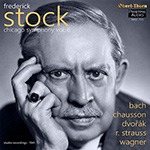
Cover photo of Frederick Stock by George Nelidoff kindly provided by the Rosenthal Archives of the Chicago Symphony Orchestra (Frank Villella, archivist).
Total duration: 75:42
Reviews
Fanfare — James A. Altena
Issue 50:1 (Sept/Oct 2026) · Read the original review
This is the concluding volume in Pristine Audio’s and Mark Obert-Thorn’s series of the complete non-concerto recordings of Frederick Stock; I enthusiastically reviewed Vols. 1–5 in issues 45:6, 46:6, 47:3, 48:3, and 49:3. These penultimate recording sessions from December 22 and 23, 1941, before Stock’s death on October 20, 1942 (he would set down Beethoven’s Fourth and Fifth Piano Concertos with Artur Schnabel in July 1942), marked his return from Columbia to RCA Victor. They were made under the dual shadows of the USA’s entrance into WW II following the December 7 attack by Japan on Pearl Harbor, and Stock’s increasingly apparent ill health. Nevertheless, the conductor went out with a bang, as it were.
Stock’s transcription of Bach’s “St. Anne” fugue is less successful than the one made by Arnold Schoenberg in 1929, and recorded by Erich Kleiber and the Berlin Philharmonic in 1931 for Ultraphon. In particular, the opening bars are somewhat muddy and uncertain here, though the transcription and the orchestra find their footing in the fugue. By contrast, the “Forest Murmurs” from Wagner’s Siegfried is a complete success. This is an unusually tender and lyrical rendition that truly lives up to the excerpt’s name. Fittingly enough, it is followed by Dvořák’s In Nature’s Realm, the first of a trilogy of tone poems followed by Carnival and Otello. Stock leads an energetic performance, if one that is slightly more Teutonic than Czech in flavor. “On the Shores of Sorrento” is the third of four movements in Richard Strauss’s earliest tone poem, Aus Italien. The work is generally considered to be his first attempt at direct programmatic depiction through music, but it has failed to gain a foothold in the repertoire. Stock leads a fine rendition, but it does not do anything to elevate the work’s stature in the estimation of most critics.
The final item, which takes up almost half of this disc, is Ernest Chausson’s only symphony. This is a work I have long treasured, and I do not understand why it is not a standard repertoire item. This was the work’s second of three appearances on 78s, being preceded by Pierre Coppola and the Orchestre da la Société des Concerts du Conservatoire in 1935 (HMV), and followed by Dimitri Mitropoulos and the Minneapolis Symphony in 1945 (Columbia). The Coppola is interpretively a fine account in its own right, but its sonics and orchestral playing are easily exceeded by RCA Victor and the CSO; Mitropoulos also has an inferior orchestra, and also less of a feel for the piece. While Stock’s approach emphasizes vigor and power over a more traditional French elegance and fluidity, he makes it work extremely well, bringing out the essential kinship of the work with its model, Franck’s Symphony in D Minor. While French conductors such as Monteux, Munch, and Paray (the latter my favorite version) would follow with excellent LP recordings in the 1950s and early 1960s, Stock’s performance also has a vividness to the recorded sound such that, if necessary, I could live with it as my only version of the work.
As before, Mark Obert-Thorn offers stellar transfers of the original 78s that supersede all predecessors. The disc case features a photo of Stock on the cover, and provides tracks, timings, and recording information. Musical scores are posted on Pristine’s website. As with its predecessors, strongly recommended; one regrets that there are no more volumes to come. James A. Altena
Fanfare — Michael Vaillancourt
Issue 50:2 (Nov/Dec 2026) · Read the original review
Pristine concludes their series devoted to the legacy of Frederick Stock and the Chicago Symphony with this sixth volume. All the material stems from Stock’s final sessions in December 1941. In fact, everything here was recorded in just two days—December 22nd and 23rd! Like earlier volumes, this one reinforces the impression that the Chicagoans were already a very good orchestra before the much-heralded arrival of Fritz Reiner. It also confirms the metamorphosis of Stock from the freewheeling interpreter of the 1910s and 1920s to the more objective musician of the Second World War era.
Stock’s orchestration of the Bach “St. Anne” Prelude and Fugue is somewhat more restrained than many of Leopold Stokowski’s efforts in this repertoire. The orchestral textures are more transparent, with what sounds like less doubling. Stock also largely avoids Stokowskian percussive effects—dramatic cymbal crashes, thunderous timpani rolls and the like. The performance is satisfying, with fairly vigorous tempos and good playing.
Wagner’s Forest Murmurs has never struck me as an effective stand-alone concert item; it sounds OK here. The opening is somewhat labored, but the performance improves when the strings get a chance to sing out. Another excerpt is the single movement of Richard Strauss’s early orchestral piece Aus Italien. On the Shores of Sorrento basically functions as the slow movement of Strauss’s four-movement suite and is probably the best part of the whole. It’s a nice performance, although the strings cannot quite match Kempe’s Dresdeners (Warner) or Ashkenazy’s Cleveland Orchestra (Decca).
Dvořák’s Overture is a rarity in concert halls these days. Stock and the orchestra make an excellent case for it with a fine rendition. Stock phrases with imagination and flair and the orchestra responds with relish. The sound quality is obviously not on the level of stereo recordings by Kubelik (DG) or Neumann (Supraphon), but the performance displays a comparative level of excellence.
The main event is undoubtedly Chausson’s underrated symphony. Long criticized as overly derivative of Franck’s Symphony, this is one instance where the imitation surpasses the model, at least from the perspective of my listening chair. Stock’s is a very fine performance. Perhaps the most useful comparison is the near-contemporary recording with Monteux and the San Francisco Symphony (RCA). It is perhaps surprising that Stock sets very much quicker tempos than his French colleague, belying the age-old cliché that German conductors were slow and French ones quick (there is a live Monteux aircheck with the BBC Symphony on ICA that is even slower than the RCA recording). Throughout, the Chicago Symphony is in excellent form and the sound is good for the era. Another point of interest is Stock’s use of the optional organ part in the chorale section of the final movement.
Like the final installments in many multi-volume series, this one collects a number of odds and ends; however, the Chausson Symphony and Dvořák Overture are outstanding performances of fine pieces and make the disc a worthwhile acquisition for anyone following this series. Mark Obert-Thorn’s restoration work and booklet note are up to his usual impeccable standards. Highly recommended. Michael Vaillancourt
