
This album is included in the following sets:
This set contains the following albums:
- Producer's Note
- Full Track Listing
- Cover Art
EMI recorded Madama Butterfly in September and October 1959 in Rome, reuniting the two stars of the 1956 recording of La Bohème, Victoria de los Angeles and Jussi Björling. It was to be the last complete opera that Jussi Björling recorded, and the heart condition that would end his life at the age of just 49 in 1960 was already apparent. He collapsed during one recording session of the act 1 love duet and needed several days to recover before he was able to continue. Yet listening to this recording you might never know. Björling’s singing is carefree, thoroughly Italiante in style, and commits to disc a Pinkerton that you want to listen to again and again. He is passionate and committed in the love duet, and rather than being callous or calculating, his Pinkerton simply doesn’t think about the consequences of his actions. EMI’s engineers did better than anyone else at capturing the full range and beauty of Björling’s voice and we are fortunate that he was able to record a role that he had not sung on stage since 1939.
Victoria de los Angeles is an ideal Butterfly. The Spanish soprano sang a wide variety of roles on stage including Carmen, Mimì, Marguerite, and Elisabeth, but for Butterfly her light and smooth tone is suitably youthful and infatuated yet it has plenty of power when needed. By act 3 de los Angeles gives us a fully-rounded picture of Butterfly’s tragedy, aching with sorrow. Few have sung the role so beautifully.
Italian baritone Mario Sereni sings Sharpless. Sereni had an extensive career at the Met in New York, singing more than 500 performances between 1957 and 1984, concentrating on Italian roles and particularly on Puccini and Verdi. He is perhaps less remembered today as some other baritones but this recording demonstrates that he was a performer of the first rank who deserves to be better known.
Conductor Gabriele Santini was the artistic director of the Rome Opera and brings all the experience of that role to bear. Conducting his own orchestra he is able to bring out the wonderful details of Puccini’s score to give us a Butterfly that remains one of the best ever recorded.
PUCCINI Madama Butterfly
disc one (53:36)
ACT ONE
1. E soffitto...e pareti (2:12)
2. Questa è la cameriera (4:08)
3. Dovunque al mondo (3:37)
4. Quale amania vi prende! (3:58)
5. Ah! Ah! quanto cielo! (3:05)
6. Gran ventura (3:34)
7. L'imperial Commissario (3:05)
8. Vieni, amor mio! (2:53)
9. Ieri son salita tutta sola (4:52)
10. Ed eccoci in famigila (5:35)
11. Viene la sera (3:35)
12. Bimba dagli occhi pieni di malia (4:08)
13. Vogliatemi bene, un bene piccolino (7:12)
ACT TWO
14. E izaghi e Izanami (7:06)
15. Un bel di vedremo (4:38)
disc two (73:08)
1. C'è Entrate (3:28)
2. Non lo sapete insomma (1:48)
3. A voi però giurerei fede costante (3:27)
4. Or a noi (5:53)
5. E questo e questo (2:08)
6. Che tua madre dovrà (2:43)
7. Io scendo al piano (1:45)
8. Vespa! Rospo maledetto! (1:54)
9. Una nave da guerra (2:30)
10. Scuoti quella fronda di ciliegio (4:49)
11. Or vienmi ad adornar (5:44)
12. Coro a bocca chiusa (3:01)
ACT THREE
13. Oh eh! Oh eh! Oh eh! (8:06)
14. Già il sole! (2:00)
15. Povera Butterfly! (2:46)
16. Io so che alle sue ...Oh! l'amara fragranza (3:35)
17. Addio, fiorito (1:43)
18. Gllielo dirai...Premetto (2:10)
19. Che vuol da me (5:36)
20. Come una mosca prigioniera (2:56)
21. Con onor muore (5:07)
CAST
Cio Cio San - Victoria de los Ángeles
Pinkerton - Jussi Björling
Sharpless - Mario Sereni
Suzuki - Miriam Pirazzini
Kate Pinkerton - Silvia Bertona
Goro - Piero De Palma
Il principe Yamadori - Arturo La Porta
Lo zio Bonzo - Paolo Montarsolo
Il commissario imperiale - Antonio Sacchetti
Yakusidè - Bonaldo Giaiotti
L'ufficiale del Registro - Paolo Caroli
La madre di Cio Cio San - Vera Magrini
La zia - Nina De Courson
La cugina - Silvia Bertona
Chorus and Orchestra of Rome Opera House
conducted by Gabriele Santini
Recorded September-October 1959, Rome
Stereo XR remastering by: Andrew Rose
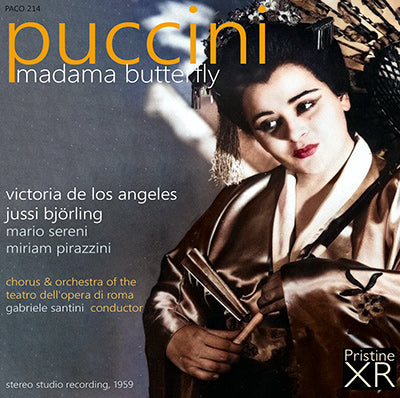
Cover artwork: Victoria de los Ángeles as Cio Cio San
Total duration: 2hr 16:44
Review
It is difficult to imagine a more beautifully sung version of the duet, or a more compelling one
The acclaimed Spanish soprano Victoria de los Ángeles recorded the role of Cio-Cio-San twice, first in mono for EMI in the early 1950s with Giuseppe di Stefano, then again in 1959 in stereo, again for EMI, with Jussi Björling. Much of the received wisdom about this second effort maintains that although Björling sings beautifully, he lacks Pinkerton’s youthful ardor and devil-may-care attitude, brilliantly conveyed by di Stefano. It is also true that di Stefano is more adept at portraying the character’s callousness, particularly in the first scene, before Butterfly’s entrance. However, Björling’s singing in the Love Duet is poetic and passionate, and it is delivered, as ever, with his uniquely beautiful voice.
I have read the criticism that in the duet the two lovers sound as if they are simply singing the notes, but I just don’t hear it that way. Björling’s repeated calls of “Vieni, vieni” are deeply urgent. De los Ángeles varies her tone between coquettish and impassioned. It is difficult to imagine a more beautifully sung version of the duet, or a more compelling one.
The two lead roles are difficult in very different ways. The soprano, in addition to singing practically throughout the opera, has to convey an immature teenager in the first act, changing to an older, more experienced woman afterward. On the other hand, the tenor, who has less to sing that most Puccini tenors, needs to find the balance between callousness and genuine affection. The music in the Love Duet and Pinkerton’s final, remorseful aria, are indicative of something deeper in the character than just a fun-loving sailor. If Björling is more comfortable as the lover, he is not the first tenor for whom this is true (Carlo Bergonzi would be another).
The secondary roles are also well taken, although Mario Sereni’s competent Sharpless cannot match the impact of Tito Gobbi on de los Ángeles’s earlier recording. Sereni sings well and is convincingly sympathetic to Cio-Cio-San’s predicament in their big scene together in the second act, but the specificity of Gobbi’s inflections is of a higher order. Miriam Pirazzini’s Suzuki is excellent, her voice blending gorgeously with de los Ángeles’s in the Flower Duet. Piero De Palma makes Goro a more interesting character than is usually the case.
We now get to the main drawback of this recording, the conducting of Gabriele Santini. It is not simply that he doesn’t possess the imagination of the great conductors who have recorded Butterfly (Karajan, Barbirolli, and Serafin come to mind), but he does not even rise to the second level of Gavazzeni and de Fabritiis. Santini makes almost nothing, for example, of the big moment when Butterfly recognizes Pinkerton’s ship. He fails to shape the Humming Chorus and misses the passion of the Love Duet. He seems to have little idea of the importance of orchestral color in underlining the drama. In the Intermezzo preceding act III Santini’s conducting is lumpish; one hears bar lines instead of long phrases. The final orchestral coda is blatant and, frankly, unfeeling.
Nonetheless, there is much that is wonderful about this recording, and Andrew Rose’s transfer, using Pristine’s XR Ambient Stereo process, represents a significant improvement, particularly in terms of adding a little more richness and warmth to de los Ángeles’s voice, which has always seemed to me a bit thin for the role in previous editions (both LP and CD). She soars through the role’s big moments with a ring and glow that have not been apparent before. Despite the dictates of today’s Woke police, Madama Butterfly is a beautiful opera, and there are a few recordings that are entirely successful. If I had to choose only one, it would be the EMI with Scotto, Bergonzi, and Barbirolli, but I would not want to be without this one either.
Pristine recordings are available at the label’s website, pristineclassical.com. They can be had in a number of download forms as well as CD and are accompanied by full scores and additional supplementary material.
Henry Fogel
