This album is included in the following sets:
This set contains the following albums:
- Producer's Note
- Full Track Listing
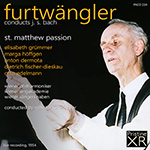
- Cover Art
Recorded in Vienna in April 1954, and drawing on a montage from live Konzerthaus performances given between 14 and 17 April, Wilhelm Furtwängler’s account of Bach’s St Matthew Passion stands among the most individual and searching interpretations of this work to have come down to us from the pre-period-instrument era. It brings together the Vienna Philharmonic and the Wiener Singakademie under a conductor whose approach to Bach was shaped less by questions of historical reconstruction than by a lifelong engagement with the central Austro-German tradition.
By the time of these performances, Furtwängler was widely regarded as one of the defining musical figures of his age, and his interpretations of Beethoven, Brahms and Wagner had already assumed near-legendary status. Bach, while never central to his public image in quite the same way, nevertheless occupied an important place in his musical thinking. When he conducted it, he did so not as a Baroque specialist but as a musician for whom the music spoke in universal, almost metaphysical terms. The result, in performances such as this, is Bach heard through a distinctly twentieth-century lens: expansive in scale, flexible in tempo, and profoundly concerned with long-breathed musical line.
The opening chorus, Kommt, ihr Töchter, sets the tone immediately. Rather than presenting the music with choral precision and architectural clarity, Furtwängler shapes it as a vast unfolding procession, the two choirs moving with a sense of weight and inevitability that recalls his readings of Bruckner as much as any conventional notion of Bach style. Throughout the work, tempi are elastic, phrases are moulded with great freedom, and transitions are guided by a deeply instinctive sense of musical direction.
Central to the success of the performance is the Evangelist of Anton Dermota, whose clear, unaffected delivery anchors the narrative with remarkable poise. His account avoids operatic excess while maintaining a strong sense of line, allowing the drama to emerge naturally from the text. Opposite him, the young Dietrich Fischer-Dieskau brings tonal nobility and a strongly individual presence to the role of Christ, combining authority with a distinctive expressive profile. Among the soloists, Elisabeth Grümmer is notable for the purity and radiance of her singing, while the supporting cast contributes to a performance that, for all its scale, retains a strong sense of ensemble.
The Vienna Philharmonic and choirs respond to Furtwängler with playing and singing of warmth and commitment, if not always with the degree of textual clarity that later generations would come to expect. Yet it is precisely this sonorous weight and blend that form part of the performance’s distinctive character. The chorales, in particular, are shaped as collective statements of reflection, their broad phrasing and rich tonal palette reinforcing the work’s overarching sense of gravity.
Heard today, this St Matthew Passion inevitably stands at some remove from current performance practice. The rise of historically informed approaches has brought with it lighter textures, faster tempi and a greater emphasis on Baroque articulation. Furtwängler offers something quite different: a reading in which Bach is treated as part of a continuous musical tradition, his music understood in terms that link it directly to the great symphonic repertoire of the nineteenth century.
These performances were given only a few months before Furtwängler’s death in November 1954, at a time when there was little sense that his career was nearing its end. Plans were already in motion for further major projects, including a new Ring cycle. In that light, the St Matthew Passion heard here is not a conscious farewell but rather a continuation of an artistic journey still very much in progress. Even so, it remains one of his most profound statements on sacred music, capturing a conductor at the height of his interpretative powers, engaging with Bach in a manner that is at once deeply personal and unmistakably of its time.
This present restoration offers an enhanced perspective on the original recording, addressing certain harshness in the upper frequencies and allowing a greater sense of space to emerge around the performers. Without altering the fundamental character of the source, it brings a measure of clarity and ease to the sound, enabling the listener to engage more fully with the breadth and depth of Furtwängler’s conception.
FURTWÄNGLER BACH St. Matthew Passion
DISC ONE: ST. MATTHEW PASSION, PART ONE (79:31)
1. No. 1. Kommt, ihr Töchter helft mir klagen (8:26)
2. No. 2. Da Jesus diese Rede vollendet hatte (0:55)
3. No. 3. Herzliebster Jesu (1:41)
4. No. 4. Da versammleten sich die Hohenpriester (0:32)
5. No. 5. Ja nicht auf das Fest (0:18)
6. No. 6. Da nun Jesus war zu Bethanien (0:39)
7. No. 7. Wozu dienet dieser Unrat? (0:37)
8. No. 8. Da das Jesus merkte, sprach er zu ihnen (1:58)
9. No. 9. Du lieber Heiland du (1:24)
10. No. 10. Buß und Reu (5:18)
11. No. 11. Da ging hin der Zwölfen einer (0:43)
12. No. 12. Blute nur, du liebes Herz! (5:40)
13. No. 13. Aber am ersten Tage der süßen Brote (0:16)
14. No. 14. Wo willst du, dass wir dir bereiten (0:28)
15. No. 15. Er sprach (2:01)
16. No. 16. Ich bin's, ich sollte büßen (1:32)
17. No. 17. Er antwortete und sprach (4:10)
18. No. 18. Wiewohl mein Herz in Tränen schwimmt (1:53)
19. No. 20. Und da sie den Lobgesang gesprochen hatten (1:34)
20. No. 21. Erkenne mich, mein Hüter (1:56)
21. No. 22. Petrus aber antwortete und sprach zu ihm (1:18)
22. No. 24. Da kam Jesus mit ihnen zu einem Hofe (2:13)
23. No. 25. O Schmerz! (3:06)
24. No. 26. Ich will bei meinem Jesu wachen (6:25)
25. No. 27. Und ging hin ein wenig (0:59)
26. No. 28. Der Heiland fällt vor seinem Vater nieder (1:32)
27. No. 30. Und er kam zu seinen Jüngern (1:38)
28. No. 31. Was mein Gott will, das g'scheh allzeit (2:03)
29. No. 32. Da kam er zu seinen Jüngern und sprach (2:42)
30. No. 33. So ist mein Jesus nun gefangen (4:44)
31. No. 34. Zu der Stund sprach Jesus zu den Scharen (1:22)
32. No. 35. O Mensch, bewein dein Sünde groß (8:27)
DISC TWO: ST. MATTHEW PASSION, PART TWO (44:23)
33. No. 36. Ach, nun ist mein Jesus hin! (5:47)
34. No. 37. Die aber Jesum gegriffen hatten (0:42)
35. No. 39. Und der Hohepriester stund auf und sprach zu ihm (0:36)
36. No. 42. Petrus aber antwortete und sprach zu ihm (1:53)
37. No. 43. Da speieten sie aus in sein Angesicht (0:48)
38. No. 44. Wer hat dich so geschlagen (1:43)
39. No. 45. Petrus aber saß draußen im Palast (1:22)
40. No. 46. Da hub er an, sich zu verfluchen und zu schwören (1:35)
41. No. 47. Erbarme dich (9:00)
42. No. 52. Jesus aber stund vor dem Landpfleger (1:06)
43. No. 53. Befiehl du deine Wege (2:01)
44. No. 54. Auf das Fest aber hatte der Landpfleger Gewohnheit (2:52)
45. No. 56. Der Landpfleger sagte (0:16)
46. No. 57. Er hat uns allen wohlgetan (1:42)
47. No. 58. Aus Liebe will mein Heiland sterben (5:12)
48. No. 59. Sie schrieen aber noch mehr und sprachen (2:21)
49. No. 60. Erbarm es Gott! (1:47)
50. No. 62. Da nahmen die Kriegsknechte (1:24)
51. No. 63. O Haupt voll Blut und Wunden (2:16)
DISC THREE: ST. MATTHEW PASSION, PART TWO CONCLUDED (39:03)
52. No. 64. Und da sie ihn verspottet hatten (0:56)
53. No. 65. Ja freilich will in uns das Fleisch und Blut (0:47)
54. No. 66. Komm, süßes Kreuz (9:24)
55. No. 67. Und da wurden zween Mörder (2:21)
56. No. 68. Desgleichen schmäheten ihn auch die Mörder (0:15)
57. No. 69. Golgatha, unseliges Golgatha! (2:34)
58. No. 71. Und von der sechsten Stunde an (2:49)
59. No. 72. Wenn ich einmal soll scheiden (2:36)
60. No. 73. Und siehe da (2:51)
61. No. 74. Am Abend, da es kühle war (2:37)
62. No. 76. Und Joseph nahm den Leib (0:40)
63. No. 77. Nun ist der Herr zur Ruh gebracht (2:41)
64. No. 78. Wir setzen uns mit Tränen nieder (8:33)
Elisabeth Grümmer, soprano
Marga Höffgen, contralto
Anton Dermota, tenor - Evangelist
Dietrich Fischer-Dieskau, baritone - Jesus
Otto Edelmann, bass - arias, Peter, Pilate, Judas
Wiener Philharmoniker
Wiener Singakademie
Wiener Sängerknaben
conductor Wilhelm Furtwängler
XR remastering by Andrew Rose
Recorded live in the Großer Konzerthaussaal, Wien, 14-17 April 1954
Total duration: 2hr 41:58