
This album is included in the following sets:
This set contains the following albums:
- Producer's Note
- Full Track Listing
- Cover Art
Jussi Björling’s (1911-1960) association with Gounod’s Roméo et Juliette lasted more than twenty years. In September 1930 he recorded Roméo’s famous aria “Ah! Lève toi, soleil!” aged just 19. A year later he appeared in his first stage production of the opera in Stockholm, singing the part of Tybalt, graduating two years later to the title role, singing both roles in Swedish. After the war Björling re-learned the part in French and sang in the San Francisco Opera’s production between 1946 and 1951 and in two performances at the Metropolitan Opera in New York in early 1947. Fortunately, the second of his New York performances was broadcast nationwide and has become treasured by opera lovers as capturing an ideal cast in full command of their roles. Björling’s unique lyric-spinto tenor encapsulates the role like very few other singers. He is both youthful and ardent with all the power and brilliance needed to ring out over the ensemble, listen for example to the thrilling climax at the end of act three when he is exiled. Yet his duets with Juliette are both tender and sensitive, and Bidú Sayão recalled that in those moments Björling would ‘sing with extreme delicacy, never to cover my voice.’
Brazilian lyric-coloratura soprano Bidú Sayão (1903-1999) first sang Juliette at La Scala, Milan, in 1931 and it would become one of her best-known roles. Her light and delicate voice was ideally suited to a variety of roles in the regular repertoire, including Rosina, Susanna, Zerlina, Manon, Mimì, and Violetta. After becoming an established star in Europe in the 1930s, Sayão made her debut at the Metropolitan Opera in the Saturday Matinee broadcast of Manon in 1937 and would sing there until 1952. The radio audience got the opportunity to hear her in no less than 32 Saturday matinee broadcasts during her Met career, but only twice did they hear her as Juliette, in 1937 and this performance in 1947. Sayão had been a pupil of the famous Jean de Reszke and through him had a direct connection to Gounod, as de Reszke had sung Romeo with the composer conducting in the 1880s. Most would agree that Sayão is an exceptional Juliette. Paul Jackson in his Saturday Afternoons at the Old Met enthuses “Has there ever been a Juliette so delightfully virginal in her entrance roulades and waltz? The complete ingénue, yes, but with a bounding joie de vivre that makes her impetuous love entirely believable.”
The smaller roles are taken by a roster of singers, many of whom would have been very familiar to the radio audience. Nicola Moscona, singing Frère Laurent, and John Brownlee, singing Mercutio, both had twenty-year careers at the Met with the latter being a notable Count in Le Nozze di Figaro. George Cehanovsky, singing Pâris, surpassed them both with a forty-year Met career between 1926 and 1966. At the other extreme, Mimi Benzell, singing Stéphano, had just a five-year spell at the Met in her 20s, before her marriage in 1949.
Ukranian conductor, Emil Cooper (1877-1960) studied under the legendary Arthur Nikisch and conducted widely in Europe, holding positions with the Imperial Opera in Petrograd, and the State Philharmonic Society in Leningrad, before emigrating to the United States in 1924. In addition to his six-year stint as a staff conductor at the Met between 1944 and 1950, Cooper also led ensembles in Montréal and Baton Rouge.
In 1984 the Met released this performance on LP for members of the Metropolitan Opera Guild to purchase. Sayão fondly recalled the performance during the intermission of that year’s Fidelio broadcast. She said that working with Björling was “wonderful” simply because he was a “marvellous singer with a really beautiful voice.” And of all her Met broadcasts she was particularly delighted they had singled out that one. This release allows us to experience once again (in superb XR remastered sound!) the magic they made together.
Bonus MaterialsThese two selections bookend Björling’s association with the role of Romeo. His recording of “Ah! Lève toi, soleil!” was the first operatic recording he made for Swedish HMV in 1930. It gives us a rare glimpse of a Romeo whose actual age was close to the age of the character he was playing. Twenty-one years later Björling and Sayão appeared together on the Standard Hour live from the stage of the War Memorial Opera House in San Francisco. Less than a month later Björling would sing his last Romeo in Los Angeles. Even though he was only 40 he never sang a note of the role again after 1951.
GOUNOD Roméo et Juliette
disc one (69:01)
1. RADIO Introduction (1:59)
2. Ouverture - Prologue - Vérone vit jadis deux familles rivales (6:35)
Act 1
3. L'heure s'envole (11:05)
4. Mab, la reine des mensonges (2:57)
5. Eh bien! Que l'avertissement me vienne de Mab (3:20)
6. Non! Je ne veux pas t'écouter plus longtemps (4:14)
7. Le nom de cette belle enfant? (0:25)
8. Ange adorable (4:47)
9. Quelqu'un! (5:54)
Act 2
10. Ô nuit! Sous tes ailes obscures (3:24)
11. L'amour, l'amour! (4:07)
12. Hélàs, moi, le haïr! (5:58)
13. Ô nuit divine! Je t'implore! (8:01)
Act 3
14. Mon père! Dieu vous garde! (6:15)
disc two (74:19)
1. Dieu qui fit l'homme à ton image! (5:19)
2. Depuis hier je cherche en vain mon maître! (3:40)
3. Ah! Ah! voici nos gens! (16:51)
Act 4
4. Va! Je t'ai pardonné (11:03)
5. Mon père! Tout m'accable (4:39)
6. Dieu! Quel frisson court dans mes veines (1:06)
Act 5
7. Entracte (2:01)
8. C'est la! Salut!...Ô ma femme! (5:12)
9. À toi, ma Juliette! (4:39)
10. Console-toi, pauvre âme (5:05)
CAST
Roméo - Jussi Björling
Juliette - Bidú Sayão
Gertrude - Claramae Turner
Frère Laurence - Nicola Moscona
Capulet - Kenneth Schon
Tybalt - Thomas Hayward
Le Prince - William Hargrave
Gregorio - Philip Kinsman
Mercutio - John Brownlee
Stéphano - Mimi Benzell
Pâris - George Cehanovsky
Benvolio - Anthony Marlowe
Metropolitan Opera Chorus and Orchestra
conducted by Emil Cooper
Live broadcast recording from the Metropolitan Opera House, New York, 1 February 1947
Bonus tracks from Roméo et Juliette:
11. Höj Dig, Du Klara Sol! (Ah! Lève-toi, Soleil!) (3:16)
Jussi Björling, tenor
Nils Grevillius and his Orchestra
Recorded in Stockholm, 29 September 1930
12. Va! Je t'ai pardonné (11:27)
Bidú Sayão, soprano
Jussi Björling, tenor
San Francisco Opera Orchestra
conducted by Gaetano Merola
Recorded 30 September 1951
War Memorial Opera House, San Francisco
Ambient Stereo XR remastering: Andrew RoseAmbient Stereo XR remastering: Andrew Rose
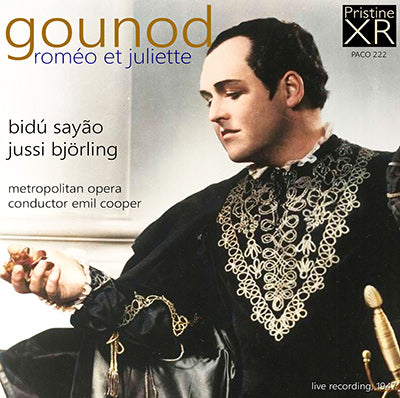
Cover artwork: Jussi Björling as Roméo
Total duration: 2hr 23:20
Review
This issue must now be the top recommendation for this classic historic performance
During the first ten years of his career as a member of the ensemble at the Royal Swedish Opera in Stockholm, the young Jussi Björling learnt fifty roles, most of them major. When he embarked on an international career, focused mainly on the Metropolitan Opera in New York, he retained only nine and for the remaining twenty years of his life he added only another two. Among them, were his only two French roles: Gounod’s Faust and Roméo et Juliette . The latter was one of his earliest, premiered only a good year after his debut – but then he didn’t sing the title role, he was Tybaltin three performances. Two years later, in 1933, he was promoted to Roméo, and it became one of his most popular roles during the Stockholm years. 34 times the audiences could enjoy Höj dig, du klara sol! ( Ah! Léve toi, Soleil! ). Practically everything was sung in the vernacular in those days. This aria was also the very first opera aria he ever recorded, as early as 29 September 1930, when he still was only 19 years old. It is included here as a bonus track. His Faust followed in 1934 and was an even bigger hit. Unfortunately, he never recorded either of them under studio conditions, but both were broadcast at Saturday matinée performances from the Met, and later transferred to gramophone records, Faust even twice, and these are utterly valuable documents of two of his finest roles.
The earliest of them is this Roméo from 1947. It has been issued on various labels since 1959, often in execrable sound, but in 2009, Richard Caniell managed to locate a better source and after laborious restoration work has come up with a version that is far superior to what has been heard before. Issued on his label Immortal Performances IPCD 1003-2 with copious documentation to match, this has become one of the jewels in my Björling collection, and I have regularly returned to it. Now that Andrew Rose has operated his XR process on the old material it is worth evaluating the possible gains of the Ambient Stereo. If I understand Andrew’s notes correctly, he has not used Caniell’s restoration, but the LP pressings from for members of the Metropolitan Opera Guild from 1984. Since the performances are identical I have chosen to reprint parts of my review of Caniell’s issue from December 2009:
“Richard Caniell has … managed to open up what was, on previous issues of the Gounod, boxy and compressed, making this restoration fully digestible for any opera-lover bar those who at all costs must have hi-fi, stereo, state-of-the-art technology. It is still a primitive sound but once one has adjusted to the limited dynamic range it is almost comparable to what one can hear on 78 rpm records from the period. The bass is distinct, the high frequencies naturally lack the lustre of a decade later but the sound is still good enough to allow the listener to enjoy the music. The voices are well defined and there is bloom around them. Björling in particular has rarely if ever sounded so free and inspired. He glows from beginning to end.
The orchestral playing is a bit uneven but in many places there is a shine around the strings and the cello department is very good in the introduction to Act IV. The chorus during this period seems to have been the weakest link at the Met. At least that’s the impression I’ve got from several broadcasts of the late forties. But I have to admit that there is a good servants’ chorus in Act II.
Roméo et Juliette is a rather long opera but fifty-sixty years ago it was quite common to cut extensively at performances – at least at the Met. As there is no libretto enclosed with this set I had to make do with the one to Pappano’s EMI recording, which left me with the feeling that I was listening to a highlights disc. There are long stretches of music that is gone: several ensembles and several solos, including Juliette’s long act IV aria – and also the whole second scene of that act.
What is left is however wonderfully executed, at least what the eponymous couple sing. Bidú Sayão during these years was so lovely and human with her somewhat fragile vibrato. Her waltz aria in act I, Je veux vivre , has fine lilt and glittering tones. Björling’s opening to the duet Ange adorable is touchingly sung with that very special tear in the voice that more than one listener has commented on, most recently Joan Baez who visited the Jussi Björling Museum the day before I wrote this review. ‘I have never been so moved by any other voice than Jussi’s’, she said. ‘There is so much soul in it.’
The whole garden scene is exquisite, and the cavatina has possibly never been sung with such beauty, feeling and brilliance – not even by Jussi Björling himself. O nuit divine as sung here is as close to Heaven as it is possible to come on an operatic stage.
Impassioned singing of a quite different kind occurs in act III, after the slaughter of Mercutio and Tybalt, where Ah! jour de deuil is magnificently heroic. In act V luckily Björling’s O ma femme is retained since this is again singing of the highest possible order. When Juliet wakes up from her sleep she exclaims Dieu! Quelle est cette voix, dont la douceur m’enchante? (God! What voice is that whose sweetness enchants me?’). I believe every listener will make the same exclamation when they hear Jussi Björling.
The rest of the cast is more run-of-the-mill but generally do a good job. Mimi Benzell’s youthful (she was not yet 23 when the recording was made) light soprano shines in the role of Stephano, and Thomas Hayward is a good, expressive Tybalt. John Brownlee, who sang for 21 seasons at the Met, was only halfway through his career in 1947 but sounds decidedly on the downgrade, rather dry and rough. Nicola Moscona also had a long tenure in New York and was always reliable. He is at his best in the act III trio.
Having reheard the performance I see no reason to change my verdict concerning the quality of the singing, besides that Nicola Moscona’s Frère Laurence is even more impressive than I remembered him. He was indeed one of the great basses of his generation. The Ambient Stereo adds fullness to the sound, more presence and atmosphere, and it guaranties more comfortable listening. Caniell’s restoration is in no way made obsolete, however, and it has a substantial bonus in the shape of the complete second act in a recording from La Scala 1934 with Beniamino Gigli and Mafalda Favero.
The bonus on the Pristine issue is also substantial. As I mentioned above, we get Jussi aged 19, in other words just about the age the real Roméo was. It is indeed a youthful voice. Remarkably, though, on the other bonus track we hear him and Bidů Sayão in the duet Va! Je t’ai pardonné from act IV recorded 21 years later, and Jussi sounds just as youthful! It’s a recording from the War Memorial Opera House in San Francisco in a live broadcast of the Standard Hour in September 1951. Only a month later Jussi sang his last Roméo in Los Angeles. He was still only 40 and sounded 25, and his partner twittered just as youthfully. An endearing duet.
Göran Forsling