This album is included in the following sets:
This set contains the following albums:
- Producer's Note
- Full Track Listing
- Cover Art
Our prior volume (PASC 737), issued to commemorate the 150th anniversary of Fritz Kreisler’s birth in 1875, featured one version of every concerto the violinist recorded. In that release, we focused on the earliest versions of each work Kreisler had made. During the mid-1930s, he re-recorded four of the works in London. While his technique in his early 60s was not as seemingly effortless as it had been a decade earlier, he was still acknowledged as one of the greatest violinists in the world; and these new recordings, with their more up-to-date sonics and (in the opinion of some listeners) stronger accompaniments quickly displaced their forebears in the catalog, and were the first to be reissued in the new LP medium decades later.
From February, 1930 through February, 1935, Kreisler made no recordings due to the financial constraints the Great Depression imposed on recording companies on both sides of the Atlantic. Among the first items he undertook in the studio when he returned was a remake of his 1926 recording of the Mendelssohn concerto. For this, as for the rest of his series of concerto remakes for HMV, he had arguably the finest orchestral ensemble in Britain at the time, the London Philharmonic, which had been organized by Beecham in 1932. Leading the orchestra in the Mendelssohn was conductor-composer-pianist Sir Landon Ronald, who had served as musical advisor to HMV since 1900 and more recently had become a director of EMI.
Kreisler’s earlier recording of the Mendelssohn stretched over seven sides, with a piano-accompanied filler. In the ensuing years, a recording of the concerto on six sides featuring Szigeti had appeared, and evidently HMV was keen to have a new version with Kreisler in this more-affordable format. As the timings indicate (12:10/7:48/6:52 in 1926 vs. 12:12/7:01/6:50 in 1935), this made hardly a difference to the outlying movements, but quite a bit in the second movement, which went from being comfortably spread over two sides to a side and a half. As a result, the tempo seems rushed, particularly in the middle section. Kreisler copes with the challenges well, however, although one notes that the first and last sides had to go to four takes before the violinist was satisfied.
His next two concerto recordings were made more or less simultaneously a year later under the direction of cellist-turned-conductor John Barbirolli (who would not become “Sir John” until 1949). Barbirolli had, by this time, made a specialty of accompanying great instrumentalists on HMV recordings (Heifetz, Elman, Piatigorsky, Rubinstein, Backhaus); and as a string player himself, he idolized Kreisler.
For his part, Kreisler was very pleased with the support Barbirolli provided him. Asked to select excerpts from his recordings to be played on a special 80th birthday radio program in 1955, Kreisler’s first choice was a movement from the Brahms concerto with Barbirolli, saying “I cannot imagine anybody who is finer as an accompanist, a better cooperator with the soloist, than he was.” (On the other hand, critic Tully Potter felt that in the Beethoven, Barbirolli gave Kreisler too much control over tempo changes, and longed for the “tighter framework” Leo Blech had provided in the older recording.)
The two concertos were a struggle for Kreisler: one can hear a momentary slip, quickly recovered from, in the cadenza for the first movement of the Beethoven; and a make-up session had to be scheduled a month after the initial recordings. One casualty of this was the Viotti 22nd concerto, which Kreisler was scheduled to record but which had to be cancelled when time ran out.
Kreisler’s last concerto recording in Europe was the Mozart 4th, which the violinist had previously made acoustically under Ronald in 1924. That set had been lavishly spread over eight sides, while the newer version under Malcolm Sargent was able to accommodate the work on six longish ones. After this, Kreisler made only one more piano-accompanied recording in the UK before retiring to America for the war years and his final recordings.
Mark Obert-Thorn
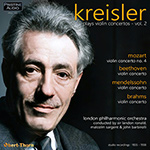
KREISLER plays Violin Concertos, Vol. 2
Studio Recordings ∙ 1935–1938
CD 1 (70:59)
MOZART Violin Concerto No. 4 in D major, K.218 (Cadenzas: Kreisler)
1. 1st Mvt. – Allegro (9:31)
2. 2nd Mvt. – Andante cantabile (8:31)
3. 3rd Mvt. – Andante grazioso – Allegro ma non troppo (9:05)
Recorded 11 February 1938, Abbey Road Studio No. 1, London
Matrices: 2EA 6212-3, 6213-4, 6214-2, 6215-3, 6216-4 & 6217-4
First issued on HMV DB 3734/6
London Philharmonic Orchestra conducted by Malcolm Sargent
BEETHOVEN Violin Concerto in D major, Op. 61 (Cadenzas: Kreisler)
4. 1st Mvt. – Allegro ma non troppo (23:04)
5. 2nd Mvt. – Larghetto (10:39)
6. 3rd Mvt. – Rondo: Allegro (10:09)
Recorded 16 & 22 June and 17 July 1936, Abbey Road Studio No. 1, London
Matrices: 2EA 2974-1, 2975-1A, 2976-2A, 2977-3A, 2978-1A, 2979-3A, 2980-2A, 2981-3A, 2982-2A, 2983-1A & 2984-3A
First issued on HMV DB 2927/32
London Philharmonic Orchestra conducted by John Barbirolli
CD 2 (63:49)
MENDELSSOHN Violin Concerto in E minor, Op. 64
1. 1st Mvt. – Allegro molto appassionato – Presto (12:12)
2. 2nd Mvt. – Andante (7:01)
3. 3rd Mvt. – Allegretto non troppo – Allegro molto vivace (6:50)
Recorded 8 April 1935, Abbey Road Studio No. 1, London
Matrices: 2EA 1465-4A, 1466-2A, 1467-1, 1468-2A, 1469-1A & 1470-4A
First issued on HMV DB 2460/2
London Philharmonic Orchestra conducted by Sir Landon Ronald
BRAHMS Violin Concerto in D major, Op. 77 (Cadenzas: Kreisler)
4. 1st Mvt. – Allegro ma non troppo (21:06)
5. 2nd Mvt. – Adagio (Léon Goossens, solo oboe) (8:29)
6. 3rd Mvt. – Allegro giocoso ma non troppo (8:08)
Recorded 18 & 22 June 1936, Abbey Road Studio No. 1, London
Matrices: 2EA 2986-1A, 2987-2A, 2988-2A, 2989-1, 2990-1A, 2991-1A, 2992-1A, 2997-4A & 2998-4A
First issued on HMV DB 2915/9
London Philharmonic Orchestra conducted by John Barbirolli
Fritz Kreisler, violin
Producer and Audio Restoration Engineer: Mark Obert-Thorn
Total duration: 2hr 14:48