

This album is included in the following sets:
This set contains the following albums:
- Producer's Note
- Full Track Listing
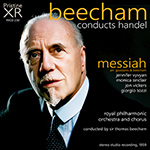
- Cover Art
When Sir Thomas Beecham set out to record Messiah in 1959, he wasn’t merely revisiting Handel’s most famous oratorio; he was creating his own. Beecham had long felt that Messiah needed rescuing from what he considered a century of undernourished performance tradition. A visionary impresario as much as a conductor, he turned to a trusted collaborator, Sir Eugene Goossens, to reimagine the score for modern forces. The result is not so much a “version” as a full-scale reinvention of Handel’s masterpiece, crafted for a large symphony orchestra, colouristic woodwind doublings, and a palette of percussion that ranges from timpani to—famously—cymbals and side drum.
From the outset Beecham was unapologetically candid: this was “Beecham’s Messiah”, not Handel’s alone, and the Gramophone critic reviewing the LP in May 1960 agreed that RCA had been admirably upfront in presenting it as such. The edition’s lineage was traced frankly as “Handel–Mozart–Prout–Beecham–Goossens”, a mischievous but accurate summation of just how much 150 years of performance culture had already altered the score before Goossens ever touched it.
The recording sessions stretched across June and July 1959 in the well-loved acoustic of Walthamstow Assembly Hall, where the Royal Philharmonic Orchestra was at its peak. Beecham presides with total conviction. He delights in the expanded sonic world Goossens created: trumpets and horns blaze with theatrical splendour, strings sing with Romantic vibrato, and the added percussion contributes a sense of drama that is—let’s be honest—pure Beecham theatre. A moment the Gramophone critic singled out occurs in “The Trumpet Shall Sound”, where Giorgio Tozzi’s noble phrasing floats above orchestral writing that swells with a grandeur unimaginable in period style performance.
Yet the most unusual feature of the recording, as the reviewer noted, is its professional chorus. While Messiah had long been the domain of amateur choral societies, Beecham turned to the RPO Chorus—80 voices strong on average—whose immaculate tuning, clarity of attack, and polished diction lend the choral movements a weight and finish rare in any age. The critic admired their sound and remarked that Handel himself, with his love of polyphony, would surely have approved.
The four soloists form a luxury cast, each bringing charisma and individuality. Jennifer Vyvyan, long admired by Beecham and already experienced in Messiah on disc, brings her trademark clarity and expressive intelligence to the soprano arias. The Gramophone reviewer found her interpretation attractively direct, though occasionally sharp at the top, yet praised the emotional intelligence she brought to “Rejoice greatly” and her radiant sense of line. Monica Sinclair’s contralto contributions offer warmth without heaviness; her “He was despised” has a human simplicity that contrasts beautifully with the orchestra’s augmented colours.
Jon Vickers, meanwhile, is a tenor of unmistakable presence. His “Comfort ye” carries the fervour and emotional immediacy of an operatic recitative, and the Gramophone critic admired the “real virility” of his delivery, noting that this kind of dramatic projection aligned surprisingly well with Handel’s directness and boldness. Giorgio Tozzi contributes a poised, resonant bass—never overstated, always noble—his “The trumpet shall sound” balancing ceremonial pomp with expressive depth.
To modern ears, this Messiah exists in a world far removed from historically informed performance. And that is exactly why it still matters. Beecham and Goossens weren’t attempting authenticity; they were crafting an oratorio for mid-century audiences, orchestras, and halls. Their goal was to restore Messiah to popular favour through richness, grandeur, and unashamed theatricality. As the 1960 review observed, if Handel was to be brought back into mainstream appreciation, “some reasonable compromise must be effected between excessive grossness and exaggerated leanness.” Beecham believed this version achieved that balance, and hearing it today, one understands his point.
There is no other Messiah quite like it. The orchestral rewrite may forever spark debate, but the performance’s craftsmanship, polish, and sheer personality remain irresistible. It captures a moment when Britain’s postwar musical life was bursting with ambition, and when a conductor of towering charisma could still bend repertoire entirely to his will.
For collectors, historians, and anyone who enjoys musical storytelling writ large, this recording is a vivid reminder that Handel’s masterpiece has never been one thing. It has survived precisely because it attracts reinvention. Beecham’s version may not aim for authenticity, but it offers something just as valuable: a thrilling, unapologetically dramatic encounter with a score reborn through the imagination of musicians who loved it deeply.
And whether you approach it as scholarship, spectacle, or simply glorious sound, this Messiah remains one of the 20th century’s most singular Handelian experiences.
A Note on the Additional Arias
Although Beecham and Goossens prepared a broader span of material for their reimagined Messiah, the conductor was ultimately selective about what he wished to present to the public. For the original 1959 issue, he shaped the oratorio with a firm dramatic arc, omitting several arias and movements that, while fully orchestrated, he felt lay outside the narrative focus and musical balance he intended. These cuts were also practical: the LP format of the time imposed strict limits on duration.
In the decades since, newer editions have sometimes reinstated these movements as appendices, offering a more expansive view of the Goossens–Beecham project. For this Pristine release, however, we have retained Beecham’s own two-disc structure exactly as issued, preserving the pacing and proportions he approved.
For listeners who wish to explore further, the additional arias — fully restored and remastered from the same sessions — are offered as exclusive download-only bonus tracks. They provide a fascinating glimpse into the wider scope of Goossens’s orchestration and the material Beecham recorded but chose not to include, enriching the historical picture while allowing the main album to remain faithful to the conductor’s original conception.
HANDEL Messiah (arr. Goosens/Beecham)
disc one (70:26)
Part I
1. Scene 1 - Sinfony (4:49)
2. Comfort ye, my people (3:41)
3. Every valley shall be exalted (3:32)
4. And the glory of the Lord (3:38)
5. Scene 2 - Thus saith the Lord of Hosts (1:53)
6. But who may abide (5:02)
7. And he shall purify (3:16)
8. Scene 3 - Behold, a virgin shall conceive (0:46)
9. O thou that tellest good tidings (7:23)
10. For, behold, darkness shall cover (3:02)
11. The people that walked in darkness (4:52)
12. For unto us a child is born (4:54)
13. Scene 4 - Pastoral Symphony (4:39)
14. There were shepherds abiding (1:00)
15. And the angel said unto them (0:53)
16. And suddenly there was (0:21)
17. Glory to the God in the highest (2:17)
18. Scene 5 - Recjoice greatly, O daughter of Zion (4:34)
19. Then shall the eyes (0:36)
20. He shall feed his flock; Come unto him (6:12)
21. His yoke is easy (3:06)
disc two (73:26)
Part II
1. Scene 1 - Behold the Lamb of God (4:10)
2. He was despised (6:03)
3. Surely he hath borne our griefs (3:00)
4. And with His stripes we are healed (2:21)
5. All we like sheep have gone astray (4:03)
6. All they that see Him (0:53)
7. He trusted in God (2:25)
8. Thy rebuke hath broken his Heart (2:39)
9. Behold, and see if there be (2:04)
10. Scene 2 - He was cut off out of the land (0:27)
11. But Thou didst not leave (3:23)
12. Scene 3- Lift up your heads (3:14)
13. Scene 5 - How beautiful are the feet (3:05)
14. Their sound is gone out (1:43)
15. Scene 6 - Why do the nations so furiously rage together (2:53)
16. Let u break their bonds asunder (1:50)
17. He that dwelleth in heaven (0:22)
18. Scene 7 - Thou shalt break them with a rod of iron (2:10)
19. Hallelujah (3:32)
Part III
20. Scene 1- I know that my Redeemer liveth (7:44)
21. Since by man came death (2:30)
22. Scene 2 - Behold, I tell you a mystery (0:42)
23. The trumpet shall sound (4:20)
24. Scene 4 - Worthy is the lamb (7:53)
ADDITIONAL TRACKS (download only)
1. Unto which of the angels (0:26)
2. Let all the angels of God worship Him (1:37)
3. Thou art gone up on high (3:59)
4. The Lord gave the word (1:12)
5. Then shall be brought to pass (0:21)
6. O death, where is thy sting (1:23)
7. But thanks be to God (2:23)
8. If God be for us (5:35)
Jennifer Vyvyan, soprano
Monica Sinclair, alto
Jon Vickers, tenor
Giorgio Tozzi, bass
Royal Philharmonic Orchestra and Chorus
conducted by Sir Thomas Beecham
XR remastering by: Andrew Rose
Cover artwork based on a photograph of Beecham
Recorded at Walthamstow Assembly Hall, June 9-13, 15-17, 20, 24 + 26 & July 3, 17-18, 1959
Total durations:
CDs: 2hr 24:05
Download 2hr 41:04 (includes additional appendix tracks)
Fanfare Review
I urge you to try this well-transferred and truthfully annotated release
Ask me to nominate the most electrifying 'Hallelujah' chorus on disc, and I'll immediately jump in with just a single option: Thomas Beecham conducting the Royal Philharmonic Orchestra and Chorus in the summer of 1959 - a spectacularly good stereo recording originally issued on LP by RCA, using an edition of the score prepared principally by Beecham himself and Eugene Goossens, with bells and whistles ringing aplenty, especially from the added winds and percussion.
The chorus is top-notch, the singers too, the pure-voiced soprano Jennifer Vyvyan being a principal attraction alongside the 'Baroque Heldentenor' of Jon Vickers (try 'Ev'ry valley shall be exalted' - you'll have to stretch as far as back as Walter Widdop, Heddle Nash and Aksel Schiøtz to match him). The other excellent soloists are the mezzo Monica Sinclair and the bass Giorgio Tozzi.
Just as a coincidence, when listening I had by my side Adrian Boult's 1961 Decca recording with the London Symphony Orchestra and Chorus (now on Decca Eloquence, 12/22), and although Boult's overall approach isn't too far removed tempo-wise from Beecham's, all those added colours and dramatic effects make a world of a difference, like them or not. I do, and I urge you to try this well-transferred and truthfully annotated release. Not only is it a significant rethink of a great score but it's among the most imaginative Messiahs ever recorded. Maybe Pristine can now venture among the many other Beecham archival treasures that Sony/RCA has cast aside - not least Delius, Mozart, Dvořák, Balakirev, Massenet, Schumann and more.
Rob Cowan
Fanfare, Mar/Apr 2026
