
This album is included in the following sets:
This set contains the following albums:
- Producer's Note
- Full Track Listing
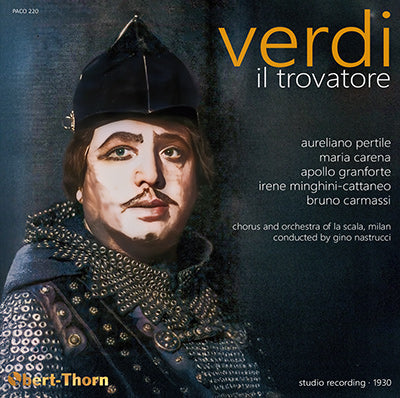
- Cover Art
[H]ere are some of the finest voices from the 30’s, conveying the drama and immediacy of a live performance without the attendant disadvantages of a live recording. The sound is particularly striking for its age – and you can hear a quartet of unparalleled splendour. I had never heard of Maria Carena, but she is a proper singer of the old school, who occasionally reminds me of Muzio without quite the beauty of that greatest of sopranos. Both vocal registers are fully developed and she knows exactly what she is doing; her technique is excellent. The other singers are better known: Pertile (a Toscanini favourite) occasionally allows his vibrato to get away from him and produce the effect of singing sharp, and Granforte makes wonderfully impressive sounds without much subtlety, but they are nonetheless mighty impressive. Minghini-Cattaneo is a paragon among Azucenas; as good as any I have ever heard. There are numerous cuts, of course, and Pertile transposes “Di quella pira” down […] which is a bit naughty and robs it of some excitement – but that is hardly unprecedented. Sabajno’s conducting fairly rattles along but that’s what this warhorse needs – and he is by no means insensitive.
From “A selective survey of Verdi’s Il Trovatore” by Ralph Moore, MusicWeb International, July, 2021
Along with the 1928 set of Aïda (reissued on Pristine PACO 196), this was one of the most strongly cast complete operas in HMV’s prewar series. Maria Carena (1891-1966) made her debut as Leonora, and studied the role under Toscanini. Critic Herman Klein compared Aureliano Pertile (1885-1952) to Tamagno and Caruso when he appeared as Manrico in London in 1927. Apollo Granforte (1886-1975) was not a regular at La Scala, but makes a splendid villain here, and Irene Minghini-Catteneo (1892-1944) was considered one of the best Azucenas in Italy.
While Carlo Sabajno was credited as the conductor on the original set (and all “official” EMI LP reissues), research done by John W. N. Francis established that all but two sides (matrices CF 3552-1 and CF 3575-1; here, CD 1, Tracks 9-10 and 13-14) were actually “ghost-conducted” by his assistant, Gino Nastrucci, who also led various remake sides for Sabajno’s HMV sets of Tosca, La Traviata, Carmen and Otello.
Mark Obert-Thorn
VERDI Il Trovatore
CD 1 (61:32)
ACT ONE
SCENE 1
1. All’erta, all’erta (3:01)
31 Oct 30; CF 3587-2 (HMV D 1952)
2. Di due figli (4:00)
31 Oct 30; CF 3588-2 (HMV D 1952)
3. E il padre? (3:08)
SCENE 2
4. Che più t’arresti (1:20)
21 Nov 30; CF 3637-2 (HMV D 1953)
5. Come d’aurato sogno (0:34)
6. Tacea la notte placida (3:18)
13 Nov 30; CF 3616-1 (HMV D 1953)
7. Quanto narrasti (0:49)
8. Di tale amor (1:28)
13 Nov 30; CF 3618-2 (HMV D 1954)
9. Tace la notte! (1:47)
10. Deserto sulla terra (1:31)
24 Oct 30; CF 3552-1 (HMV D 1954)
11. Non m’inganno (1:58)
12. Di geloso amor sprezzato (2:27)
24 Nov 30; CF 3551-5 (HMV D 1955)
ACT TWO
SCENE 1
13. Vedi! Le fosche notturne spoglie (2:57)
14. Stride la vampa! (part 1) (1:21)
29 Oct 30; CF 3575-1 (HMV D 1955)
15. Stride la vampa! (part 2) (2:53)
16. Soli or siamo (0:56)
19 Nov 30; CF 3633-2 (HMV D 1956)
17. Condotta ell’era in ceppi (4:17)
18 Nov 30; CF 3631-2 (HMV D 1956)
18. Non son tuo figlio? (2:02)
19. Mal reggendo all’aspro assalto (2:52)
18 Nov 30; CF 3632-2 (HMV D 1957)
20. L’usato messo, Ruiz invia (1:16)
21. Perigliarti ancor languente (1:55)
19 Nov 30; CF 3634-2 (HMV D 1957)
SCENE 2
22. Tutto è deserto (1:25)
23. Il balen del suo sorriso (3:11)
3 Nov 30; CF 3593-2 (HMV D 1958)
24. Qual suono! (0:30)
25. Ardir! Andiam! . . . Per me ora fatale (2:13)
26 Nov 30; CF 3655-1 (HMV D 1958)
26. Ah! se l’error t’ingombra (2:06)
27. Perchè piangete? (2:07)
21 Nov 30; CF 3639-2 (HMV D 1959)
28. E deggio e posso crederlo? (3:56)
21 Nov 30; CF 3648-2 (HMV D 1959)
CD 2 (52:36)
ACT THREE
SCENE 1
1. Or co’ dadi, ma fra poco (2:00)
2. Squilli, echeggi la tromba guerriera (2:15)
31 Oct 30; CF 3586-1 (HMV D 1960)
3. In braccio al mio rival! (2:04)
30 Oct 30; CF 3580-2 (HMV D 1960)
4. Giorni poveri vivea (4:17)
30 Oct 30; CF 3581-3 (HMV D 1961)
SCENE 2
5. Quale d’armi fragor poc’anzi intesi? (1:55)
6. Ah, si ben mio (2:50)
25 Nov 30; CF 3636-2 (HMV D 1961)
7. Manrico (0:49)
8. Di quella pira (2:12)
21 Nov 30; CF 3638-1 (HMV D 1962)
ACT FOUR
SCENE 1
9. Siam giunti (2:39)
22 Nov 30; CF 3640-1 (HMV D 1962)
10. D’amor sull’ali rosee (3:27)
22 Nov 30; CF 3641-1 (HMV D 1963)
11. Miserere (4:48)
24 Nov 30; CF 3649-1 (HMV D 1963)
12. Udiste? (1:42)
13. Mira, di acerbe lagrime (1:51)
17 Nov 30; CF 3630-2 (HMV D 1964)
14. Conte! (1:10)
15. Vivrà! Contende il giubilo (2:06)
20 Nov 30; CF 3635-1 (HMV D 1964)
SCENE 2
16. Madre, non dormi? (4:31)
17 Nov 30; CF 3638-2 (HMV D 1965)
17. Sì, la stanchezza m’opprime (1:19)
18. Ai nostri monti (2:05)
17 Nov 30; CF 3629-1 (HMV D 1965)
19. Che! Non m’inganno! (4:00)
15 Nov 30; CF 3619-2 (HMV D 1966)
20. Ti scosta (4:27)
15 Nov 30; CF 3620-1 (HMV D 1966)
CAST
Manrico - Aureliano Pertile (tenor)
Leonora - Maria Carena (soprano)
Conte di Luna - Apollo Granforte (baritone)
Azucena - Irene Minghini-Cattaneo (mezzo-soprano)
Ferrando - Bruno Carmassi (bass)
Ines - Olga de Franco (soprano)
Ruiz - Giordano Callegari (tenor)
Un vecchio zingaro - Antonio Gelli (bass)
Un messo - Giordano Callegari (tenor)
Orchestra and Chorus of Teatro alla Scala
conducted by Gino Nastrucci
(Vittore Veneziani, chorus master)
Recorded in the Conservatorio, Milan
Producer and Audio Restoration Engineer: Mark Obert-Thorn
Special thanks to Gregor Benko for providing source material and to Tully Potter for information on the singers.
Cover artwork based on a photograph of Aureliano Pertile as Manrico.
Total duration: 1hr 54:09
Review
HMV recording ... here we meet the cream of the elite
I have to admit that I was totally enthralled by this almost 94-year-old HMV-recording of Verdi’s blood-and-thunder Il Trovatore. I was not entirely unprepared, having read my colleague Ralph Moore’s survey of Trovatore recordings three years ago, which is also quoted in the documentation to this issue. What is not quoted is the first sentence: “This recording is not for audiophiles…”, something that he immediately modifies by saying: “…but that does not mean that you have to put up with distant squawking overlaying someone having an almighty fry-up. No; these are very listenable discs as long as you do not demand modern, stereo sound.” Hearing it in Mark Obert-Thorn’s superb restoration, there is no longer any need for an apology. The sound is full and lifelike, even the chorus and orchestra can be appreciated by the most inveterate opponents to historical recordings. The singers also ring out with a presence that presents them in all their glory – and what voices they are.
In most of these early electrical recordings many of the singers seem to be second rank, but here we meet the cream of the elite. Take for instance the first solo voice we hear, Ferrando, the chief officer of Luna’s soldier. He is sung by Bruno Carmassi with solid, steady tone, sonorous and beautiful – and expressive. Today he is largely forgotten, but he had a long career and sang in the 1950s opposite Callas. Maria Carena as Leonora was also previous unknown to me, and impressed greatly. A beautiful voice, strong but admirably nuanced, technically impeccable and she handles the coloratura expertly too. This was obviously her only recording, which perhaps says something about the general standard of the singing in the period. Apollo Granforte was one of the greatest baritones of the period, and his is a really classy voice, big, steady and sonorous. Il balen in the second act should be a model for any young baritone. Irene Minghini-Cattaneo recorded Amneris in 1928 and returned as Azucena two years later. In both cases, she was formidable. Her Stride la vampa can compete with Simionato and Cossotto and the whole scene with Pertile is one of the highpoints in this recording. Obviously they had a very special rapport, and in the last act Ai nostri monti is deeply moving, with both singers at their most sensitive and lyrical. Otherwise Pertile can sometimes be a bit wayward, overemphatic and pushing his voice past its limits. But it is a glorious instrument, and generally he is well-behaved.
All in all one couldn’t wish for finer singers – and bear in mind that almost simultaneously – in September 1930 – Italian Columbia recorded another highly recommendable Il trovatore with La Scala forces under Lorenzo Molajoli, so competition was keen also in those days. It also shows that there were a large number of excellent singers around, steeped in the Italian tradition. But opera is not only a matter of singing; there is also need for a conductor with dramatic insight. HMV’s counterpart to Molajoli was normally Carlo Sabajno, and he has hitherto been credited as the conductor of this Trovatore, but recent research has found that, apart from two 78 rpm sides, it was his assistant Gino Nastrucci, who “ghost-conducted” the lot – and he was indeed no mean conductor. From the beginning he sets the pace, and the opera literally fizzes along with an energy and dramatic thrust that is overwhelming but without rigidity. The lyrical and sensitive scenes, like the Azucena/Manrico encounters are in no way skimmed over. Nastrucci knows what he is doing, and it is only fair that he at long last gets credit for it.
Of course, this recording can never replace the foremost modern stereo recordings – Serafin, Mehta, Bartoletti, Giulini – for sonic splendour, but it is a wonderful alternative, and gives a glimpse of singers from an earlier generation with insight in the tradition.
Göran Forsling